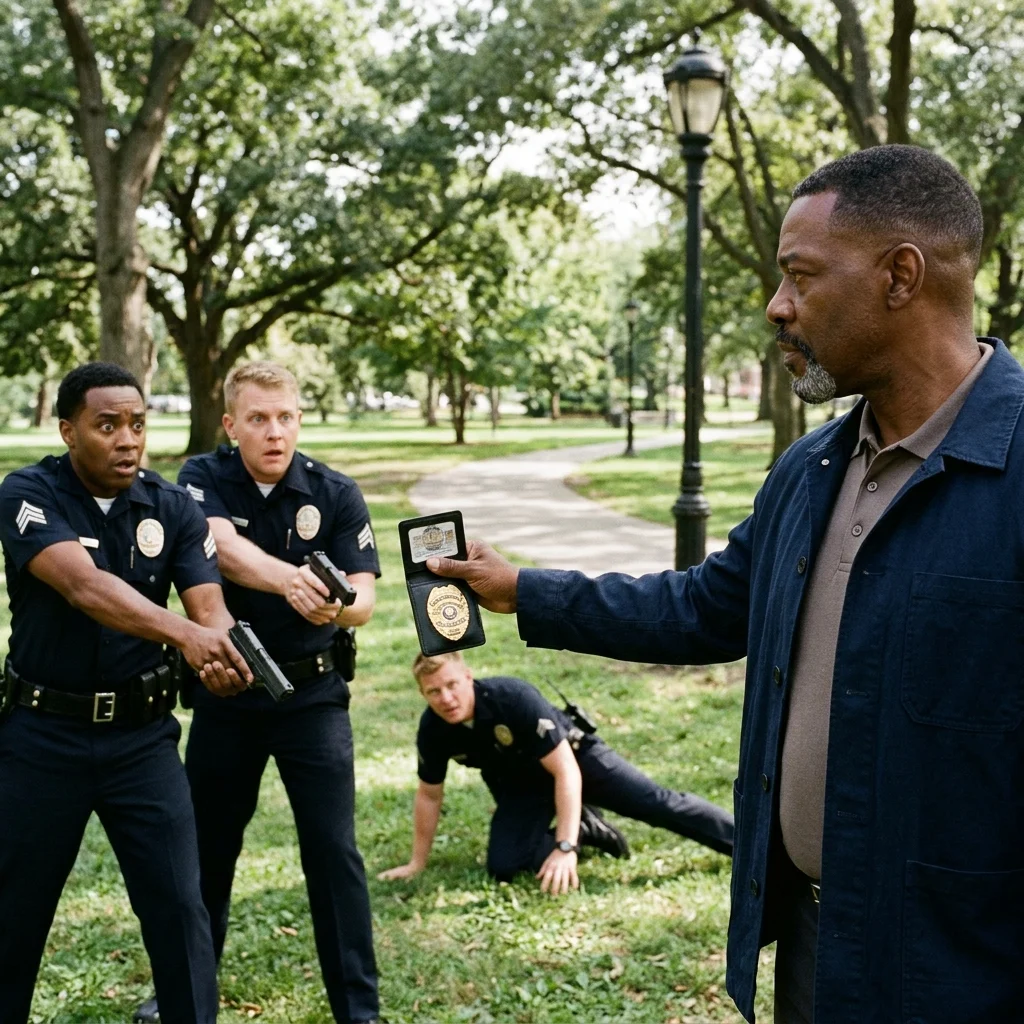
Their weapons were already drawn.
“POLICE! LET HIM GO!”
Marcus turned his head.
He saw the officers’ tense faces.
He saw their fingers near their triggers.
And he understood that the next few seconds could determine whether anyone in the park survived the encounter.
He stopped moving.
“My hands are visible,” Marcus announced.
“GET OFF THE OFFICER!”
“I will release him when you are positioned to keep everyone safe.”
“NOW!”
Marcus carefully removed his knee, released Briggs’s wrist, and rose without making sudden movements.
He raised both hands.
Briggs rolled onto his side.
“He attacked me!” Briggs shouted.
“He’s got drugs!”
The younger officer, whose nameplate read HALL, tightened his grip on his pistol.
“On your knees!”
Marcus looked directly at him.
“What threat am I presenting?”
“GET DOWN!”
Marcus slowly lowered himself to one knee.
He had spent thirty-seven years serving in law enforcement.
He had investigated murders, negotiated hostage releases, and personally attended the funerals of officers killed in the line of duty.
Yet here he was, kneeling in a public park while armed officers decided whether to believe an accusation they had never witnessed.
And the only thing protecting him from a catastrophic mistake might be the identification concealed inside his jacket.
For the first time in years, Marcus felt the full weight of what it meant to be judged before being heard.
“My identification is inside my jacket,” he said.
“I am going to explain exactly what I am doing before I move.”
Officer Hall hesitated.
The second officer, a woman named Elena Ruiz, looked more carefully at Marcus.
Something about his voice seemed familiar.
“What’s your name?” she asked.
“Marcus Hale.”
Briggs barked another laugh.
“His name doesn’t matter!”
Marcus kept his eyes on Ruiz.
“My official credentials are in my left inside pocket.”
Ruiz signaled for Hall to maintain his position.
“Two fingers,” she instructed.
“Slowly.”
Marcus reached into his jacket.
He removed a dark leather credential holder and extended it toward her.
Ruiz approached cautiously.
She took it.
Opened it.
And froze.
Inside was an official state police identification card bearing the photograph of the man kneeling before her.
Beside the photograph were words that made her stomach drop.
GENERAL MARCUS E. HALE.
COMMANDING GENERAL — STATE POLICE SERVICE.
An embossed gold seal shimmered beneath the afternoon sun.
Ruiz read the name again.
Then she looked at Marcus.
Then at the badge.
Her mouth opened.
“GENERAL MARCUS?!”
Hall lowered his pistol slightly.
“What?”
Ruiz turned the identification toward him.
His face drained of color.
“Oh, my God.”
Briggs stopped struggling.
He twisted his head toward Marcus.
For several seconds, nobody spoke.
Then Briggs whispered, “That’s impossible.”
Marcus rose slowly.
Ruiz immediately lowered her weapon.
Hall followed.
But Marcus did not look relieved.
He looked disappointed.
“You should have lowered those weapons when the threat ended,” he said. “Not when you discovered my rank.”
Neither officer answered.
Briggs climbed awkwardly to his feet.
“General, sir, there must be some misunderstanding.”
Marcus turned toward him.
“Was it a misunderstanding when you placed that bag in my pocket?”
Briggs swallowed.
“I thought you were acting suspiciously.”
“Was it a misunderstanding when you struck me?”
“You moved aggressively.”
Marcus pointed toward the walking path.
“Then let’s ask the people who watched.”
A teenage girl stood beside a bench, holding her phone with trembling hands.
She wore a green backpack and a faded denim jacket.
Her eyes were wide.
“I recorded it,” she said.
Briggs’s expression changed instantly.
“Give me that phone!”
The girl stepped backward.
Marcus moved between them.
“You will not approach that witness.”
Briggs stared at him.
“Sir, that recording could be evidence.”
“Exactly.”
The girl looked up at Marcus.
“Are you really a general?”
“Yes.”
“Then can you make him tell the truth?”
The question struck Marcus harder than Briggs’s attempted punch.
He glanced toward her phone.
“What is your name?”
“Talia Brooks.”
“How old are you, Talia?”
“Seventeen.”
“Did you record the entire incident?”
She nodded.
“From when he bumped into you.”
Briggs shook his head desperately.
“She’s lying.”
Talia’s voice rose.
“No, I’m not!”
She swallowed.
“I saw you put that bag in his pocket!”
People began speaking at once.
An older man said he had witnessed the officer initiate the physical confrontation.
A woman near the fountain confirmed that Marcus had attempted to walk away.
Another witness announced that he had recorded Briggs throwing the first punch.
Within minutes, what had begun as one officer’s accusation had become a crowd of citizens demanding answers.
Marcus directed Ruiz to secure the suspected evidence without allowing Briggs to handle it again.
He requested independent investigators and asked witnesses to preserve their original recordings.
He also instructed Hall to remain beside Briggs.
“Sergeant Briggs is not leaving until investigators arrive.”
Briggs’s face reddened.
“You can’t do this to me!”
Marcus looked at him.
“Actually, Sergeant, I can request that your conduct be investigated.”
He paused.
“And unlike what you attempted to do to me, that investigation will begin with evidence.”
Sirens approached from the western entrance.
Additional patrol vehicles arrived.
A police supervisor hurried toward the gathering crowd.
Behind him came a black sedan carrying Chief Everett Voss, the longtime head of Riverton’s municipal police department.
Marcus recognized him immediately.
Voss had been his friend for nearly thirty years.
They had trained together, attended the same funerals, and helped one another navigate careers defined by difficult decisions.
Voss approached with an expression of alarm.
“Marcus?”
His eyes moved from the crowd to Briggs.
“What happened?”
Marcus answered carefully.
“Your sergeant attempted to plant suspected narcotics on me and assaulted me.”
Voss stared at Briggs.
Then he forced a smile.
“I’m sure we can clear this up privately.”
Marcus noticed the word privately.
He noticed it because Voss had used the same word fourteen years earlier.
Back when Marcus’s son had died inside a police station.
Back when unanswered questions had been buried beneath official reports.





