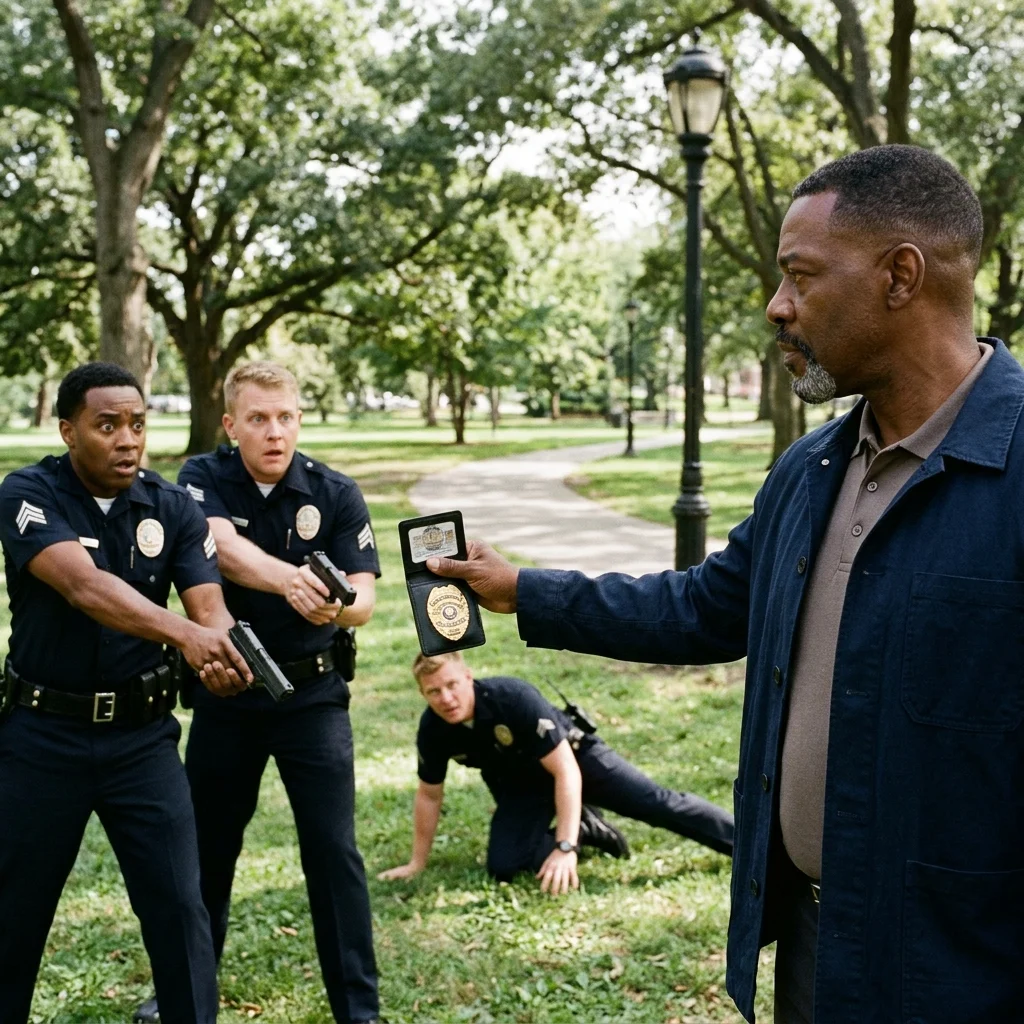
Back when Marcus had believed that protecting the department and protecting the truth were somehow the same thing.
He met Voss’s eyes.
“There will be nothing private about this.”
Voss’s smile weakened.
Before he could respond, Ruiz approached with a sealed evidence sleeve.
“General, there’s something unusual about the bag.”
Marcus looked at the transparent packaging.
A tiny blue marking appeared near the bottom seam.
It was barely visible.
Three digits.
004.
For a moment, Marcus forgot the surrounding crowd.
He had seen that number before.
Fourteen years earlier.
On a photograph inside a file that should never have been closed.
And suddenly, the afternoon’s terrifying confrontation no longer felt like an isolated act of police misconduct.
It felt like the first crack in a wall that someone had spent years building.
By midnight, the video had been viewed more than two million times.
The footage showed everything.
Briggs blocking Marcus’s path.
The suspicious movement of his hand.
The small plastic bag appearing in Marcus’s pocket.
The sudden punch.
The controlled takedown.
And finally, the unforgettable moment when two armed officers discovered they had pointed their weapons at a police general.
News organizations across the country began broadcasting the confrontation.
Commentators called it an extraordinary abuse of authority.
Police representatives demanded patience while the investigation proceeded.
But beneath the public outrage, Marcus saw something that disturbed him far more than the attention.
Thousands of people were sharing stories about similar encounters that had ended very differently.
Some had been arrested.
Some had lost their jobs.
Some had spent years defending themselves against charges they insisted were fabricated.
Others had never returned home.
Marcus sat alone in his office at State Police Headquarters, studying a printed photograph of the bag Briggs had planted.
A desk lamp illuminated the tiny blue number near its seam.
004.
He had asked his forensic division to examine the packaging independently.
The preliminary result had arrived forty minutes earlier.
The powder was not cocaine.
It was a mixture of powdered plaster and a harmless chemical commonly used in police training exercises.
Briggs had attempted to manufacture a drug arrest using a substance that was not an illegal drug at all.
That fact alone would support serious disciplinary action and potential criminal charges.
But the number troubled Marcus more.
He opened a locked cabinet behind his desk.
Inside rested a small wooden box containing personal belongings he rarely touched.
There was his wife’s wedding ring.
A photograph of their first home.
A birthday card from his daughter.
And a thick envelope marked with the name of his son.
CALEB HALE — SEPTEMBER 2012.
Marcus hesitated before opening it.
Fourteen years had passed since Caleb’s death.
Fourteen years since an officer had telephoned him just after midnight.
Fourteen years since Marcus had arrived at a police station and discovered his twenty-two-year-old son lying beneath a white sheet.
The official explanation had been an accidental overdose.
Caleb had supposedly been found carrying narcotics during a routine street encounter.
After being taken into custody, he had experienced a medical emergency.
The officers involved claimed they had attempted to help him.
Their statements had been consistent.
The evidence had appeared straightforward.
And Marcus, devastated by grief, had accepted the department’s conclusions.
His daughter, Imani, had never accepted them.
She had insisted that Caleb was investigating something before his death.
She believed officers had planted the drugs.
She believed the medical timeline had been falsified.
And she believed her father had failed his own son by trusting the people responsible for holding him.
Marcus had spent years rejecting those accusations.
Now he removed a photograph from the envelope.
It showed the evidence recovered from Caleb’s jacket.
A small plastic bag lay beside a ruler.
Near its lower seam was a faded blue marking.
004.
Marcus gripped the edge of his desk.
The room seemed suddenly too quiet.
He compared the photograph with the image from Riverside Park.
The markings appeared identical.
Even the slight defect in the final digit matched.
He reached for his telephone.
“Get me Dr. Adrian Chen in forensic analysis.”
Across the city, seventeen-year-old Talia Brooks sat at her kitchen table watching the same video for the twenty-third time.
Her mother, Leah, stood beside the refrigerator, holding a cup of coffee that had long since gone cold.
“You should never have gotten involved,” Leah whispered.
Talia looked up.
“Mom, that officer was planting drugs.”
“I know what he was doing.”
“Then why are you angry?”
Leah’s eyes filled with tears.
“Because I know what happens when you tell the truth about people like him.”
Talia lowered her phone.
Six years earlier, her father, Reuben Brooks, had been arrested near Riverside Park.
He had worked as a school bus driver for nearly two decades.
He coached youth basketball on weekends.
He never missed Talia’s birthdays.
Then Sergeant Briggs, a younger patrol officer at the time, claimed to have discovered cocaine in Reuben’s vehicle during a traffic stop.
Reuben insisted the drugs had been planted.
Nobody believed him.
His conviction destroyed the family.
Their savings disappeared into legal expenses.
Leah took two jobs.
Their house was sold.
And Talia grew up visiting her father through thick glass in a state correctional facility.
The officer who testified against Reuben was Derek Briggs.
The same man Talia had filmed planting drugs on General Marcus Hale.
She opened a folder on her laptop.
Inside were dozens of photographs from her father’s trial.
Evidence bags.
Police reports.
Witness statements.
And one image she had examined so many times that she could almost remember every scratch on the plastic.
The bag allegedly recovered from her father’s vehicle.
Talia enlarged the photograph.
Her heart began beating faster.
A tiny blue number appeared beside the sealed edge.
004.
“Mom.”
Leah moved closer.
“What?”
Talia pointed at the screen.
“Look.”
Leah stared.
Then she covered her mouth.
For six years, people had called her husband a criminal.





