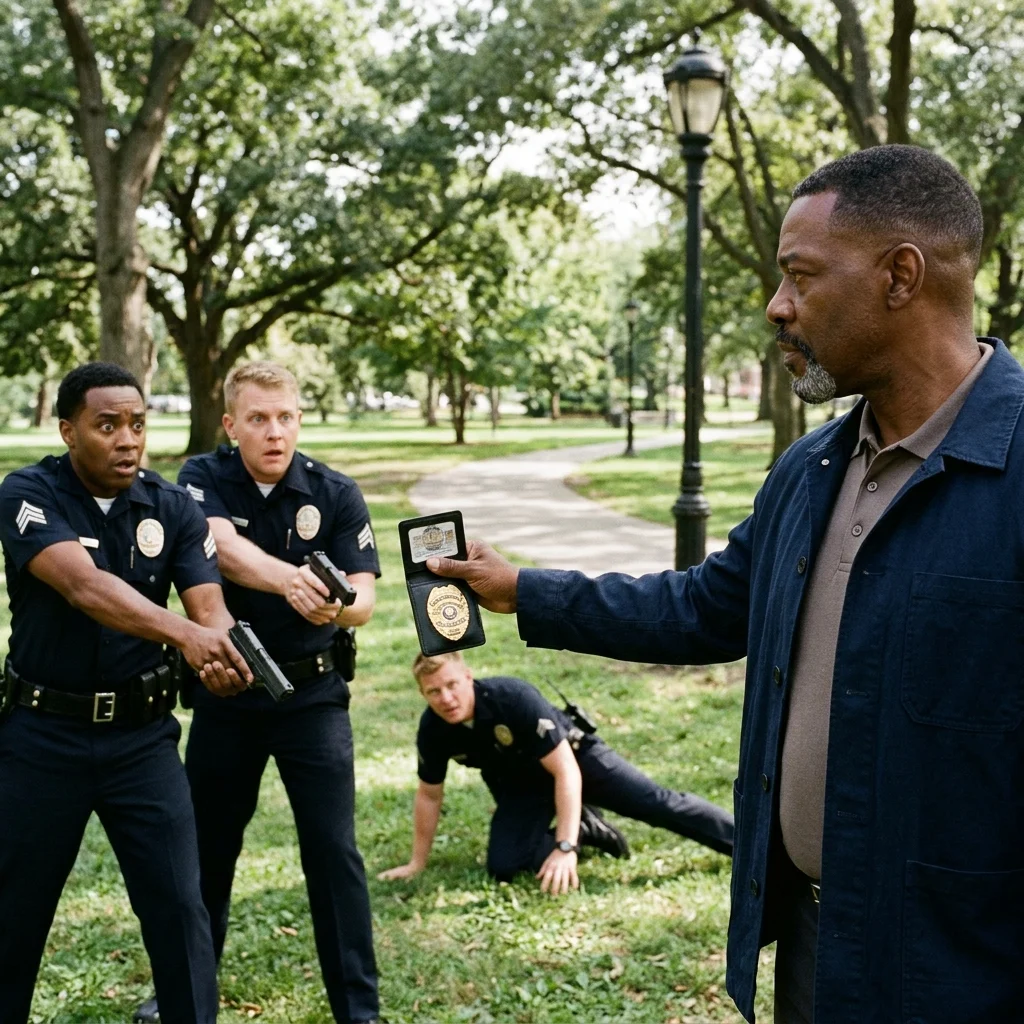
“That’s not an answer.”
He turned toward her.
“I spent fourteen years believing I knew how your brother died.”
His voice weakened.
“I owe him the truth.”
Imani looked down.
“You owed him that when he was alive.”
Marcus accepted the words without defending himself.
“Yes.”
For a long moment, they stood in silence.
Then he spoke again.
“I’m sorry, Imani.”
She looked up.
He continued.
“Not because you were right.”
His eyes filled.
“Because you were asking me to listen, and I treated your grief like an accusation against my career.”
Imani covered her mouth.
Marcus stepped closer.
“I was so afraid of losing my faith in the department that I let you lose your faith in me.”
Tears rolled down her cheeks.
She did not immediately forgive him.
Fourteen years of pain could not disappear because of one apology.
But for the first time in a long time, she reached for her father’s hand.
At 11:32 that night, Chen called them into the laboratory.
“I recovered forty-one minutes of audio.”
Marcus stared at the small speaker.
“Is it clear?”
“Some sections are damaged, but the last fifteen minutes are surprisingly intact.”
Imani stood beside him.
Chen pressed play.
At first, they heard shuffling noises.
Then a door closing.
A man’s voice spoke.
“Those packages should have been destroyed.”
Another voice answered.
“We’re not throwing away evidence we can use.”
Marcus recognized the second voice instantly.
Everett Voss.
The recording continued.
There were references to seized narcotics, falsified custody records, and arrest reports.
Then a younger voice interrupted.
“That’s illegal.”
Marcus stopped breathing.
Caleb.
Fourteen years had passed since Marcus heard his son’s voice.
Now it emerged from an old speaker, clear enough to make the room seem to disappear.
“You’re putting drugs on people who never had them,” Caleb said.
Voss responded.
“You don’t understand police work, son.”
“I understand what happens to the people you arrest.”
“Put the recorder away.”
“No.”
A chair scraped across the floor.
Voss’s voice hardened.
“Your father doesn’t need to know about this.”
Caleb replied without hesitation.
“My father taught me that a badge doesn’t make a person innocent.”
Marcus closed his eyes.
He remembered teaching Caleb those words when the boy was ten.
He had forgotten the lesson.
His son had not.
The recording continued.
A frightened child’s voice cried from somewhere nearby.
“Please let me out!”
Ruiz, standing at the back of the laboratory, began trembling.
“That was me.”
Caleb spoke again.
“Why is there a kid locked in there?”
No one answered.
“Open it!”
Then came the sound of a metal door.
Footsteps.
A child crying.
Caleb spoke gently.
“Hey, it’s okay.”
The crying softened.
“What’s your name?”
“Elena.”
“I’m Caleb.”
“Are they going to hurt me?”
“No.”
A pause followed.
Then Caleb said something Marcus would remember for the rest of his life.
“As long as I’m standing here, nobody’s going to hurt you.”
Ruiz broke down.
Imani held her.
The recording continued.
Voss returned.
His voice had changed.
“You should have stayed out of this.”
Caleb answered.
“I’m reporting everything.”
“To whom?”
“My father.”
Voss laughed.
“Your father trusts me more than he trusts your imagination.”
A struggle followed.
Furniture crashed.
Caleb shouted.
Then there was a sickening impact.
Marcus flinched.
A second impact followed.
And then Caleb’s voice, weaker now.
“Call an ambulance.”
No one responded.
“Please.”
The silence stretched.
Then Voss spoke.
“Move him to the holding area.”
Another man asked, “What about the girl?”
Voss answered coldly.
“She didn’t see anything.”
The recording ended several minutes later.
Nobody moved.
Chen slowly stopped the playback.
Marcus stared at the table.
He had investigated homicide scenes.
He had attended autopsies.
He had testified in murder trials.
But nothing in his career had prepared him to hear his own child begging for medical attention while people sworn to protect life chose to protect themselves instead.
His knees weakened.
Imani caught his arm.
For the first time since the funeral, Marcus allowed himself to cry openly.
He did not hide his face.
He did not apologize.
And he did not ask anyone to leave.
The recording changed the investigation overnight.
Independent prosecutors obtained warrants for Voss’s communications, financial records, and archived evidence transfers.
Detectives identified a network of officers who had manipulated drug seizures and falsified reports over more than a decade.
Some defendants had lost businesses.
Others had lost custody of their children.
Several had died before their innocence could be examined.
The scheme had also generated money through unlawful seizures and fraudulent payments to private contractors.
Voss had not merely allowed it.
He had supervised it.
Briggs had become one of its most aggressive participants.
And General Marcus Hale’s signature had been used to create the access loophole that helped conceal the operation.
Marcus understood the consequences.
His authorization had been granted after Caleb’s death, but it had allowed years of evidence handling without proper oversight.
He could argue that Voss deceived him.
He could insist that he never intended to enable wrongdoing.
Both statements would be true.
But they would not erase the damage.
When the attorney general asked Marcus to provide a statement, he refused to conceal his involvement.
“Put my signature in the report,” he said.
The prosecutor looked surprised.
“General, you may want legal representation before making that decision.”
“I’ll have counsel.”
“Then we should wait.”
Marcus shook his head.
“But I will not ask you to pretend the signature belongs to somebody else.”
Three days later, the state held an emergency public hearing.
Families filled the chamber.
Journalists crowded the rear walls.
Talia sat beside her mother.
A large screen displayed evidence photographs, payment records, and excerpts from the recovered audio.
Chief Everett Voss appeared with two attorneys.
He denied everything.
He claimed the recording had been manipulated.
He insisted Marcus was using the death of his son to settle a personal dispute.
Then Officer Ruiz took the witness chair.
Under oath, she described being locked inside Locker 004.





