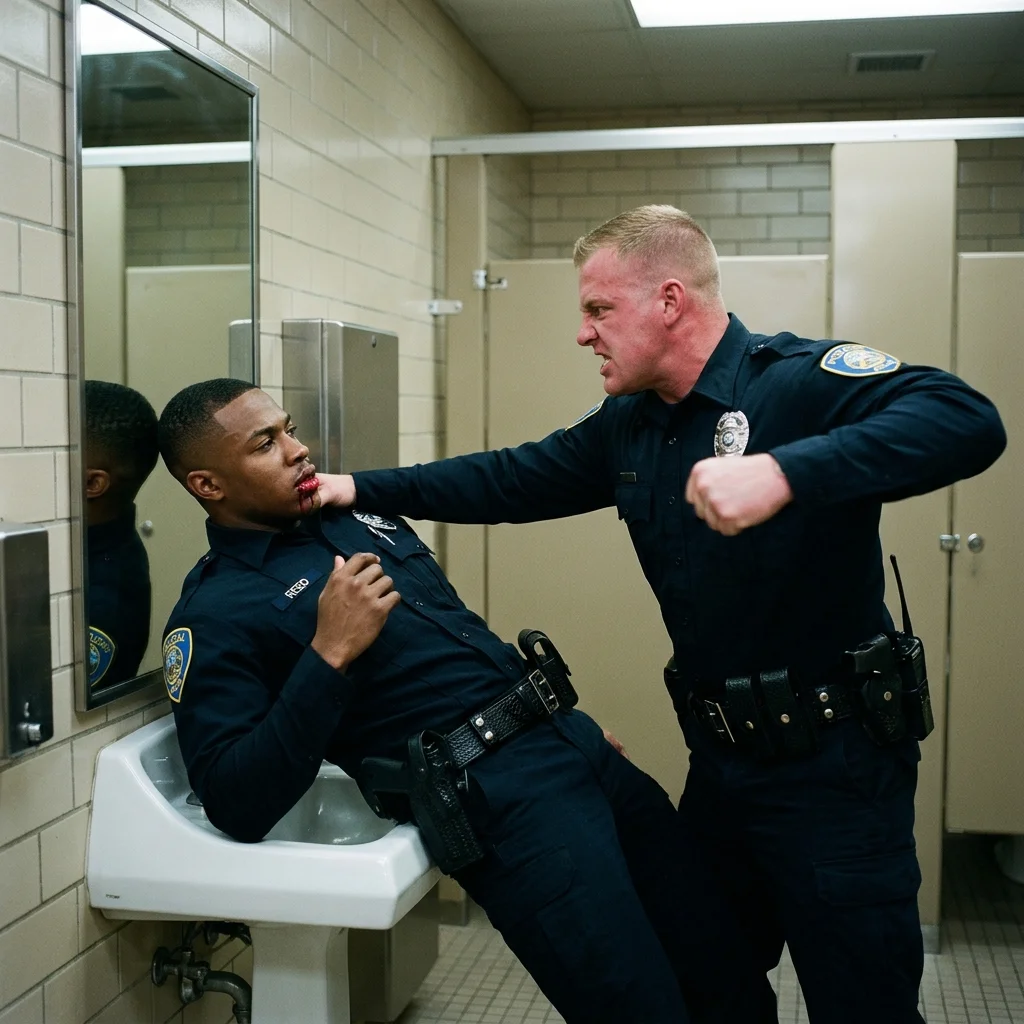
The first punch wasn’t what frightened Officer Marcus Reed.
It was the realization that someone inside his own police department had decided he knew too much to be allowed to speak.
The blow came without warning, sending Marcus stumbling against a porcelain sink inside the Ninth Precinct’s second-floor restroom.
Officer Daniel Brooks seized the front of his uniform and shoved him backward.
“What the hell are you looking at?” Brooks shouted.
His face was flushed with anger, and the veins in his neck stood out beneath his collar.
Marcus steadied himself against the counter.
“I wasn’t looking at anything, Daniel.”
“Don’t lie to me!”
Brooks stepped closer.
“You’ve been asking questions about me.”
Marcus looked toward the restroom door.
It was closed.
There were no cameras inside, no witnesses, and no reason for anyone to enter this particular restroom during the shift change.
Brooks had chosen the location carefully.
“I requested a disciplinary file,” Marcus replied.
“That doesn’t mean I accused you of anything.”
Brooks gave a humorless laugh.
“You think I don’t know what you’re doing?”
He moved closer until their uniforms nearly touched.
“You come into this precinct, act like you’re better than everybody, and suddenly you want to investigate officers who’ve been here fifteen years?”
Marcus had heard variations of that accusation before.
Sometimes the words were subtle.
Sometimes they weren’t.
As one of the few Black officers assigned to the Ninth Precinct, Marcus understood how quickly a legitimate question could become an accusation of disloyalty.
But he refused to let Brooks turn the conversation into something it wasn’t.
“This is about missing evidence,” Marcus said.
“Then maybe you should learn to mind your own business.”
Brooks swung again.
Marcus blocked the blow and moved backward, creating distance between them.
“Stop, Daniel.”
Brooks charged.
The impact sent them both against a metal stall divider, which rattled loudly against the tiled floor.
Marcus regained his footing.
Brooks attempted another punch, but Marcus stepped aside, caught his arm, and brought him under control.
Within seconds, Brooks was on the floor, struggling beneath Marcus’s restraint.
“Enough!”
Marcus’s voice echoed through the restroom.
“You’re making this worse.”
Brooks tried to pull free.
Marcus maintained his hold without striking him.
“You’re going to destroy your career over a file?”
Brooks stopped struggling.
For a brief moment, Marcus saw something unexpected in his colleague’s expression.
Fear.
Not embarrassment.
Not anger at losing the confrontation.
Real fear.
Marcus lowered his voice.
“That evidence file you tried to destroy?”
Brooks stared at him.
“I already made a copy.”
The color drained from Brooks’s face.
Marcus continued.
“And you’re not the only officer named in it.”
A faint sound came from outside.
Marcus turned his head.
Someone had moved near the door.
Brooks noticed it too.
His expression changed immediately.
“Marcus,” he whispered.
For the first time, he sounded almost desperate.
“You don’t understand what you’ve done.”
Before Marcus could answer, the restroom door opened.
Captain Evelyn Shaw stood in the doorway.
At fifty-six, Shaw was one of the precinct’s most respected senior officers.
Her silver-streaked hair was pulled into a neat bun, and her uniform was as immaculate as ever.
She looked down at Brooks, then at Marcus.
Neither man spoke.
“Officer Reed,” she said quietly.
“Release him and step back.”
Marcus hesitated.
“Captain, he attacked me.”
“I heard enough to know that.”
He released Brooks and moved toward the sinks.
Shaw called for another supervisor over her radio.
“Officer Brooks, remain where you are.”
Brooks sat upright.
“Captain, I can explain.”
“Save it.”
Two officers arrived moments later.
Shaw ordered them to escort Brooks to a separate interview room and keep the men apart.
As Brooks passed Marcus, he stopped.
His lips barely moved.
“They’re going to make you regret opening that file.”
Shaw heard him.
Marcus could tell from the sudden tension in her face.
But she said nothing until Brooks disappeared down the hallway.
Then she closed the restroom door.
“Where is the copy?”
Marcus looked at her.
“Captain?”
“The disciplinary file you mentioned.”
Her voice was controlled, but her hands were trembling slightly.
“Where did you put it?”
Marcus didn’t answer.
Shaw took a slow breath.
“Listen carefully, Marcus.”
She glanced toward the door.
“Whatever you think you’ve discovered, you need to understand that this is much bigger than Daniel Brooks.”
Marcus studied her.
“Then you know what happened to the missing evidence.”
Shaw’s silence told him more than her answer could have.
For six weeks, Marcus had been noticing irregularities in the Ninth Precinct’s records.
At first, the discrepancies appeared ordinary.
A seized phone listed under the wrong case number.
An evidence envelope transferred without the required signature.
A complaint filed by a civilian that mysteriously disappeared from the digital system.
But the mistakes followed a pattern.
Almost every questionable case involved residents of the same three neighborhoods along Bellhaven’s waterfront.
And several involved people who had lost their homes or businesses during a controversial redevelopment project.
The city called it the Harbor Renewal Initiative.
Politicians had described it as a historic investment in public safety and economic opportunity.
But Marcus remembered the neighborhoods before the expensive construction began.
He remembered the family restaurants, hardware stores, barbershops, and apartment buildings where generations of working families had lived.
He remembered his mother’s bakery on Mercer Street.
He remembered the morning a city inspector taped a condemnation notice to its front window.
His mother, Denise Reed, had spent twenty-three years building that business.
She lost it in eleven days.
At the time, officials claimed the building had become unsafe.
The family never received enough compensation to reopen.
Marcus’s father died three years later, still keeping the bakery’s old brass doorbell in a kitchen drawer.
And Marcus had never forgotten his father’s last advice.
“A badge doesn’t make a man honest, son.”
“What he does when nobody’s watching tells you who he really is.”
That was why Marcus had joined the department.





