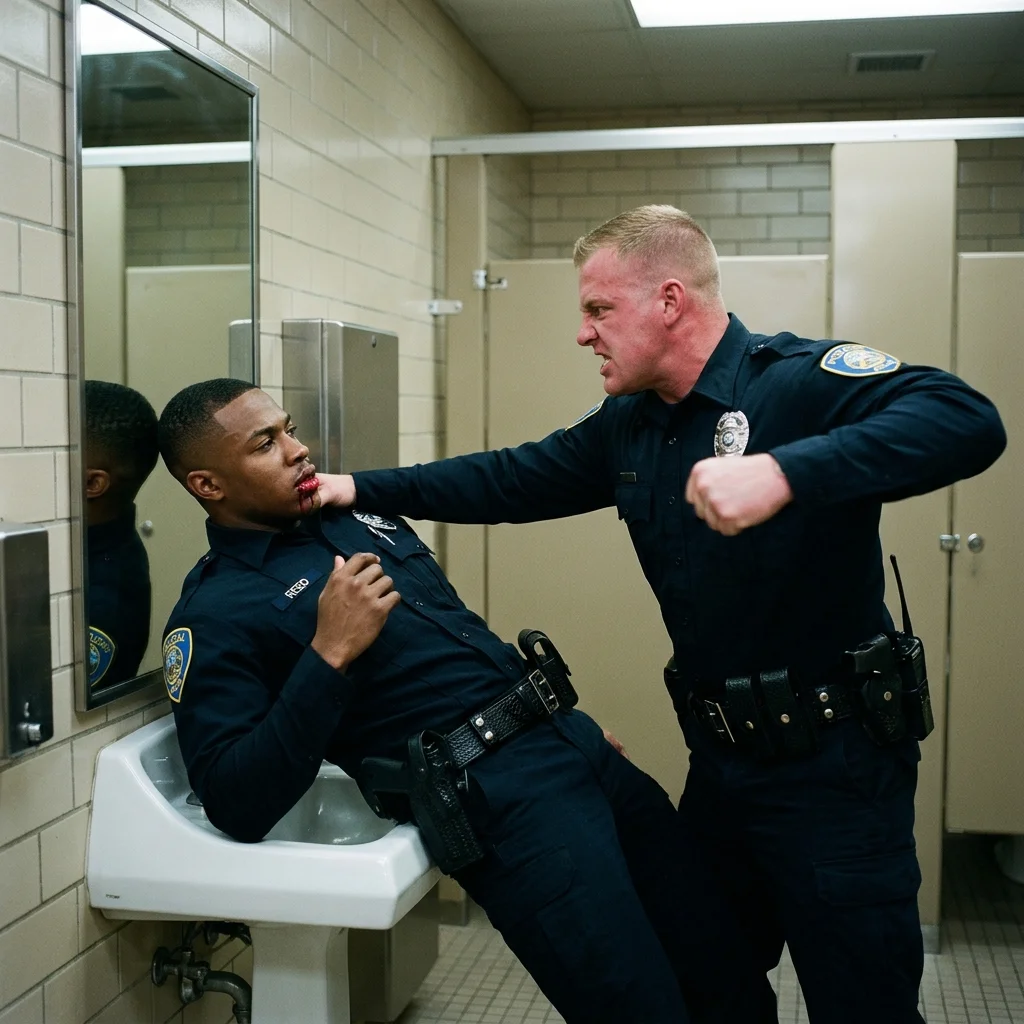
And that was why he couldn’t ignore what he had discovered.
Captain Shaw moved closer.
“Marcus, I need you to trust me.”
He looked directly at her.
“Then tell me why Daniel Brooks wanted to stop me from reading that file.”
Shaw glanced at the sink where the confrontation had started.
“Because Daniel knows what’s inside it.”
“And you?”
Her expression tightened.
“I know enough.”
Marcus waited.
Shaw finally spoke.
“Seven years ago, an investigation was opened into evidence handling at this precinct.”
“It involved thirty-one complaints and fourteen properties scheduled for redevelopment.”
“Several officers were questioned, but the investigation was closed before any findings became public.”
Marcus frowned.
“Why?”
“Officially, the complaints couldn’t be substantiated.”
“And unofficially?”
Shaw looked away.
“The evidence used to support them disappeared.”
Marcus felt his suspicion turning into something colder.
“What happened to the officers who complained?”
“Two transferred.”
“One resigned.”
“Another was dismissed for misconduct.”
“And the others?”
Shaw didn’t answer.
Marcus stepped toward her.
“Captain, I’ve already compared the original evidence inventory with the current database.”
“Some of those records were rewritten months after the cases closed.”
Shaw’s eyes widened.
“You have the original inventory?”
Marcus remained silent.
Shaw suddenly appeared older.
“Then you’re in more danger than you realize.”
A knock interrupted them.
“Captain?”
It was Lieutenant Howard Pike.
“Chief wants Reed upstairs immediately.”
Shaw opened the door.
“Tell the chief we’ll be there.”
Pike glanced at Marcus.
“There’s something else.”
He held out a printed document.
“Evidence Control flagged an unauthorized destruction order.”
Marcus took the paper.
It listed six boxes of archived case materials.
All six were associated with the Harbor Renewal Initiative.
The document claimed those materials had been legally destroyed after their retention period expired.
At the bottom was an electronic authorization.
Marcus stared at it.
His badge number appeared beside the approval.
OFFICER MARCUS REED.
He looked up.
“That’s impossible.”
Pike shifted uncomfortably.
“The system says you approved it.”
“I’ve never authorized the destruction of evidence.”
Shaw took the document.
Her expression changed as she read the date.
“Marcus,” she said slowly.
“When did you transfer to the Ninth Precinct?”
“September 2022.”
Shaw looked at Pike.
Then she turned the document toward Marcus.
The destruction authorization was dated June 18, 2018.
Four years before Marcus joined the precinct.
Someone had not merely used his badge number.
Someone had rewritten an old record to make Marcus appear responsible for destroying evidence before he ever worked there.
Pike swallowed.
“Internal Affairs is already asking questions.”
Marcus looked at Shaw.
“Who can change historical records?”
She answered without hesitation.
“Evidence Control administrators.”
“And?”
“Internal Affairs.”
“And?”
Shaw’s voice dropped.
“The City Office of Public Integrity.”
Marcus recognized the name immediately.
That office was supposed to investigate corruption and protect public confidence in government.
Its director, Julian Ashford, was one of Bellhaven’s most celebrated public officials.
Ashford appeared regularly on television, promising accountability and transparency.
The mayor called him the conscience of the city.
Last month, he had received a civic leadership award.
Marcus remembered his speech.
“The truth belongs to the people, not to those who hold power.”
At the time, Marcus had admired him.
Now those words felt different.
Shaw folded the document.
“Don’t discuss this with anyone else until you’ve spoken to an attorney.”
Pike interrupted.
“Captain, the chief specifically ordered Reed to surrender his badge and department-issued devices.”
Marcus looked down at his uniform.
His badge had been the proudest possession of his adult life.
He thought about his father watching him graduate from the academy.
About his mother standing outside the auditorium, holding a homemade sign.
About all the people who had trusted him because they believed he would treat them fairly.
Now someone was trying to turn that same badge into evidence against him.
Marcus removed it carefully.
He placed it on the counter beside his department phone.
But when Pike asked whether he had taken any evidence home, Marcus answered with a question.
“Am I being accused of a crime?”
Pike hesitated.
“I’m following orders.”
“Then I want those orders documented.”
Shaw nodded.
“That’s reasonable.”
She turned toward Pike.
“Tell the chief that Officer Reed is requesting counsel and a written inventory of anything surrendered.”
Pike reluctantly stepped outside.
For a moment, Marcus and Shaw were alone again.
“Marcus,” she whispered.
“One more thing.”
He waited.
Shaw’s expression had become almost pleading.
“Daniel Brooks wasn’t the first person sent to frighten someone away from this investigation.”
A cold silence settled between them.
Marcus asked the question he had been avoiding.
“Who was the first?”
Shaw looked toward the hallway.
Then she said something that made the entire confrontation suddenly seem like a small part of a much larger nightmare.
“The first officer who asked these questions was Lena Ortiz.”
Marcus recognized the name.
Ortiz had been publicly accused of falsifying evidence years earlier.
Her dismissal had become a scandal.
According to department records, she had lost her career because she couldn’t be trusted.
Shaw’s next words changed everything.
“Lena Ortiz wasn’t fired because she falsified evidence.”
“She was fired because she refused to falsify it.”
And before Marcus could ask another question, Shaw added one final warning.
“Whatever you do, don’t let Julian Ashford know that you have the original inventory.”
Marcus stared at her.
“Why?”
Shaw lowered her eyes.
“Because I’m the one who signed the order that made Lena Ortiz disappear from this department.”
By noon, Marcus Reed had lost his badge, his firearm, his access to the precinct, and the protection that came with being one of its officers.
By evening, someone had already started telling the city that he was corrupt.
The first television report appeared shortly after six.
Marcus was sitting at his mother’s kitchen table when the news anchor announced that an unnamed Bellhaven police officer was under investigation for serious evidence-handling violations.
The report mentioned the Harbor Renewal Initiative.
It mentioned missing records.
And it suggested that the officer involved might have manipulated historical case files.





