The familiar ringing filled the empty bakery.
For the first time in years, Marcus heard that sound without feeling only loss.
But one more surprise remained.
As they walked inside, a woman approached from the back room.
It was Lena Ortiz.
Marcus stared at her.
“What are you doing here?”
Lena smiled.
“Your mother asked me to help organize the community records program.”
“The what?”
Denise pointed toward a room beside the kitchen.
Inside were computers, filing cabinets, and a long table.
A sign above the doorway read COMMUNITY RIGHTS AND RECORDS CENTER.
Marcus looked confused.
Denise explained.
“People lost their homes because they couldn’t see the records being used against them.”
“Some didn’t know how to request documents.”
“Others couldn’t afford lawyers.”
She looked at Lena.
“So we’re creating a place where families can learn how to protect their rights.”
Lena nodded.
“Ada’s helping with the public records workshops.”
“And Tessa’s firm will provide legal information sessions.”
Marcus slowly looked around.
The bakery wasn’t simply being restored.
It was becoming a place where the people who had once been silenced could learn how to make themselves heard.
He turned toward his mother.
“How long have you been planning this?”
Denise smiled.
“Since the day you told me you weren’t going to stop investigating.”
Marcus was speechless.
Then she reached into her handbag again.
This time, she removed a small envelope.
“Your father wrote this before he died.”
Marcus recognized the handwriting immediately.
The envelope contained a single folded letter.
He opened it carefully.
“Marcus,” it began.
“If you’re reading this, I hope you’ve become the man you always wanted to be.”
“I know you believe a police officer can make a difference.”
“There were days when I stopped believing that.”
“But I never stopped believing in you.”
Marcus paused.
His eyes filled with tears.
He continued reading.
“When people in power make you choose between what is easy and what is right, remember that courage isn’t winning every fight.”
“Sometimes courage is refusing to let another person lose their voice.”
At the bottom, his father had written one final sentence.
“If you ever find the truth about our bakery, don’t use it to become bitter.”
“Use it to make sure somebody else’s family doesn’t have to suffer the way we did.”
Marcus folded the letter.
For a long moment, he couldn’t speak.
His mother placed a hand on his shoulder.
“Your father would have been proud of you.”
Marcus looked around the room.
At the tables.
The shelves.
The little community center.
The brass bell above the door.
Then he thought about Daniel Brooks.
Brooks had been the first officer to report the corruption.
He had seen the truth before almost anyone else.
But when doing the right thing became dangerous, he chose to protect himself.
One compromise became another.
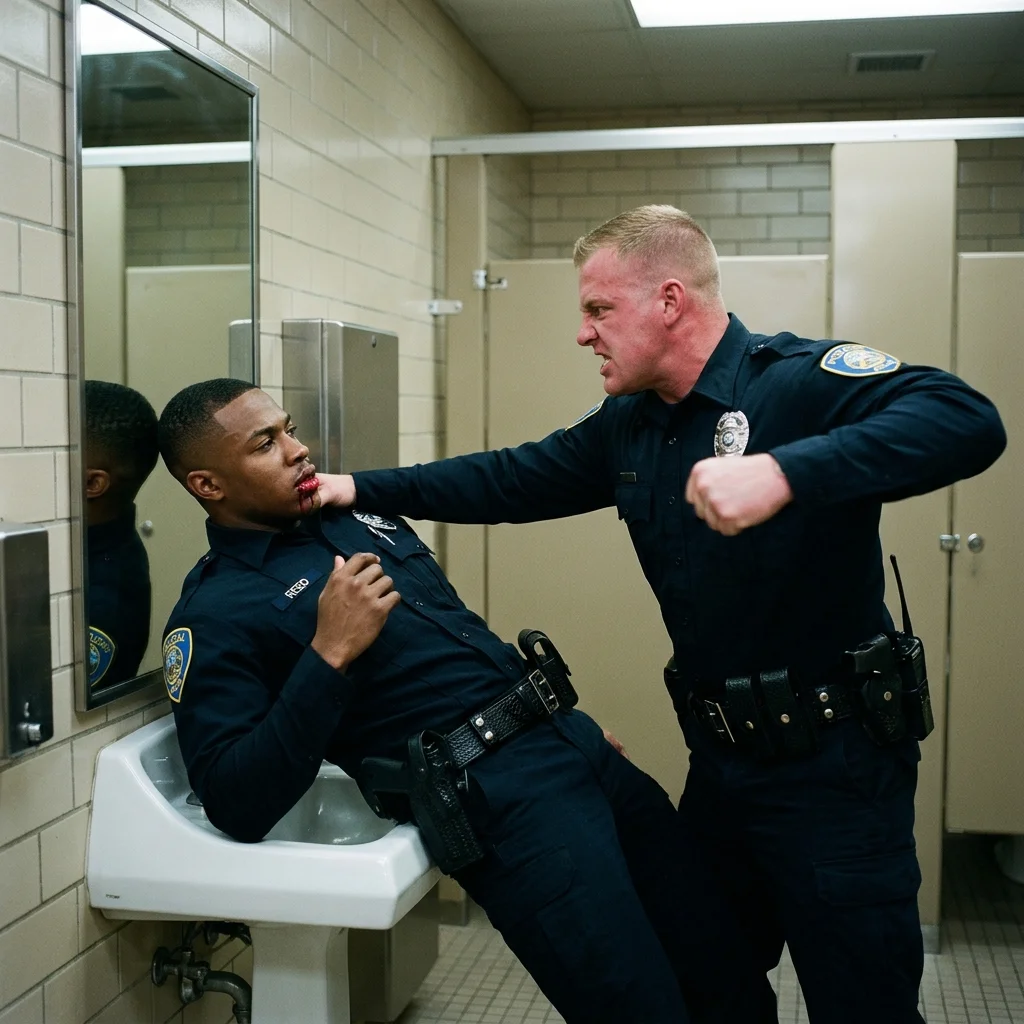
Until the man who had once tried to expose wrongdoing was attacking another officer for attempting the same thing.
Marcus understood something now that he hadn’t understood inside the restroom.
Corruption didn’t always begin with a person deciding to become evil.
Sometimes it began with a frightened person deciding that one small lie was easier than one difficult truth.
That didn’t excuse Brooks.
It explained why accountability required more than removing a few powerful people.
It required ordinary people to make different choices.
Six months later, Marcus returned to the Ninth Precinct.
His suspension had been lifted, his record cleared, and his complaint against Brooks substantiated.
He had been offered a promotion.
Instead, he requested an assignment helping build the department’s newly established evidence accountability unit, which operated under independent civilian oversight.
On his first morning back, he walked past the second-floor restroom.
The same door.
The same hallway.
The same building where someone had once tried to frighten him into silence.
He stopped for a moment.
A young officer approached.
“Officer Reed?”
Marcus turned.
“Yes?”
The young man looked nervous.
“I’ve been assigned to assist your unit.”
“I heard what happened here.”
Marcus nodded.
The officer hesitated.
“Can I ask you something?”
“Of course.”
“Were you ever afraid you were going to lose everything?”
Marcus thought about his badge.
His career.
His mother.
The accusations.
The months when he didn’t know whether the truth would ever be believed.
Then he answered.
“Every day.”
The young officer looked surprised.
“Then how did you keep going?”
Marcus glanced toward the restroom door.
He remembered Brooks standing over him.
The first punch.
The accusations.
The warning that he would regret opening the file.
And he remembered the frightened man who had eventually admitted the truth.
“Because I realized something,” Marcus said.
“Fear isn’t the most dangerous thing a police officer can feel.”
The younger officer frowned.
“What is?”
Marcus looked him directly in the eye.
“The belief that protecting your reputation matters more than protecting an innocent person.”
He started walking toward his new office.
Then his phone rang.
It was his mother.
“Marcus, are you coming by after your shift?”
He smiled at the sound of her voice.
“Wouldn’t miss it.”
“Good, because we’ve got a line out the door.”
“Already?”
Denise laughed.
“Your father’s cinnamon rolls are still the best thing in Bellhaven.”
Marcus looked toward the morning sunlight streaming through the precinct windows.
For the first time in a long while, the future felt open.
He had not rescued everyone.
He had not repaired every injustice.
And he had not changed the past.
But he had helped restore something that powerful people had tried to erase.
The right of ordinary people to be heard.
And across town, above the entrance to a modest bakery, an old brass bell rang again.
Not to announce the return of what had been lost.
But to welcome the beginning of something no one in Bellhaven had expected.
A place where the truth would always have an open door.
THE END.





