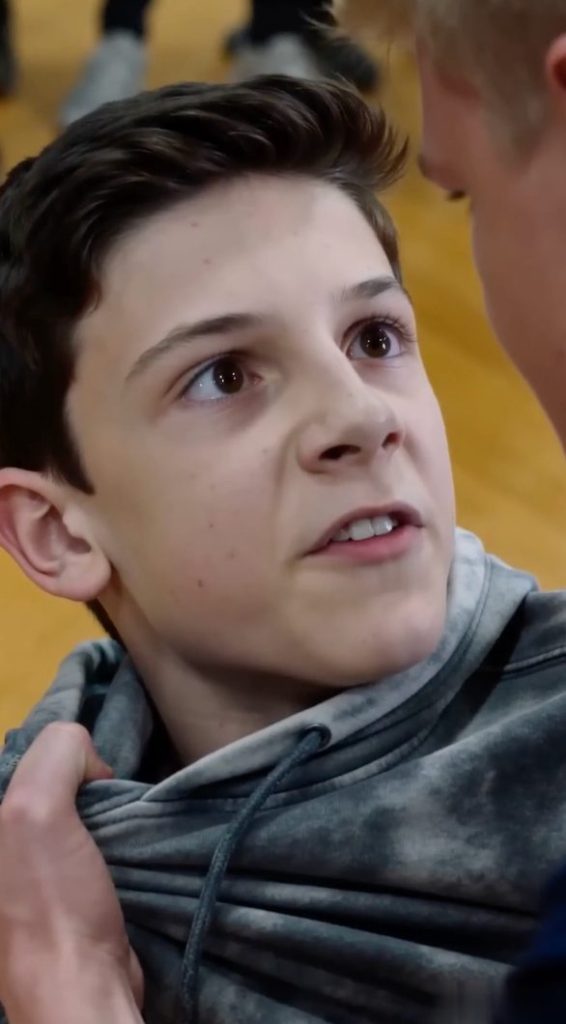
The first thing I remember about that afternoon was how cold the gymnasium floor felt against my back.
The second was the sound of nearly a hundred students laughing while a boy twice as confident as I had ever been held me down by the collar of my hoodie.
His fist was raised, his expensive sneakers were planted on either side of my legs, and every phone in the circle around us seemed to be pointed directly at my face.
“Fight back, loser!”
Tyler shouted.
His voice bounced off the high ceiling of the gym, carrying over the squeak of sneakers and the excited shouting of my classmates.
Somewhere behind him, basketballs rested in a metal rack, and the bright afternoon sun came through the upper windows in long rectangles that stretched across the polished hardwood.
Coach Vance stood beside the bleachers, close enough to see exactly what was happening.
He did nothing.
I had imagined plenty of humiliating moments during my first three months at that school.
I had imagined Tyler knocking my books out of my hands or making another joke about my clothes.
I had imagined being left alone at lunch, laughed at during class, or trapped in the locker room while his friends blocked the doorway.
But I had never imagined lying on the gym floor with an entire sophomore class waiting to see whether I would be beaten in front of them.
Tyler leaned closer, twisting the fabric of my faded gray hoodie around his fist.
“What’s the matter, charity scholarship kid?” he asked, smiling broadly.
“Suddenly lose your voice?”
A fresh wave of laughter rolled around us.
I could feel the wooden floor pressing against my shoulder blades.
My heart was beating hard enough that I could hear it in my ears, but my hands remained open at my sides.
I wasn’t looking at his fist.
I was looking at his feet.
His right sneaker carried most of his weight.
His left knee was bent awkwardly, and his shoulders were leaning too far forward.
Every time he laughed, his balance shifted toward me, leaving him less stable than he understood.
Nine years of Taekwondo had taught me to notice things like that.
Nine years had also taught me something much more important.
Knowing how to fight didn’t mean I had to fight.
For three months, I had lived by that lesson while Tyler and his friends did everything they could to make me forget it.
Now, with my back against the floor and his fist rising above me, I wondered whether that lesson was about to face its hardest test.
Because what Tyler didn’t know was that the quiet boy beneath him had spent most of his life learning how to remain calm when somebody else lost control.
And what Coach Vance didn’t know was that I had already decided I would rather endure another humiliation than become the kind of person who enjoyed hurting someone.
But there was a difference between refusing to fight and allowing somebody to hurt you.

I was beginning to understand how important that difference could become.
Three months earlier, I had arrived at that suburban high school carrying a secondhand backpack, a folder containing my scholarship documents, and a promise I had made to my mother.
The promise was simple.
I would work hard, stay out of trouble, and give myself a chance at the kind of future she had spent years trying to provide.
It didn’t seem like a difficult promise at the time.
My mother and I had moved into a small apartment on the edge of the district during the summer.
The building was old, the parking lot had more cracks than painted lines, and our kitchen window faced a brick wall that blocked most of the afternoon sunlight.
My bedroom was barely large enough for a narrow bed, a desk, and two plastic drawers stacked beside the closet.
The desk had one uneven leg, which I fixed by folding a piece of cardboard underneath it.
The mattress came from a discount furniture warehouse, and the sheets were the same blue ones I had used for years.
My mother apologized when she first showed me the room.
“I know it’s not much,” she said, standing in the doorway with a cardboard box balanced against her hip.
I looked around at the freshly cleaned walls, the small window, and the desk she had positioned carefully beneath it.
“It’s enough,” I told her.
She smiled, but there was something tired in that smile.
My mother had been working long hours for as long as I could remember.
She was the kind of person who would come home exhausted and still ask whether I had eaten, whether I needed help with homework, and whether there was anything important happening at school.
Sometimes she asked those questions while taking off shoes that had rubbed her heels raw.
Sometimes she fell asleep sitting upright on the couch before I finished answering.
When she told me I had been accepted into the district’s academic scholarship program, she sounded happier than I had heard her in months.
“It’s a good school,” she said.
“They have excellent teachers.
Good resources.
Opportunities you wouldn’t have had before.”
I remembered looking at the acceptance letter in her hands.
The paper was thick and white, with a school emblem printed near the top.
It seemed almost too important to belong in our little kitchen.
“Are you sure we can afford everything else?”
I asked.
My mother gave me the look she always gave when she thought I was worrying about something a boy my age shouldn’t have to carry.
“You let me worry about that.”
“But Mom—”
“Your job is to learn.”
She reached across the table and flattened the corner of the letter with her fingertips.
“That’s what this is for.
A chance to build something better.”
I didn’t know then how often I would remember those words.





