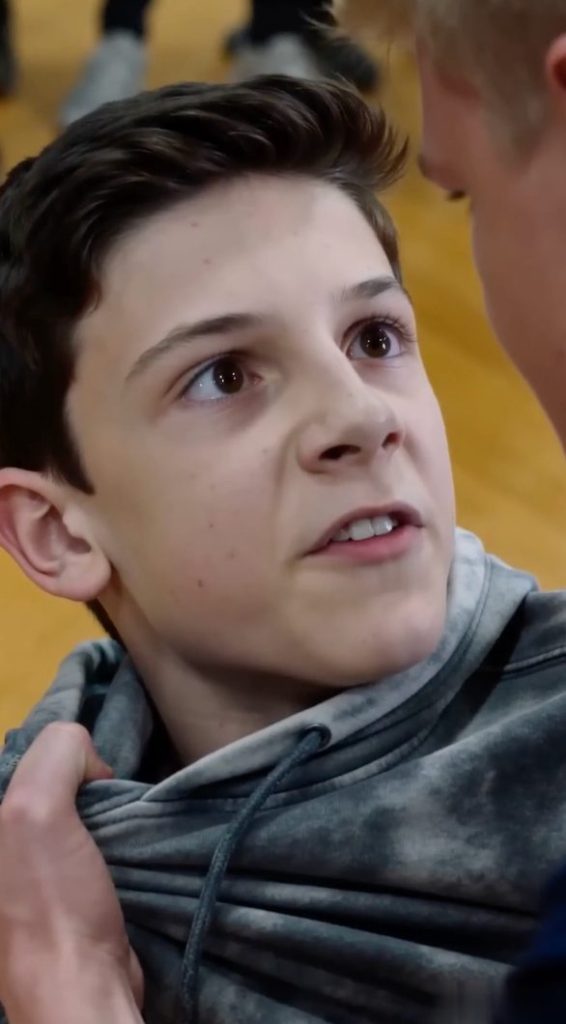
I tried to sit up.
He grabbed my hoodie collar and pushed me back against the floor.
“Where you going?”
The fabric tightened across my chest.
I looked toward Coach Vance.
He was watching.
I saw him watching.
His whistle was hanging from one hand, and for a brief moment, his eyes met mine.
I expected him to move.
To tell Tyler to step away.
To send someone for help.
To do anything that would remind the students that an adult was in the room.
Instead, he looked toward the equipment rack.
My stomach dropped.
It was a different kind of pain from the impact against the floor.
I had spent three months telling myself that if things ever became serious enough, an adult would intervene.
Surely there was a boundary.
Surely Tyler couldn’t simply do whatever he wanted.
Yet here I was, on my back, surrounded by students, with a teacher standing only a short distance away.
And the teacher was pretending not to see.
Tyler leaned closer.
“What’s the matter, charity scholarship kid?” he asked.
“Suddenly lose your voice?”
The laughter came again.
I looked at his hand.
His fingers were twisted tightly into the collar of my hoodie.
I could feel the fabric pulling against the back of my neck.
My breathing became faster.
For an instant, anger rushed through me.
I thought about the cafeteria tray.
About the locker room.
About every time he had deliberately struck my shoulder, laughed at my clothes, or tried to make me feel ashamed of my mother’s hard work.
I thought about how many times I had walked away.
How many times I had swallowed words I desperately wanted to say.
And I thought about the way Coach Vance had looked away.
Tyler pulled me slightly forward, then pushed me down again.
“Come on,” he said.
“Do something.”
My shoulder blades struck the hardwood.
The crowd shouted.
I heard someone say, “This is crazy.”
Another voice laughed.
Then Tyler bent nearer.
“Get on your feet and fight back, loser!”
He shouted the last word directly into my face.
I could smell the sweet, artificial scent of an energy drink on his breath.
His friends cheered.
A student standing near the back lifted his phone higher.
I stared past Tyler at the gym ceiling.
The bright lights blurred for a moment.
My heart was pounding.
Every part of me wanted the humiliation to end.
But beneath the fear and anger, something familiar began to return.
I remembered the mats at the old training room.
I remembered my instructor telling me to breathe.
I remembered countless hours spent practicing the simplest movements until they became natural.
And I remembered the day he had explained why restraint mattered.
“Anyone can be carried away by anger,” he had said.
“The difficult part is knowing what to do while anger is trying to carry you.”
I closed my eyes for the briefest moment.
Then I opened them.
I took one slow breath.
My shoulders lowered slightly.
My hands relaxed against the floor.
I looked at Tyler again.
Not at his grin.
Not at the fist he kept waving near my face.
At the position of his body.
His weight was too far forward.
His feet were not evenly placed.
His grip was strong, but his balance was poor.
I recognized the mistakes without effort.
He had no idea.
To him, I was still a frightened boy wearing a cheap hoodie.
To me, he was somebody making careless decisions in a situation that was becoming dangerous.
I didn’t want to hurt him.
I didn’t want to win anything.
I wanted him to let go.
“I really don’t want to fight you, Tyler,” I said.
My voice was quiet but steady.
Tyler stared at me.
Then he laughed.
“That’s not your decision.”
He tightened his grip.
I felt the collar press against my throat.
The students edged closer.
Their phones formed a ragged ring of glowing screens.
I could see my own face reflected faintly in one of them.
For a moment, I wondered what the recording would look like later.
Would people laugh when they watched it?
Would they share it with friends?
Would my mother see it?
That thought hurt more than the others.
I imagined her sitting at our little kitchen table, looking at a video of her son being humiliated while an adult stood nearby doing nothing.
I imagined the questions she would ask.
Why hadn’t I told her?
Why had I kept letting it happen?
Why had I believed that protecting her from worry meant hiding something she needed to know?
My throat tightened.
I swallowed.
Across the circle, Coach Vance finally looked in our direction again.
“Keep moving, boys,” he called.
“I don’t want any drama during floor exercises.”
The words were so casual that for a moment I thought I had misunderstood them.
He wasn’t telling Tyler to release me.
He wasn’t ordering the crowd to disperse.
He was speaking as though we were wasting time with childish nonsense.
Tyler turned his head toward him.
For one second, I thought the interruption might be enough.
Then the coach returned his attention to the equipment.
Tyler looked back down.
His grin widened.
He had received exactly the message he wanted.
Nobody was going to stop him.
I felt a cold disappointment settle in my chest.
My instructor had always told me that strength came with responsibility.
I had believed adults understood that better than children.
Yet the strongest authority in the room was choosing comfort over responsibility.
And the boy standing over me was mistaking that choice for permission.
Tyler shook my collar.
“Did you hear me?”
I looked straight at him.
“Yes.”
“Then do something.”
I kept my voice calm.
“Let go of my hoodie.”
He laughed.
“Make me.”
I could hear the excitement rising around us.
The circle had become tighter.
A student’s shoe was only inches from my hand.





