I only knew that she had worked hard to get us there, and I couldn’t bear the thought of making her believe all that work had been wasted.

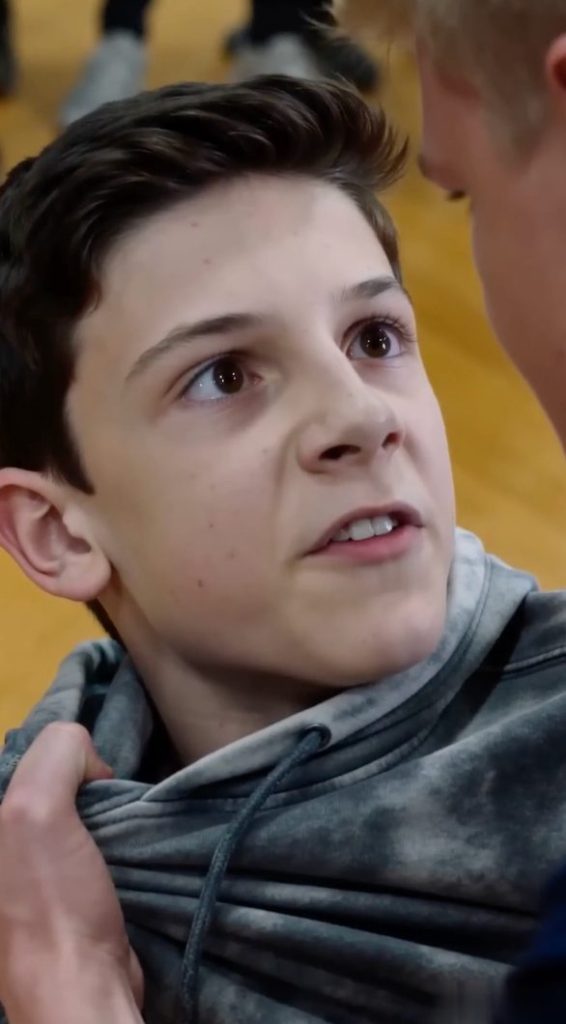
On the morning of my first day, she stood beside the apartment door and straightened the collar of my hoodie.
The gray fabric had faded from years of washing.
One sleeve had a barely noticeable patch near the cuff, sewn with thread that didn’t quite match.
It wasn’t fashionable, but it was comfortable, and it was mine.
“You look good,” she said.
I glanced down at myself.
“Everyone else is probably going to look better.”
She laughed softly.
“That’s not the same thing.”
I smiled because she wanted me to.
Then she touched my cheek.
“Remember what matters.”
I nodded.
“Good grades.
No trouble.”
“And?”
I knew what she wanted.
“Be kind.”
She smiled again.
“Especially when it isn’t easy.”
I carried that advice with me when I walked through the glass entrance of the school for the first time.
The building was enormous compared with my previous school.
The floors shone beneath fluorescent lights, and the hallways were lined with polished trophy cases and photographs of championship teams.
Students moved through the corridors wearing expensive sneakers, varsity jackets, and backpacks decorated with brand names I recognized from advertisements but had never considered buying.
Most seemed to know one another already.
They shouted greetings across the hallway, slapped hands, complained about summer assignments, and exchanged stories about vacations.
I heard someone mention a family trip to Europe.
Another student talked about spending two weeks at a beach house.
I thought about the summer my mother and I had spent carrying boxes upstairs, cleaning our apartment, and trying to make a new life fit inside three small rooms.
I wasn’t ashamed of our apartment.
But standing there, surrounded by people whose lives seemed so different from mine, I became aware of how little I knew about belonging.
I found my first classroom and chose a seat near the back.
That was where I first saw Tyler.
He entered with three other boys, laughing loudly, carrying a basketball under one arm even though we weren’t anywhere near the gym.
He was tall for a sophomore, broad through the shoulders, and moved with the easy confidence of someone who had never needed to wonder whether he was welcome.
His hair was neatly cut.
His shoes looked brand-new.
His friends seemed to respond to every change in his expression before he even spoke.
When he dropped into the seat two rows ahead of me, one of them leaned over to whisper something.
Tyler glanced backward.
Our eyes met for a moment.
I looked away.
At the time, I thought nothing of it.
I didn’t know that Tyler was the school board president’s son.
I didn’t know that his athletic achievements were celebrated at nearly every school assembly, or that teachers regularly mentioned his name with a kind of practiced approval.
I didn’t know that some students were afraid to challenge him because he could make their days miserable with a word.
I didn’t even know his full name.
He was just another student in a room full of strangers.

For the first few days, I tried to convince myself that things were going well.
My classes were challenging, but I liked them.
The library was larger than any I had ever used, and I discovered a quiet table beside a window overlooking the courtyard.
The teachers expected a lot from us, which I appreciated.
When I raised my hand, they listened.
When I turned in assignments, they were graded fairly.
At least in the classroom, I understood the rules.
Work hard.
Pay attention.
Treat people respectfully.
Those were rules I knew how to follow.
The first problem began in the hallway outside the cafeteria.
I was carrying a tray with a sandwich and a carton of milk when someone struck my shoulder hard enough to make me stumble.
The milk slid across the tray.
I caught it before it fell.
“Watch where you’re going,” a voice said.
I looked up.
Tyler stood in front of me, smiling.
His friends were gathered behind him.
“You walked into me,” I said.
The words came out quietly.
Tyler raised his eyebrows.
“Did you hear that?” he asked the others.
“New kid thinks he’s giving directions.”
A couple of them laughed.
I glanced at the space beside him.
There was room to pass.
“I didn’t mean anything by it,” I said.
Tyler moved aside with theatrical generosity.
“Then keep walking.”
I did.
Behind me, I heard one of his friends imitate my voice.
“Didn’t mean anything by it.”
More laughter.
I told myself it was nothing.
A stupid moment in a hallway.
The kind of thing that happened in schools everywhere.
By the time I reached an empty table, my face had cooled, and I had almost managed to believe it.
The next day, Tyler bumped into me again.
This time he wasn’t carrying anything, and the hallway was nearly empty.
He came from behind, struck my shoulder with his own, and continued walking without looking back.
“Oops,” he said.
His friends laughed.
I turned toward him.
For a moment, I considered saying something.
Then I remembered my mother’s face when she handed me the scholarship letter.
I kept walking.
That was the first time I chose silence.
I didn’t realize how many times I would have to make the same choice.
I began Taekwondo when I was six years old.
At that age, I didn’t understand discipline or self-control.
I liked the uniforms, the sharp sounds people made when they practiced, and the way the older students seemed capable of moving faster than my eyes could follow.
My mother had found a small training program that offered affordable classes for children in our neighborhood.
The training room wasn’t impressive.





