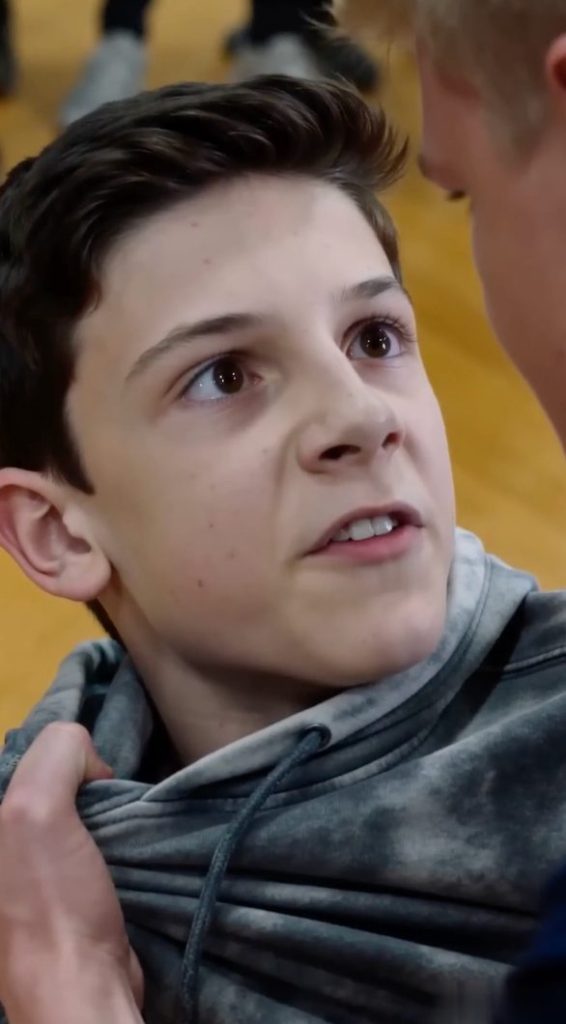
But each small change made my world a little smaller.
There were days when I reached the library after lunch and realized I had spent the entire break trying not to be noticed.
The library was quiet enough that I could hear pages turning.
I sat beneath the same window and opened my textbooks, grateful for a place where nobody cared what my hoodie cost.
Sometimes I watched groups of students crossing the courtyard below.
They walked together, talking and laughing, their movements relaxed.
I wondered what it felt like to move through school without calculating which direction might be safest.

I had never been particularly popular at my old school, but I had never felt hunted either.
Here, I was learning to recognize Tyler’s voice before I could see him.
I was learning to tense my shoulders whenever someone approached from behind.
And I was learning how exhausting it could be to pretend none of it mattered.
My mother noticed the change before I admitted it to myself.
One evening, while we were eating dinner at our little kitchen table, she studied me across her plate.
“You’ve been quiet lately.”
I gave her a small smile.
“I’m always quiet.”
“Not like this.”
I pushed a piece of food around with my fork.
“School’s just busy.”
“Are your classes too difficult?”
“No.
The classes are good.”
She seemed relieved for a moment.
Then she looked at me again.
“Are you making friends?”
I hesitated.
“A few people are nice.”
“That wasn’t exactly my question.”
I laughed softly.
She didn’t.
I looked down at my plate.
“It’s different there.”
She waited.
“Everyone already knows everybody.
I’m the new kid.”
“That takes time.”
“I know.”
She reached for her glass.
“I hope you’re not feeling that you have to impress anyone.”
I shook my head.
“I’m not.”
“Good.
Because you don’t.”
I wanted to tell her about the hallway.
About the jokes.
About the way people sometimes looked at my worn clothes before looking at my face.
But she had come home late that evening, and there were small shadows beneath her eyes.
I knew she had spent the day working, worrying about bills, and making sure we had enough food in the refrigerator.
I didn’t want to place another burden on the table between us.
So I told her about my science class instead.
She listened with genuine interest.
When I finished, she smiled.
“See?
You’re doing exactly what you’re supposed to do.”
I nodded.
For the rest of dinner, I tried to believe that was enough.
The lunch tray incident happened during the second month.
It was a Thursday, and I remember the day so clearly because the cafeteria was serving something I actually liked.
I had gotten through the morning without seeing Tyler.
My first two classes had gone well, and a teacher had returned an assignment with an encouraging comment written across the top.
For the first time that week, I felt almost ordinary.
I carried my tray toward an empty table near the windows.
Tyler appeared beside me.
“Hey,” he said.
I stopped.
He looked down at my lunch.
“That’s a lot of food.”
I adjusted my grip on the tray.
“It’s lunch.”
He grinned.
“Relax.
Just making conversation.”
His friends gathered behind him.
One of them glanced toward the nearby tables, where several students were watching.
I recognized that look by then.
They were waiting for something.
I stepped to the side.
“Can I get through?”
Tyler mirrored my movement.
“What’s the hurry?”
“I want to eat.”
He looked toward his friends.
“He wants to eat.”
They laughed.

I could feel people turning in their seats.
“Please move,” I said.
He widened his eyes in exaggerated surprise.
“Please?
Look at that.
He’s got manners.”
I tried moving again.
At the same moment, Tyler struck the side of my tray with his hand.
The tray tipped.
The carton of milk fell first, hitting the floor and bursting open.
Food scattered across the tiles.
The sound was sharp enough to draw attention from the far end of the cafeteria.
For one terrible second, everything seemed to go quiet.
Then Tyler laughed.
“Whoa.
Careful, man.”
His friends joined in.
I stood motionless, holding the empty tray.
I could feel heat spreading through my face.
The students at the nearest table stared at the mess.
Someone raised a phone.
I looked down at the food scattered around my shoes.
I knew what had happened.
Tyler knew what had happened.
Everyone close enough to see knew what had happened.
But Tyler stood there smiling as though I had simply dropped my lunch.
“Maybe you need somebody to carry your food for you,” he said.
My hands tightened around the tray.
I imagined setting it down, looking him in the eye, and telling him exactly what I thought of him.
I imagined refusing to move until he admitted what he had done.
For an instant, anger rose through me so fiercely that it was difficult to breathe.
Then I noticed how close he was standing.
How eagerly he watched my face.
He wanted a reaction.
Not an explanation.
Not a solution.
A reaction he could turn into a spectacle.
I slowly lowered the tray onto a nearby table.
Then I bent down and began picking up what I could.
The laughter returned.
One of Tyler’s friends made a comment I couldn’t quite hear.
My fingers felt clumsy as I gathered napkins and pieces of food from the floor.
A cafeteria worker approached with a mop bucket.
“Leave that, honey,” she said quietly.
“I’ll get it.”
I looked up at her.
She was older, with tired eyes and a kind expression.
“I can help.”
“I know you can.”
She gave me a small, understanding smile.
“But you don’t need to clean up somebody else’s foolishness.”
Something in her voice almost broke me.
Not because she had said anything extraordinary.





