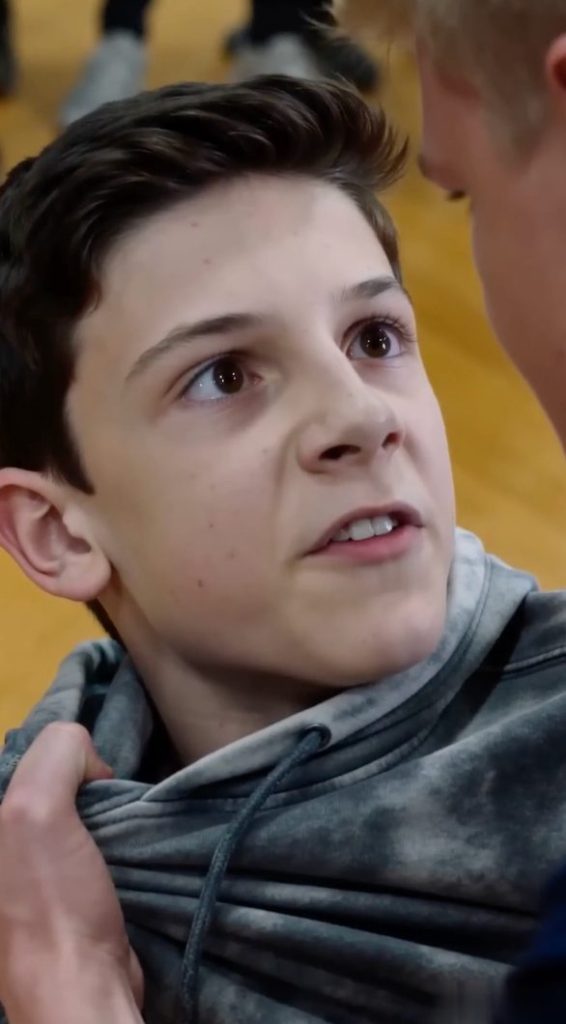
That was why Tyler’s jokes about my clothes made me angry in a way I had difficulty explaining.
My hoodie was faded because my mother washed it carefully instead of replacing it every season.
My sneakers were worn because we prioritized groceries and rent.
My backpack was secondhand because it still worked.
Those objects were not evidence that I was worth less than anybody else.
They were evidence of the choices my mother made so I could attend school without worrying whether there would be food waiting at home.
Tyler had never met her.
He didn’t know how tired she looked after a double shift.
He didn’t know how often she insisted she wasn’t hungry when there was only a little dinner left.
He didn’t know that she saved small amounts of money for my school supplies in an envelope tucked inside a kitchen drawer.
And he didn’t know how much it hurt to hear her sacrifices turned into jokes.
Sometimes, after she went to bed, I sat at my desk and stared at the scholarship acceptance letter.
I had pinned it above the lamp.
The paper reminded me why we had moved.
It also reminded me what I was afraid of losing.
I worried that if I confronted Tyler, the school would see me as the problem.
I worried that his father’s position would make everything complicated.
I worried that Coach Vance would defend him and that my mother would be called away from work to answer questions about something she hadn’t caused.
Most of all, I worried that a single moment of anger could undo months of hard work.
My instructor had told me that courage wasn’t always loud.
I repeated that to myself.
There were evenings when it helped.
Other evenings, it sounded like an excuse for being afraid.
I struggled to tell the difference.
As autumn progressed, I became more familiar with the quiet ways people responded to bullying.
Some students actively encouraged Tyler.
They laughed at his jokes, recorded his behavior, and repeated stories about me in conversations where I wasn’t supposed to hear.
Others watched without joining in.
A few looked uncomfortable.
One boy in my science class sometimes lowered his eyes when Tyler passed my desk.
I had noticed him laughing once during a hallway incident, but afterward he seemed unable to meet my gaze.
We never discussed it.
On another afternoon, a girl moved her backpack from the empty chair beside her when I entered the library.
“You can sit here,” she said.
I was surprised.
“Thanks.”
She returned to her book.
We didn’t become close friends, and she didn’t ask me to explain my life.
But for one lunch period, I sat at a table where nobody made me feel unwanted.
It was a small thing.
I remembered it for days.
That was something I learned during those months: cruelty could make a person feel small, but kindness didn’t have to be enormous to help them stand a little straighter.
Sometimes it was just a chair being moved.
Sometimes it was a cafeteria worker speaking gently.
Sometimes it was a teacher writing a few encouraging words on an assignment.
Those moments didn’t erase the bad ones.
But they gave me something to hold on to.
They reminded me that Tyler wasn’t the entire school, even when his voice seemed to fill every hallway.
Still, I found myself growing more tired.
I wasn’t sleeping well.
I woke before my alarm and lay awake imagining where Tyler might be waiting that day.
I stopped looking forward to lunch.
Physical education, which should have been one of the easier parts of my schedule, became the class I dreaded most.
I had spent nine years training my body.
Yet I walked into that gym feeling as though every movement might be used against me.
I hated the contradiction.
When we practiced running drills, I deliberately avoided finishing near the front.
When teams were selected, I tried not to attract attention.
During exercises, I moved carefully, keeping my abilities ordinary.
I didn’t want Tyler to become curious.
I didn’t want Coach Vance to ask questions.
I didn’t want anyone deciding that my training made me an interesting challenge.
Above all, I wanted to get through the semester without another confrontation.
But Tyler seemed to interpret every effort I made to avoid him as proof that he could do whatever he wanted.
By the final weeks of the third month, the insults had become constant.
He nudged my chair with his foot during class.
He made comments when I walked into the cafeteria.
He whispered things loudly enough for other people to hear.
Every time I refused to respond, he seemed to grow more determined to provoke me.
I began to feel as though he was waiting for something.
A shouted insult.
An angry shove.
One careless movement that would allow him to say I had started the trouble.
I knew the feeling from training.
An impatient opponent could become dangerous not because he was especially skilled, but because he wanted so badly to win that he stopped thinking about consequences.
Tyler’s confidence was slowly turning into carelessness.
And I was becoming increasingly afraid that someday his carelessness would force me to make a decision I had spent years learning to avoid.
The morning of the confrontation began like most other school mornings.
My mother was already dressed for work when I entered the kitchen.
She had prepared toast and placed a banana beside my plate.
“Morning,” she said.
“Morning.”
She looked at my face.
“Didn’t sleep well?”
“Not much.”
“Too much homework?”
I shrugged.
“Something like that.”
She poured coffee into a travel mug.
I watched her search through the drawer for the lid.
For a moment, I nearly told her everything.
I imagined explaining Tyler’s behavior from the beginning, showing her the messages classmates had exchanged about me, and admitting how much I dreaded certain parts of the school day.





