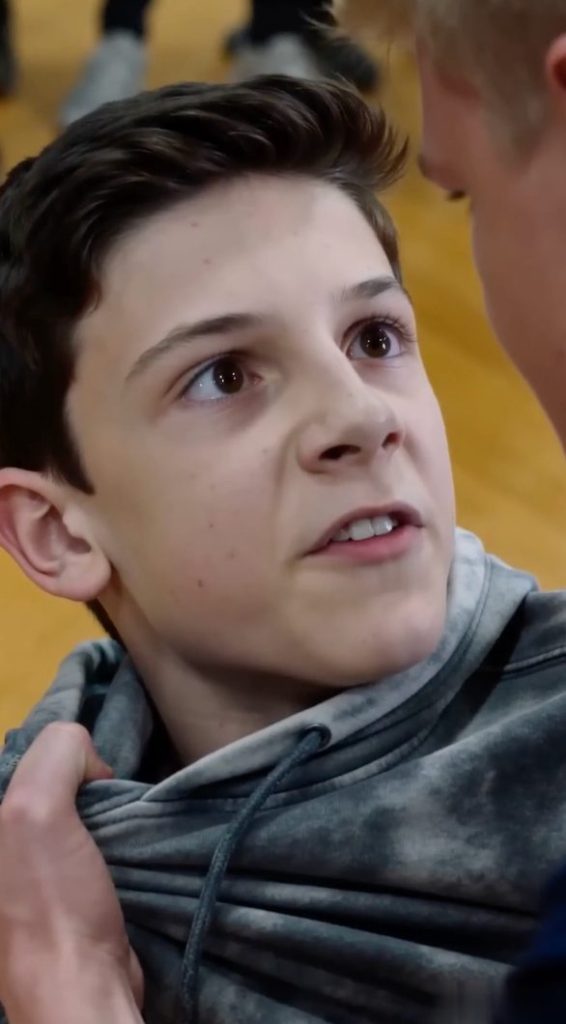
Because she had spoken as though I deserved kindness without having to earn it.
I stood slowly.
“Thank you.”
She nodded toward the serving area.
“Go get something to eat.”
I wanted to.
But I couldn’t bear another walk past Tyler and his friends.
So I left the cafeteria.
I spent the rest of lunch sitting in a bathroom stall, staring at my hands.
They were shaking.
Not from fear alone.
From anger.
I kept remembering how easily I could have grabbed Tyler’s wrist when he struck the tray.
I had seen the movement before it happened.
My body had recognized the angle of his arm, the sudden shift of his weight.
I had deliberately done nothing.

It was supposed to be the right decision.
Yet sitting there with an empty stomach and laughter still echoing in my memory, I struggled to feel proud of it.
I washed my hands before returning to class.
In the mirror, I looked pale and exhausted.
I straightened my hoodie.
Then I practiced the same quiet breathing my instructor had taught me years earlier.
In through my nose.
Out slowly.
Again.
When I returned to the hallway, the lunch period was nearly over.
Nobody mentioned the incident to me.
But a few students looked away as I passed.
That silence hurt almost as much as the laughter.
Tyler’s favorite place to bother me was the locker room.
It gave him an audience without the inconvenience of teachers standing nearby.
His friends would gather near the entrance after physical education, blocking the narrow passage while everyone else hurried toward their next class.
The first time it happened, I assumed they were simply talking.
“Excuse me,” I said.
Nobody moved.
I waited.
Tyler looked over his shoulder.
“Oh, you need to get through?”
“Yes.”
He made a show of looking at the space around him.
“Looks crowded.”
One of his friends laughed.
I shifted my backpack from one shoulder to the other.
“I’m going to be late.”
“That’s rough.”
I stood there until another student approached from behind and asked what was happening.
Only then did Tyler step aside.
He gave me a smile as I passed.
“See?
All you had to do was ask.”
The next time, they made me wait longer.
By the third time, they had turned it into a routine.
They would pretend not to hear me.
They would joke about charging an admission fee.
Sometimes they moved just far enough for me to squeeze through, forcing me to turn sideways while they laughed at the awkwardness.
I began changing faster after gym class.
I learned to pack my things before most students finished showering, and I stopped using the locker closest to theirs.
Every adjustment seemed reasonable on its own.
Together, they became a way of arranging my life around someone else’s cruelty.
The strangest part was that Tyler rarely seemed genuinely angry with me.
He was often cheerful.
He laughed while humiliating me.
He smiled when I looked uncomfortable.
He acted as though making another person miserable was simply a harmless form of entertainment.
That made his behavior harder to understand.
If I had offended him, I might have apologized.
If there had been a misunderstanding, I might have explained.
But Tyler didn’t need a reason.
He needed an audience.
And the more quietly I endured him, the more entertaining he seemed to find me.
I tried once to speak to Coach Vance after class.
The coach was standing near the equipment room, checking something on a clipboard.
“Coach?”
He looked up.
“What is it?”
I glanced toward the locker room.
“Some of the guys keep blocking the door after class.”
He sighed.
“Who?”
I hesitated.
There was a moment when I could have said Tyler’s name.
I knew I should have.
But I also knew that Tyler had friends in almost every class, and I feared what would happen if he learned I had complained.
“The guys near the entrance,” I said.
Coach Vance looked at his watch.
“Then use the other side.”
“They stand across the doorway.”
He pressed his lips together.
“Look, you’re going to have to figure out how to get along with your classmates.”
I stared at him.
“I’m trying.”
“Then keep trying.”
He returned to his clipboard.
The conversation was over.
I walked away feeling foolish.
I hadn’t expected him to solve everything.
I had only wanted him to listen.
From then on, I stopped asking.
Coach Vance seemed comfortable with that arrangement.
Tyler was one of his favorite athletes, and the coach often praised his strength, speed, and competitive drive during class.
When Tyler pushed too hard during games, Coach Vance called it enthusiasm.
When Tyler shouted at someone who missed a pass, the coach called it leadership.
If another student complained, he usually told them to toughen up.
I began to understand that some adults could mistake confidence for character.
And some could mistake quietness for an absence of need.
At home, my mother kept trying to make our apartment feel less temporary.
She placed a small plant on the windowsill, even though sunlight rarely reached it.
She found inexpensive curtains at a discount store and spent an entire evening adjusting them until they hung evenly.
One Saturday, she brought home a secondhand lamp for my desk.
The shade had a tiny dent near the bottom.
“Thought this might help with your homework,” she said.
I plugged it in.
A warm circle of light spread across the scratched wooden surface.
“It’s perfect.”
She smiled.
“Good.”
That night, I stayed up finishing an assignment while she folded laundry in the living room.
Every so often, I could hear her moving between the couch and the small kitchen.
There was comfort in those ordinary sounds.
Our apartment wasn’t large.
We didn’t own many things.
But everything inside it had been chosen, repaired, cleaned, or saved for by someone who loved me.





