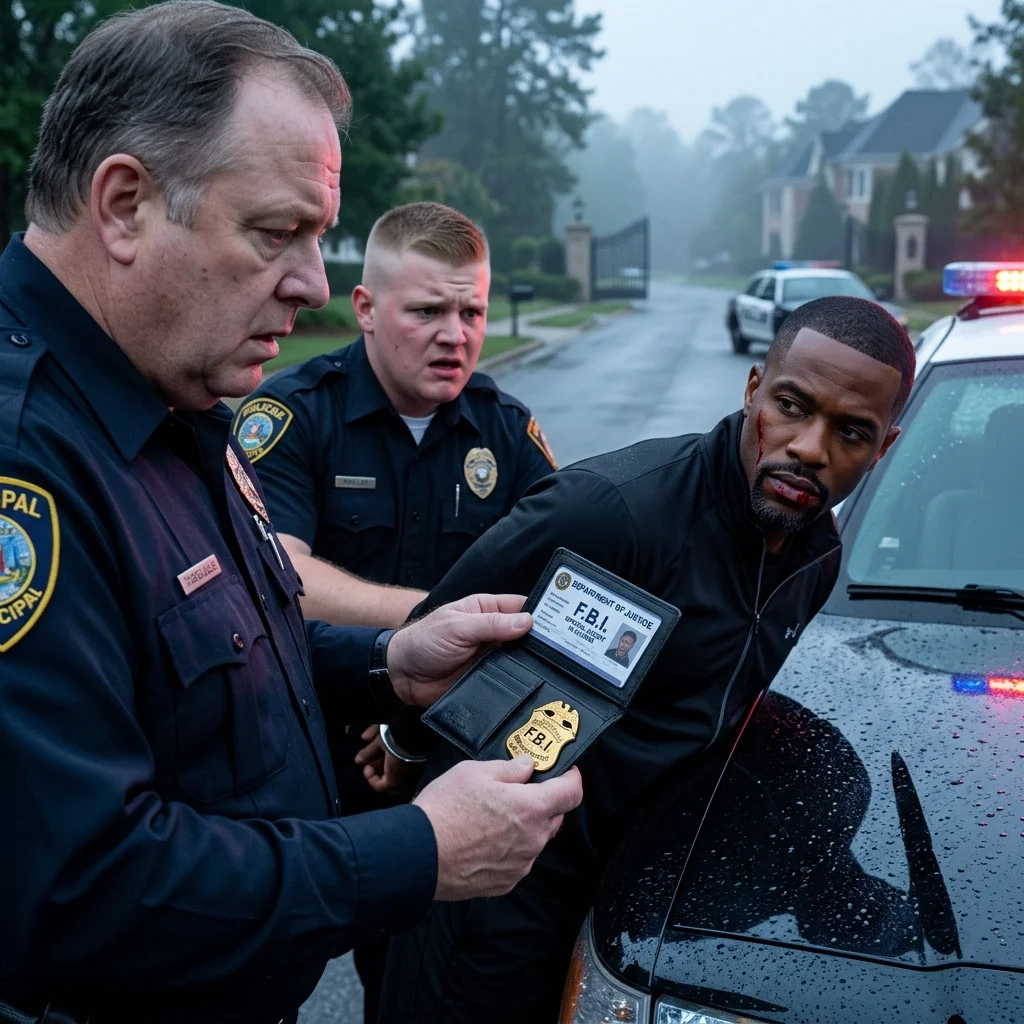
At 5:15 in the morning, the house at 412 Elm Street smelled of fresh paint, unpacked cardboard, and the faint, lingering cedar of the closet shelves.
Marcus Sterling sat on the bottom step of the grand mahogany staircase, pulling the laces of his Brooks Glycerin running shoes tight. Around him, the cavernous foyer was a landscape of brown moving boxes stacked three high, each labeled in his own neat, angular block lettering: Kitchen—Daily, Study—Case Files, Elena’s Books. He hadn’t opened that last one yet. Even three years after the funeral, some seals were better left unbroken until the rooms around them felt less like a museum and more like a home.
He stood, rolling his shoulders to work out the stiffness from a week of hauling furniture and unpacking. At forty-eight, six-foot-two, and two hundred and ten pounds of lean, disciplined muscle, he still carried himself with the quiet, economical posture of a man who had spent twenty-two years in federal law enforcement. He pulled a black technical hoodie over his head, slipped a bright neon-yellow reflective running vest over his torso, and checked the dark titanium face of the Apple Watch Ultra strapped to his left wrist.
5:18 AM. Forty-six degrees. Clear skies.
Before stepping out, he reached into the small zippered pouch sewn into the front of his reflective vest and felt the reassuring, rigid rectangle of his leather credential folio. Habit was a stubborn thing; even on a five-mile tempo run, he never left the house without his identification.
He disarmed the newly installed perimeter security system—a high-definition, four-camera optical array he had personally contracted a federal-grade vendor to mount into the brick pillars of his wrought-iron driveway gates two days prior—and stepped out into the crisp Virginia dawn.
Oakridge was the kind of suburb that didn’t just imply wealth; it policed it. The median home price hovered comfortably around two and a half million dollars. Every lawn was an expanse of emerald fescue trimmed to a uniform two inches, glistening now with heavy morning dew. The air carried the clean, expensive scent of damp mulch, cedarwood, and freshly laid asphalt. No streetlights flickered out of turn. No trash cans lingered at the curbs past collection hour.
Marcus touched the screen of his watch, starting his workout timer, and eased onto the sidewalk.
The first mile was a warm-up, his breath pluming white in the cold air as his strides lengthened into a steady, rhythmic cadence. He moved past the sprawling Georgian colonials and manicured boxwood hedges, his neon vest catching the faint silver of the pre-dawn sky.
As he passed 414 Elm—the stately brick residence directly adjacent to his own—something shifted in the corner of his eye. On the second floor, behind a set of heavy cream drapes, a shadow moved. The curtain parted by two inches, held open by a pale hand. A moment later, the faint blue glow of a smartphone screen illuminated a face before the fabric fell smoothly back into place.
Marcus didn’t break stride. He knew that look. He had seen it in boardrooms, in courtrooms, and on quiet suburban streets from Maryland to Georgia.
He rounded the cul-de-sac at the north end of Elm, dropping his pace down to a brisk six-minute mile, his lungs opening to the cold air. As he hit the straightaway leading back toward his own wrought-iron gates, he spotted the dark silhouette of a municipal police cruiser idling near the intersection of Elm and Sycamore. Its headlights were killed. Its engine hummed softly in the quiet morning, exhaust curling gray into the mist.
Marcus kept his eyes forward, his pace steady, his hands loose at his sides.
He was fifty yards from his own driveway when the night behind him exploded into strobing red and blue.
The cruiser didn’t just pull alongside him; it lurched forward with a sharp bark of tires on wet asphalt and angled sharply across the apron of his neighbor’s driveway, cutting off his path. The high-beams flared, blindingly white, pinning Marcus in the glare.
Marcus slowed from a run to a jog, then to a complete stop ten feet from the front bumper. He raised both hands to chest height, palms open, and stood perfectly still. His heart rate, which had been humming at a controlled hundred and fifty-five beats per minute, didn’t spike. Instead, it began to drop.
Both doors of the Ford Explorer Interceptor swung open simultaneously.
The driver came out first—a stocky man in his early forties with a thick neck, a receding hairline, and the weathered, slightly flushed complexion of someone who lived on drive-thru coffee and overtime shifts. His uniform was crisp, his gold sergeant’s stripes gleaming under the flashing light bar. His partner, emerging from the passenger side, was younger, heavier in the shoulders, with a fresh buzzcut and a jaw set in eager, performative aggression.
“Don’t you move a muscle!” the sergeant barked, his hand already resting on the retention hood of his holstered Glock. “Keep those hands up! Walk toward the hood of the car—slow!”
“Good morning, Officer,” Marcus said. His voice was level, unhurried, carrying easily across the quiet street. “Is there a problem?”
“I didn’t ask you to talk!” the sergeant snapped, closing the distance between them in four heavy strides. “Turn around! Put your hands on the hood!”
Marcus didn’t argue. He didn’t reach for his vest. He turned smoothly, stepped forward, and placed both palms flat against the hood of the cruiser.
The metal was freezing.
Before he could even exhale, a pair of thick, gloved hands seized the back of his hoodie collar and drove him forward with sudden, gratuitous violence. His right cheek slammed into the icy blue paint of the cruiser, the impact rattling his teeth.
“Don’t you twitch, you understand me? Don’t you even breathe heavy!” the sergeant roared, his voice cracking with a sudden, ugly surge of adrenaline.





