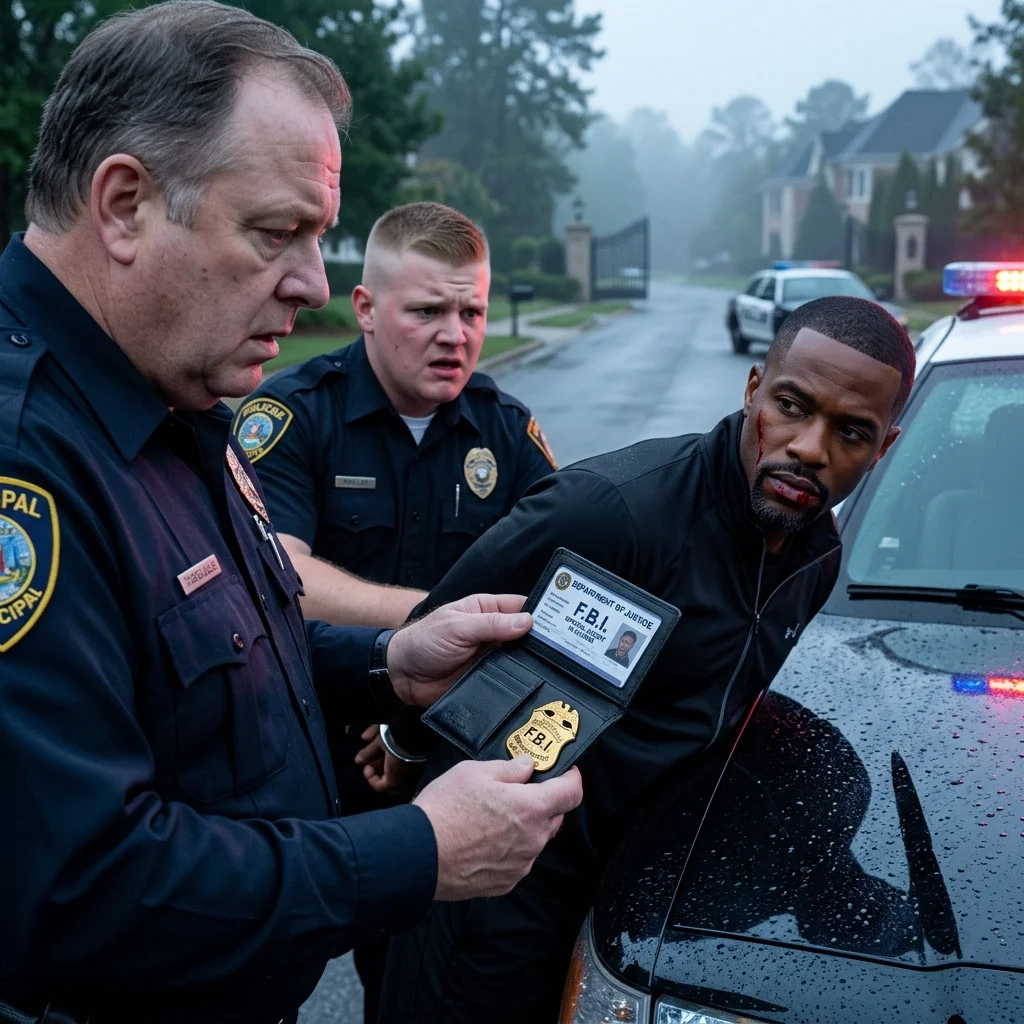
Officer Derek Miller had stepped away from the fender. His face was slick with sweat despite the cold air, his breathing ragged. Slowly, deliberately, he reached up to his uniform placket, unclipped his black body-worn camera, and held it out toward Agent Hayes with both hands.
“It’s still recording,” Miller said, his voice cracking, yet carrying clearly across the silent street. “Sergeant Kowalski’s was off, but mine has been running since we turned onto Elm. Everything’s on it. The stop, the slam into the wiper blade, the Chief telling Ray to wipe the dashcam.”
“Miller, shut your damn mouth!” Kowalski roared, lunging half a step forward before two FBI agents instantly stepped between them, hands resting firmly on their belts.
Miller didn’t flinch this time. He looked straight at Marcus, then over at Evelyn Caldwell, who was standing frozen on the curb as if turned to stone.
“And there’s something else,” Miller said, swallowing hard. “It wasn’t a random 911 call. Councilman Caldwell called the precinct desk last night around nine. He saw the moving truck at 412 yesterday afternoon and saw Mr. Sterling unloading boxes. He told Sergeant Kowalski that ‘the wrong element’ was hanging around the Harrison place and told him to run a saturation patrol on Elm at dawn. Mrs. Caldwell’s call this morning was just the pretext.”
The silence that fell over Elm Street was absolute.
Up and down the manicured block, heavy curtains were parting in second-story windows. Porch lights flickered on one by one as Oakridge’s wealthy residents peered out at the spectacle of federal agents surrounding their own police chief.
Evelyn Caldwell’s bone-china mug slipped from her fingers. It struck the flagstone walkway and shattered into a dozen white shards, dark coffee splashing across the hem of her silk pink bathrobe. She didn’t even look down. She turned abruptly, stumbled up her front steps, and vanished behind her heavy oak door, the deadbolt sliding home with a sharp, panicked click.
Agent Hayes took the body camera from Officer Miller, sealed it into an anti-static evidence bag, and nodded to two of her agents.
“Sergeant Ray Kowalski,” Hayes said, her voice flat and final. “You are under arrest for deprivation of rights under color of law and assault under Title 18 of the United States Code. Turn around and place your hands behind your back.”
Kowalski’s shoulders slumped. The arrogance, the swagger, the coffee-breathed certainty—all of it evaporated in an instant, leaving behind a small, terrified man staring at the end of his life as he knew it. He turned slowly, letting the federal agents snap their own steel handcuffs around his wrists.
Beside him, Chief Harlan stood motionless as another agent relieved him of his service weapon and his badge, reading him his rights in a low, steady monotone.
Marcus watched them load Kowalski into the back of the lead Charger. He felt no surge of triumph, no cheap thrill of revenge. Only the quiet, heavy satisfaction of a job finally begun.
Two hours later, Elm Street was quiet again.
The strobing lights were gone. The cruisers had been towed by federal impound units. A gentle, golden morning sun had risen over the rooftops, burning off the last of the mist and turning the wet lawns into sheets of sparkling green.
Inside the sunlit kitchen of 412 Elm, Marcus stood at the marble island, a small white bandage taped neatly over his lower lip. The rich, dark aroma of freshly brewed French press coffee filled the room, mingling with the scent of cardboard and cedar.
He poured himself a mug, walked over to the tall bay window overlooking the front lawn, and took a slow sip.
Across the street, the neighborhood looked exactly the same as it had at five-fifteen. Pristine. Quiet. Aggressively manicured. Yet everything beneath the surface had shifted permanently. By noon, the Department of Justice would issue a formal press release announcing the federal oversight of the Oakridge Police Department and the grand jury subpoenas for the town council. By dinner, half the homeowners on Elm Street would be calling their lawyers.
Marcus set his mug down on the sill, reached over to the nearest moving box—the one labeled Elena’s Books—and ran his thumb cleanly through the packing tape, breaking the seal.
He was home. And he wasn’t going anywhere.





