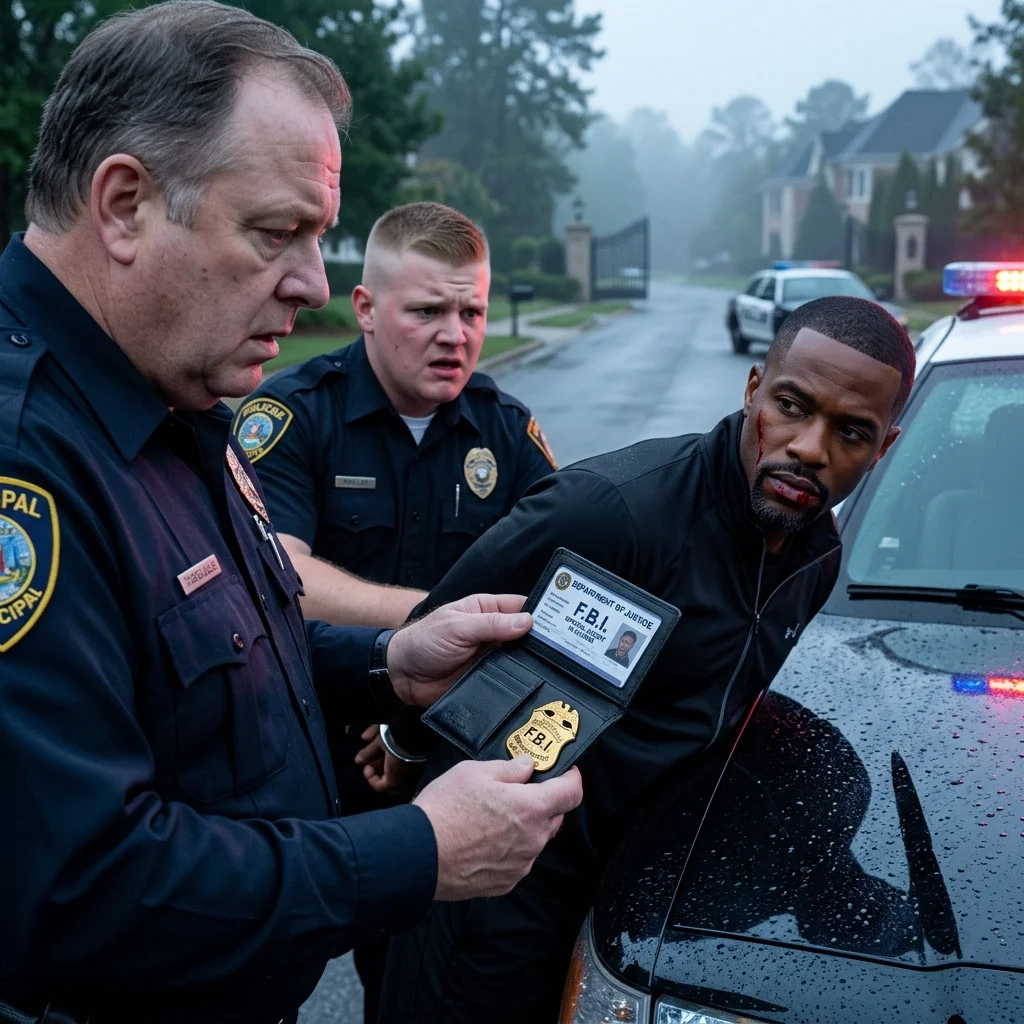
“Your sergeant just bypassed a recorded dispatch channel to make a private call on his personal phone,” Marcus said. “He is almost certainly calling your Chief of Police to ask how to make this disappear. Do you know what happens when two sworn officers conspire to cover up a color-of-law assault?”
Miller swallowed hard, his Adam’s apple bobbing violently. “Sir, I—he told me—”
“Look at your chest, Officer Miller,” Marcus interrupted gently. “Your body camera is still recording. Sergeant Kowalski’s is off. That means right now, you are the only person on this street with an unedited federal exhibit strapped to his uniform. You have about ninety seconds before your Chief arrives to decide whether you’re going to be a material witness for the United States Government, or a co-defendant in a federal penitentiary.”
Miller stared at Marcus, his chest rising and falling in shallow, terrified breaths. His eyes dropped to his own hands—the hands that had just cranked the steel cuffs three clicks too tight.
Twenty feet away, Kowalski was pacing in tight, erratic circles by the rear bumper, his voice a hushed, desperate hiss into his phone. “Chief, you need to get over to Elm Street right now. No, not on the air—just get here. It’s the guy who bought the Harrison place. He’s—Chief, he’s DOJ. High up. Yeah, he’s cuffed. Yeah, he’s bleeding. Just get here!”
Kowalski ended the call and walked slowly back toward the front of the cruiser, trying and failing to assemble a mask of professional composure. He slid Marcus’s credentials back into his own shirt pocket—a reflex of control he couldn’t quite surrender.
“Look, Mr. Sterling,” Kowalski began, his voice a strained, forced baritone. “There’s clearly been a misunderstanding here. We had a call about a prowler, it’s dark, you’re wearing a black hoodie—”
“Give me back my credentials, Sergeant,” Marcus said.
“My Chief is three minutes away,” Kowalski said, his eyes darting nervously toward the end of the street. “We’re going to sort this out like gentlemen. Miller, take the cuffs off him.”
Miller fumbled with his key ring, his fingers shaking so badly he dropped the handcuff key onto the wet asphalt. He knelt clumsily, scooped it up, and unlocked the steel jaws. As the cuffs fell away, Marcus brought his hands forward, flexing his numb fingers slowly. Deep, angry red grooves circled both wrists.
He reached into his hoodie pocket, pulled out a clean white handkerchief, and dabbed gently at the split in his lower lip. The fabric came away bright crimson.
“Sergeant Kowalski,” Marcus said, tucking the handkerchief away. “Did you just put my federal credentials in your pocket?”
Kowalski hesitated, his jaw clenching, then reluctantly pulled the black folio out and handed it back. “Just securing them until the Chief gets here, sir.”
Before Marcus could reply, the low rumble of a heavy V8 engine echoed down Elm Street.
An unmarked black Chevrolet Tahoe turned the corner from Sycamore, moving fast without lights or sirens. It pulled up sharply behind Kowalski’s cruiser, its tires hissing on the wet pavement.
The driver’s door opened, and Chief Thomas Harlan stepped out.
Harlan was fifty-eight, trim, with silver hair swept neatly back and a tailored dark overcoat thrown hastily over his crisp dress uniform. He had been the Chief of Police in Oakridge for fifteen years, surviving three town councils by understanding one fundamental rule of suburban politics: the people who paid the highest property taxes didn’t want justice; they wanted insulation.
He took in the entire tableau in three seconds—the strobing lights, the blood smeared on the hood of Unit 41, the pale, sweating rookie, the tight-lipped sergeant, Evelyn Caldwell hovering nervously on the curb in her pink silk robe, and the tall Black man in a neon running vest standing calmly in the center of it all.
Harlan’s face shifted effortlessly into an expression of grave, practiced concern. He strode forward, extending a manicured hand.
“Mr. Sterling,” Harlan said smoothly, his voice rich with manufactured warmth. “Chief Thomas Harlan. I am deeply, profoundly sorry for this confusion. Welcome to Oakridge—this is certainly not the introduction we want for our newest resident.”
Marcus didn’t take his hand. He simply looked at it until Harlan was forced to let it drop back to his side.
“Confusion,” Marcus repeated evenly. “Is that what you call an unprovoked assault, a false arrest, and a split lip on the hood of a city vehicle, Chief?”
Harlan’s smile didn’t quite reach his eyes. He glanced briefly at the smear of blood on the blue paint, then back at Marcus. “Now, Deputy Assistant Attorney General—I understand you’re upset. Anyone would be. But let’s look at the practical reality of what happened here at five-forty-five in the morning. My officers responded to a priority call from a respected resident regarding a suspicious individual near a recently vacated property. You were wearing a dark hood, moving at speed in low light. In the heat of a felony stop, things happen fast. Nobody here had any ill intent.”
Harlan leaned in half a step, lowering his voice into that confidential, clubby register powerful men use when they expect another powerful man to play along.
“You and I both know how these things look in the press, Marcus. Can I call you Marcus? You just moved into a beautiful neighborhood. You don’t want your first week here defined by a messy local dispute over whether you complied quickly enough with a lawful stop. Let’s get you cleaned up, I’ll personally review Sergeant Kowalski’s training file, and we’ll chalk this up to an overzealous patrolman doing his best to keep your new street safe.”
Harlan turned his head slightly toward Kowalski, his tone dropping to a flat, coded murmur. “Ray, go sit in the cruiser and check your vehicle telemetry. Make sure the dashcam system didn’t suffer a power glitch when you hit the light bar.”





