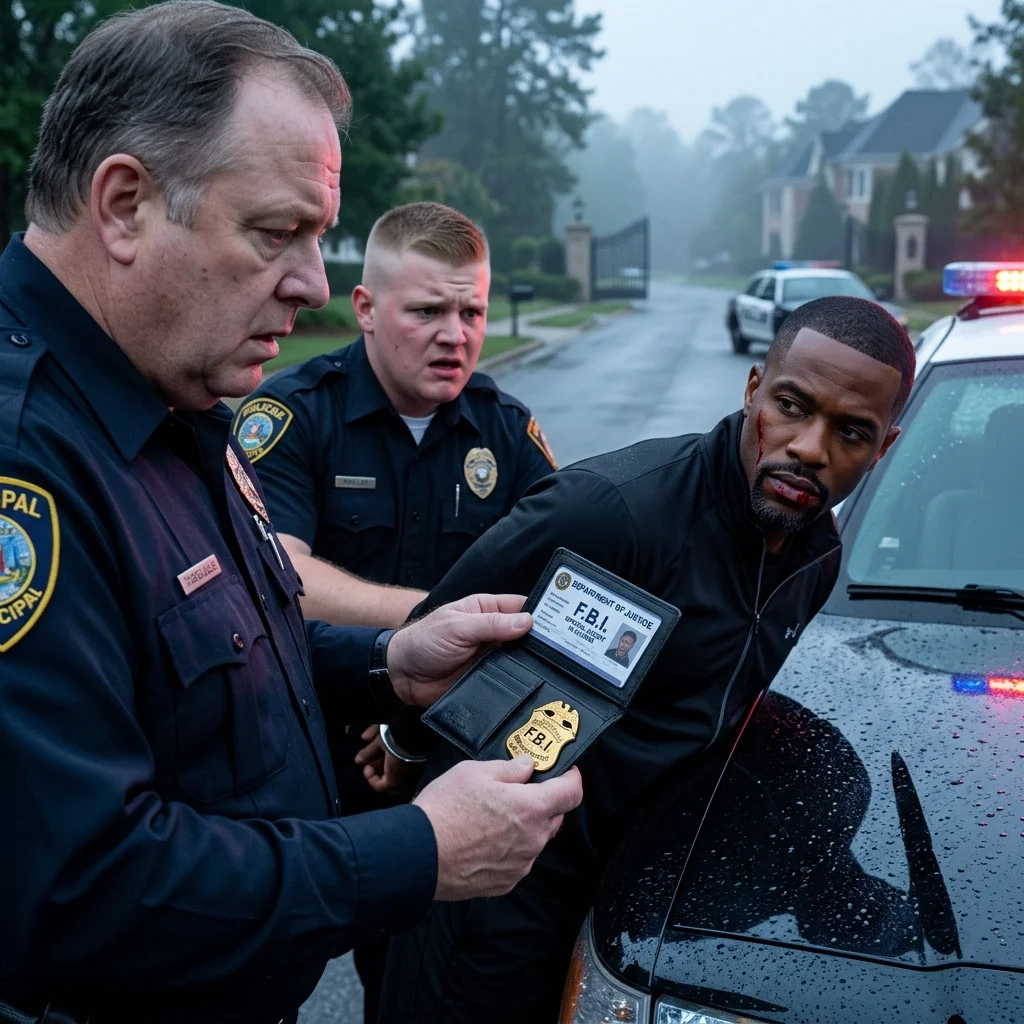
A hard, bony knee dug sharply into the small of Marcus’s back, pinning him against the fender. The pressure wasn’t accidental; the officer drove his weight directly into the L4 vertebra with a practiced, cruel precision designed to shoot a jolt of blinding pain down the sciatic nerve. He wanted Marcus to flinch. He wanted a reflex—a jerk of the hip, a twist of the shoulder—anything that would look like resistance on a report.
On his left, the younger officer wrenched Marcus’s left arm high up behind his shoulder blades, twisting the wrist until the cartilage in his shoulder joint popped audibly in the quiet morning air.
“I’m not resisting,” Marcus said.
His voice was deliberately flat. It was completely devoid of the panic, the breathless fear, and the submissive pleading they were so desperately trying to provoke out of him.
“Shut your mouth!” the younger cop snapped, shoving his forearm across the back of Marcus’s neck to grind his face harder against the slick, freezing clear-coat.
Marcus didn’t cry out. He didn’t beg. He didn’t ask them why they were doing this.
He knew exactly why they were doing this.
In twenty-two years of federal service—first as a special agent, then as a federal prosecutor, and now as Deputy Assistant Attorney General for the Department of Justice’s Civil Rights Division—Marcus had read ten thousand incident reports that began with this exact choreography. He knew the physiological cocktail flooding the two men behind him right now: the intoxicating rush of unchecked authority, the tribal certainty of wearing a badge in a wealthy town that never questioned how its borders were kept clean.
As he lay pinned to the hood, his left eye angled toward the sergeant’s chest, Marcus noticed something crucial. The rectangular black body-worn camera clipped to the sergeant’s uniform placket was dark. No blinking green standby light. No red recording indicator.
He shifted his gaze slightly toward the younger officer’s reflection in the cruiser’s windshield. A tiny red diode was pulsing steadily on the rookie’s chest.
Good, Marcus thought.
And sixty feet away, mounted neatly into the twin brick pillars flanking the wrought-iron gates of 412 Elm, his own 4K perimeter cameras were pointed directly down the street, capturing every frame in crystal-clear, high-definition color.
“Dispatch, Unit Four-One,” the sergeant said into his shoulder mic, slightly out of breath, his chest heaving against Marcus’s back. “Suspect secured on Elm Street. Matches the description of the prowler. Code four.”
A prowler.
Marcus stared down at the reflection of his own neon-yellow reflective vest in the cruiser’s paint. He was wearing two-hundred-dollar running shoes, an eight-hundred-dollar GPS watch, and enough high-visibility fabric to land a commercial airliner. If he was a prowler, he was the most visible, fitness-conscious burglar in the history of the eastern seaboard.
“What’s your name, boy?” the sergeant demanded, leaning down until his hot, stale coffee breath washed over Marcus’s ear.
Marcus didn’t answer immediately. He was mentally cataloging every statutory element. Color of law. Unreasonable seizure. Excessive force. Deprivation of constitutional rights under Title 18, Section 242. Every second they held him here, every word they spoke, was another brick in the wall of a federal indictment. He needed them to dig the hole deep enough that no county prosecutor, no friendly local judge, and no police union attorney could ever pull them out of it.
“I asked you a damn question!” the sergeant roared.
He yanked the collar of Marcus’s hoodie backward and slammed his face down a second time against the cruiser.
This time, Marcus’s mouth caught the raised metal edge of the windshield wiper arm. His lower lip split instantly. A warm, metallic rush of blood flooded his tongue, and a thin crimson thread trickled down his chin, pooling into a dark red circle on the pristine blue paint of the Oakridge Police Department cruiser.
“Marcus,” he finally said, his tone unnervingly calm even as the blood dripped from his jaw.
“Marcus what? Where do you live? Because you sure as hell don’t live around here,” the younger cop sneered, his free hand roughly patting down the outside of Marcus’s running tights.
“I live at 412 Elm,” Marcus replied smoothly.
The younger cop’s hand froze mid-pat. Across the roof of the cruiser, he shot a quick, uncertain glance at his sergeant.
412 Elm was the massive, six-bedroom colonial estate sitting directly across the street from where they currently had him pinned. It was the largest property on the block, set back behind a sweeping circular drive and tall wrought-iron gates.
“Bullshit,” the sergeant laughed, though the sound had a brittle, nervous edge to it. “The Harrison family lives there. They closed last week and moved to Florida. The house was sold to some hotshot lawyer from DC.”
“I am the hotshot from DC,” Marcus said.
He turned his head just enough against the icy metal to look the sergeant dead in the eye, letting the older man see the utter, chilling absence of fear in his expression.
For a fraction of a second, the sergeant’s smirk faltered. A tiny flicker of doubt—cold and sharp—crossed his pupils.
Then, his ego violently reclaimed the wheel.
“Yeah, right. And I’m the damn Mayor,” the sergeant spat, driving his knee deeper into Marcus’s spine until a low, involuntary grunt escaped Marcus’s chest. “You’re casing the neighborhood. We got calls about a suspicious male sprinting through the cul-de-sacs, checking out empty houses.”
“I was running a six-minute-mile pace,” Marcus corrected him, holding the man’s gaze without blinking. “That’s called a tempo workout, Sergeant. Not fleeing.”
“Smartass,” the younger cop hissed. He grabbed Marcus’s right wrist, yanked it behind his back to meet the left, and violently slapped a pair of heavy steel handcuffs onto his skin. He didn’t just close them; he squeezed the toothed jaws shut three clicks past the necessary tension, double-locking them with a sharp snick.
The cold steel bit directly into Marcus’s radial bone, instantly choking off the circulation to his fingers.





