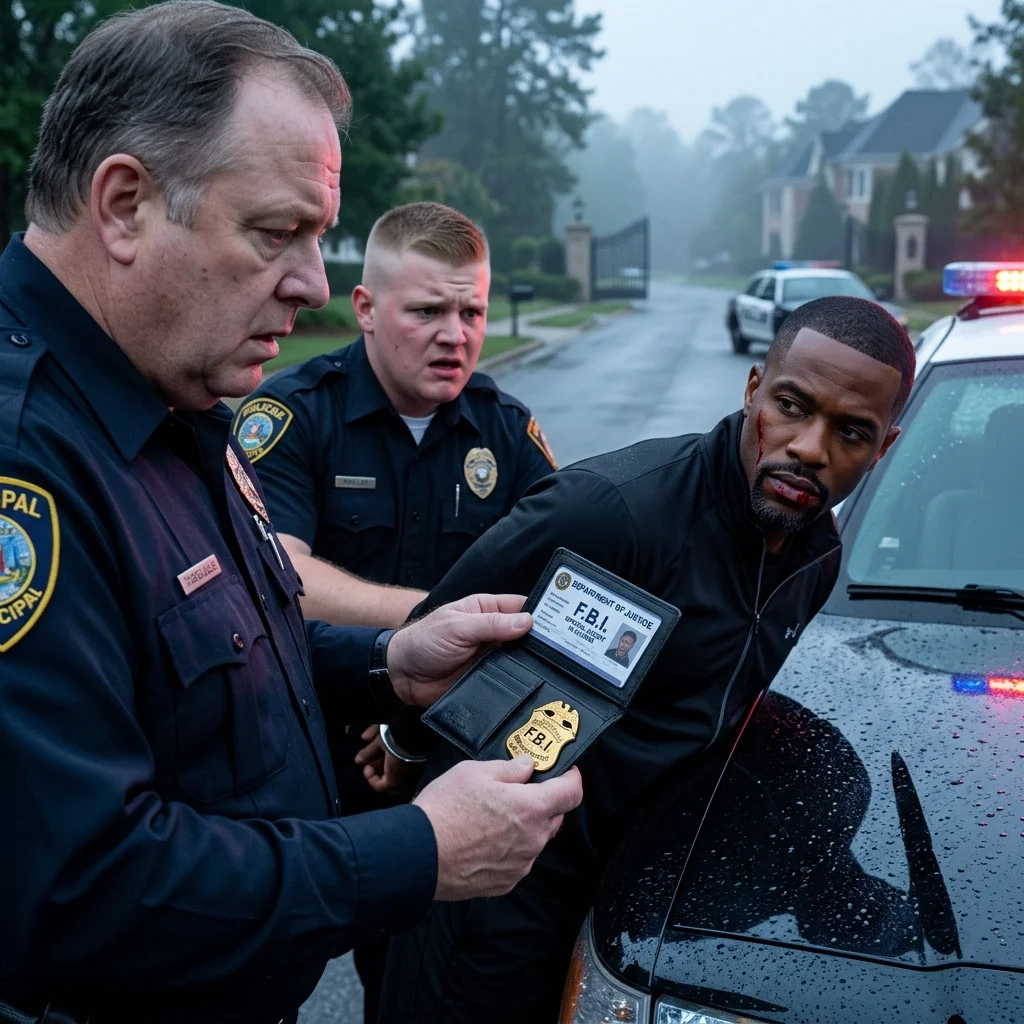
Kowalski’s eyes flicked to his Chief’s. He understood the order instantly. “Yes, sir. Right away, sir.”
He turned toward the open driver’s door of Unit 41.
“I wouldn’t touch that console, Sergeant,” Marcus said.
His voice wasn’t loud, yet it stopped Kowalski dead in his tracks.
Marcus smiled for the first time all morning. It wasn’t a warm smile. It was the quiet, surgical expression of a prosecutor who had just watched the defense attorney walk straight into a perjury trap.
“Chief Harlan,” Marcus said, gesturing casually across the street toward the wrought-iron gates of 412 Elm. “Look at the brick pillars flanking my driveway.”
Harlan’s eyes followed Marcus’s finger. Nestled seamlessly into the dark mortar, just beneath the carriage lamps, were two matte-black optical lenses—industrial-grade, wide-angle security cameras aimed directly down the length of Elm Street.
“Those are four-K continuous-stream cameras backed up in real time to an encrypted federal cloud server,” Marcus said smoothly. “They captured your sergeant idling at the corner with his lights off. They captured me stopping with my hands raised. They captured him slamming my face into the wiper blade twice while I was completely compliant. And if Sergeant Kowalski climbs into that cruiser and deletes your dashcam file right now, he won’t just be facing a civil rights violation—he’ll be adding federal obstruction of justice and spoliation of evidence to both of your indictments.”
The smooth, political warmth drained from Chief Harlan’s face, leaving behind something cold and hard.
“Now hold on just a minute,” Harlan said, his voice dropping an octave. “You’re throwing around some very heavy words for a guy standing in my jurisdiction, Sterling. You may be a big shot in Washington, but out here, this is a municipal matter. You don’t have a warrant, you don’t have a case, and you sure as hell don’t walk into my town and threaten my command staff.”
“You’re right about one thing, Chief,” Marcus said softly. “I didn’t move to Oakridge by accident.”
Harlan froze. “What?”
“Six months ago,” Marcus said, taking a single, deliberate step closer, “a twenty-two-year-old delivery driver named Devon Brooks was pulled over on Sycamore Avenue at six in the morning. He ended up in the ICU with three cracked ribs and a ruptured spleen. Your department claimed he resisted arrest. Strangely, the dashcam in Sergeant Kowalski’s cruiser suffered a ‘power glitch’ that morning, too. And your county prosecutor sealed the settlement before the ink was dry.”
Kowalski’s face went gray. On the curb, Evelyn Caldwell took an involuntary step backward, her coffee mug trembling in her hands.
“The Civil Rights Division opened a preliminary pattern-or-practice inquiry into the Oakridge Police Department four months ago,” Marcus continued, his voice cold as winter iron. “When 412 Elm came on the market, I needed a place close to the regional field office anyway. I figured I’d see firsthand how you keep your streets so quiet. I just didn’t expect you to hand me the entire case on my third morning in town.”
Harlan’s jaw worked silently. For the first time in fifteen years, he looked like a man who had just realized the floor beneath him was made of glass. “You’re bluffing,” he hissed. “You don’t have an active federal warrant.”
Marcus raised his left wrist.
The dark face of the Apple Watch Ultra glowed softly in the dawn light. A tiny red icon pulsed in the upper corner—an active, encrypted audio stream.
“When Sergeant Kowalski lit his light bar,” Marcus said, “I didn’t just stop my workout timer. I double-tapped the action button. That triggers a silent DOJ emergency beacon and live audio relay directly to our field office in Alexandria. They’ve been listening to every word since you asked me for my name, Sergeant. Including your Chief’s order to tamper with the dashcam.”
As if on cue, the quiet morning air at the far end of Elm Street was broken by the low, synchronized hum of approaching engines.
Three dark, unmarked sedans—a pair of black Dodge Chargers and a charcoal Ford Expedition—turned smoothly off Sycamore Avenue and rolled down the street in tight formation. They didn’t use sirens. They didn’t need them. They glided to a stop directly behind Chief Harlan’s Tahoe, sealing off the block.
The doors opened in unison. Six men and women in dark windbreakers bearing crisp gold lettering across the chests—U.S. DEPARTMENT OF JUSTICE / FBI—stepped onto the wet asphalt.
Leading them was a sharp-eyed woman in her late thirties with dark hair pulled back into a tight knot. Special Agent Clara Hayes. She carried a thick manila folder in her left hand and a holstered sidearm at her hip.
She walked straight past Chief Harlan without a glance, stopping in front of Marcus. Her eyes flicked immediately to his split lip and the bruised skin around his wrists.
“You alright, Marcus?” she asked, her voice quiet and tight with controlled anger.
“I’m fine, Clara,” Marcus said. “Just got a little more cardio than I planned.”
Clara turned slowly toward Chief Harlan. She held up a thick white document stamped with the raised blue seal of the United States District Court for the Eastern District of Virginia.
“Chief Thomas Harlan,” she said clearly. “I am Special Agent Clara Hayes, Federal Bureau of Investigation. This is an emergency federal preservation order and a search warrant for the Oakridge Police Department’s server room, dispatch logs, and all vehicle telemetry from Unit Forty-One. It was signed by Judge Vance at seven o’clock last night as part of an ongoing federal civil rights investigation. Effective immediately, this street is a federal crime scene.”
Harlan stared at the warrant as if it were written in a foreign language. His hand twitched at his side. “This is—you can’t just—I’m calling the Mayor! I’m calling Councilman Caldwell!”
“I wouldn’t bother calling Councilman Caldwell,” a shaky voice interrupted from beside the cruiser.
Every head turned.





