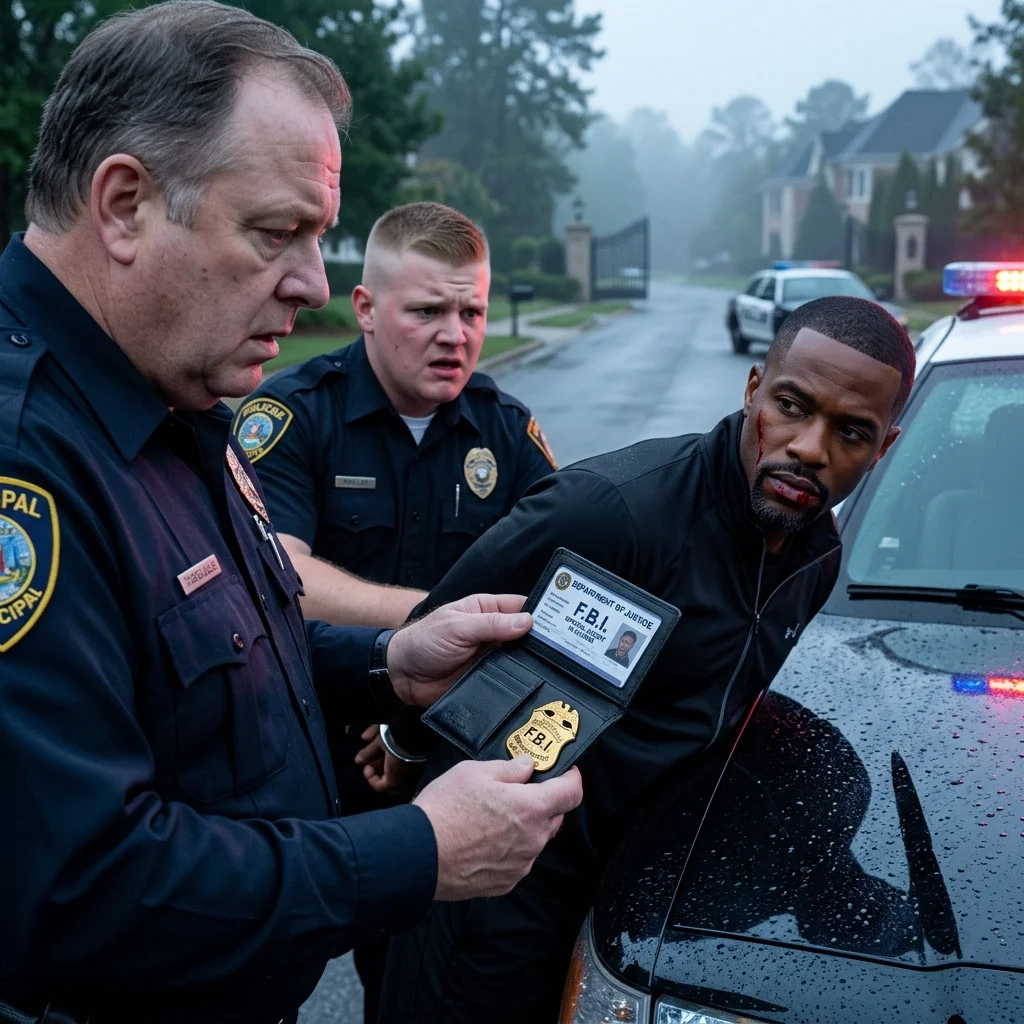
“You think you’re clever?” the young officer whispered fiercely in his ear. “You think because you talk quiet and use big words, we don’t know what you are?”
“I know exactly what you think I am,” Marcus replied quietly, watching the red and blue strobe lights dance across the wet asphalt.
Suddenly, the heavy oak front door of 414 Elm swung wide open.
A woman in a floor-length silk pink bathrobe stepped out onto her sprawling flagstone porch, clutching a steaming bone-china mug of coffee. She was in her late fifties, with tight blonde curls, immaculate makeup even at dawn, and a look of absolute, vindicated triumph on her face.
She marched briskly down her immaculate front walkway, her slippers whispering against the wet stone, stopping just at the edge of the curb.
“Thank goodness you boys got here so fast!” she called out, her voice shrill and carrying in the stillness of the morning. “I told Arthur last night—the second the Harrisons pulled their moving van out, the neighborhood was going to be a target! He’s been circling this block for twenty minutes, Sergeant! Peering right through the gates at 412!”
The sergeant immediately straightened his posture, playing to his audience like a stage actor stepping into a spotlight. He kept one heavy hand planted firmly between Marcus’s shoulder blades. “Morning, Mrs. Caldwell. Don’t you worry, ma’am. We’ve got him secured. He was just trying to tell us he’s the new owner.”
Evelyn Caldwell let out a sharp, condescending laugh, taking a slow sip of her coffee. “The new owner? Please. I’m the president of the Oakridge Homeowners Association, Sergeant. I personally reviewed the architectural transfer packet. The buyer is a senior federal executive from Washington. This man is clearly casing an empty estate.”
Marcus lifted his chin slightly from the hood, ignoring the dull throb in his split lip. “Good morning, Mrs. Caldwell,” he said, his voice cutting cleanly through the morning air. “You reviewed the transfer packet, did you? Then you must have skipped page four. The part with the buyer’s name.”
Evelyn’s smile tightened, a flush of irritation rising above the collar of her silk robe. “Sergeant, why is he speaking to me? Shouldn’t he be in the back of the car?”
“You’re right, ma’am,” the sergeant said, his jaw tightening. He looked across the hood at his partner. “Miller, run his pockets. Find some ID and see if he’s carrying a blade or a lockpick. Then put him in the cage.”
Officer Miller stepped around to Marcus’s front side, his heavy fingers grabbing the zipper of the small pouch sewn into the reflective running vest. He yanked it open, reached inside, and pulled out the slim, black leather bifold.
“Nothing else in here, Sarge. Just a wallet,” Miller muttered.
“Open it up,” the sergeant ordered, his tone bored and triumphant. “Let’s see how many warrants Mr. DC Hotshot has out in Richmond.”
Officer Miller flipped the leather folio open.
He didn’t find a state driver’s license. He didn’t find a crumpled gym membership card.
Pinned to the left interior panel, catching the strobing blue glare of the light bar, was a heavy, gleaming gold federal shield. Opposite it, sealed in tamper-proof holographic laminate beneath the blue-and-gold seal of the United States Department of Justice, was a crisp photograph of Marcus Sterling in a charcoal suit.
Below the photograph, printed in stark, unmistakable black lettering, were two lines:
MARCUS STERLINGDEPUTY ASSISTANT ATTORNEY GENERAL — CIVIL RIGHTS DIVISION
The smile vanished from Officer Miller’s face as if someone had thrown a bucket of ice water over his head.
His fingers went rigid around the leather. The color drained from his cheeks, leaving his skin the pale, waxy shade of tallow. He stared at the gold shield, then looked down at the blood pooling on the blue paint of the cruiser, and then at the steel handcuffs biting purple into Marcus’s wrists.
“Miller?” the sergeant barked, annoyed by the sudden silence. “What’s the hold-up? Read the name.”
Miller’s mouth opened, but no sound came out. Slowly, as if handling a live grenade, he extended the open folio across the roof of the cruiser.
The sergeant snatched it impatiently, glancing down with a practiced sneer.
The sneer died in his throat.
The heavy hand pressing between Marcus’s shoulder blades went abruptly slack, then lifted away entirely. The sergeant’s eyes darted from the holographic seal to the title, then back to the photograph, then down to Marcus’s calm, bleeding face.
“What is this?” the sergeant whispered, his voice suddenly thin and hollow. “Where’d you get this?”
“The President of the United States appointed me to the position, Sergeant,” Marcus said, slowly pushing himself upright off the hood now that the weight was gone from his back. Neither officer moved to stop him. “And the United States Senate confirmed it. Though I’d be happy to let you verify it with the FBI field office in Alexandria. In fact, I’d insist on it.”
On the curb, Evelyn Caldwell frowned, sensing the sudden, violent drop in temperature. “Sergeant Kowalski? What’s going on? Is it a fake? Because impersonating a federal officer is a felony, isn’t it? Arthur will want to know—”
“Mrs. Caldwell, please step back onto your porch,” Kowalski snapped, his voice tight with a rising, frantic panic. He didn’t look at her. He was staring at the leather folio in his trembling hand as if it might burst into flames.
He took two stumbling steps backward, away from the cruiser, and reached for his hip—not for his department radio, which was clipped to his shoulder, but for his personal cell phone.
Marcus watched him with cold, clinical precision.
“Officer Miller,” Marcus said softly, turning his head slightly toward the frozen rookie standing beside him.
Miller flinched as if struck. “S-sir?”





