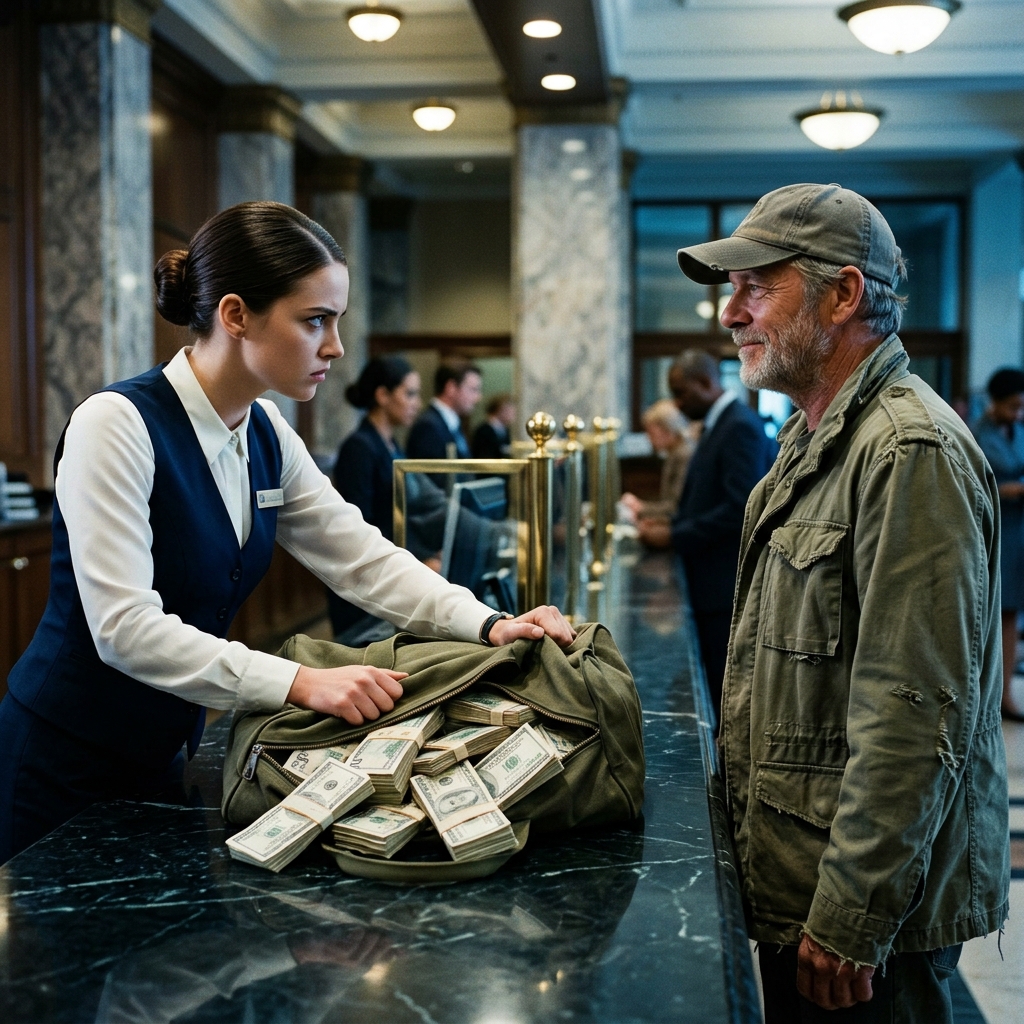
The brass-trimmed regulator clock above the vault entrance had been losing two minutes every forty-eight hours since the September heatwave, but on a Friday at twenty past four, its ticking still held the weight of a metronome in an interrogation cell.
Sarah Vance didn’t glance at the dial; she didn’t need to. Her body had its own internal register of the workday’s decay: the dull, thrumming knot behind her right clavicle where the strap of her thrifted shoulder bag dug in every morning, the dry sting of ozone from the thermal receipt printers, and the faint, unmistakable smell of damp overcoats drying against the limestone radiators of the banking hall.
Counter Three was hers. It sat squarely in the draft that swept through the revolving doors on Fourth and Montgomery, catching every blast of wet Pacific fog that rolled off the bay and into the financial district. In the hierarchy of the Pacific Merchants Bank flagship branch, Counter Three was a proving ground or a penalty box, depending on who was whispering in the breakroom behind the cashier cages. To Sarah, it was simply thirty-six linear inches of Italian travertine that she kept scoured with lemon oil and bleach until it gleamed like a butcher’s block.
Beside her, at Counter Two, young Miller was fumbling through an overseas draft, his collar too tight, his Adam’s apple bobbing with the nervous perspiration of a twenty-two-year-old who had never held twenty thousand dollars in five-hundred-franc notes before.
“Check the watermark against the sodium lamp, Miller,” Sarah murmured without moving her head, her fingers rattling over the ten-key with the rhythm of a machine gun. “Not the window light. It’s raining out; the gray makes the silk threads look like smudges.”
“Right. Thanks, Sarah,” the boy whispered, his knuckles red from cold.
Sarah entered the balance on the commercial ledger, slammed the carriage return on her keyboard, and reached for her glass water tumbler. Her reflection looked back at her from the three-inch-thick acrylic bandit barrier: twenty-seven years old, her dark hair pulled back into a knot so severe it seemed to pull the skin of her high cheekbones taut. Her navy blazer was four seasons out of date, its wool worn slick at the cuffs from friction against the teller ledger, but her white poplin shirt was starched until it cracked. She wore no rings, no watch other than a plain steel Timex with an elastic band, and no expression that could be mistaken for an invitation.
Six months. That was the timeline she had given herself. Six months of perfect reconciliation sheets, six months of zero-variance drawers, six months without an administrative flag from the compliance desk in Seattle. Her mother’s medical arrears from the lingering hospice stay had finally been consolidated into a single five-figure lien against the small bungalow in Sunset, and the junior compliance examiner position on the seventh floor came with a forty-percent salary bump, dental coverage, and a desk that didn’t smell of wet pennies.
All she had to do was follow the manual. The Bank Secrecy Act manual—a two-inch ring binder bound in greasy red leather that sat beneath her left elbow like a family Bible—was not an abstract legal text to Sarah. It was a tactical doctrine. It was the only thing standing between an eight-dollar-an-hour line teller and the federal penitentiary in Dublin if some cartel courier or crooked contractor managed to wash thirty thousand dollars through her till.
The revolving door at the main portal ground through its heavy brass housing with a slow, hydraulic hiss.
Sarah watched the shadow cut across the marble floor before she saw the man. It was long, distorted by the low, wet afternoon light that angled through the street-level transoms, stretching past the velvet stanchions toward her wicket.
The man who followed it did not belong in the premium commercial lobby of Pacific Merchants Bank on a Friday afternoon.
He was in his late sixties, broad across the shoulders with the stooped, forward-leaning gait of an old lineman or a longshoreman whose knees had given up thirty years ago. A frayed khaki field jacket—the kind sold out of surplus bins on lower Market Street—hung from his frame, its elbows patched with coarse olive duck canvas that had been hand-stitched with black nylon line. His denim jeans were stiff with dry road dust around the cuffs, tucked into scuffed eight-inch Red Wing boots that had lost their oil and their laces’ aglets years ago. Beneath a rain-spotted baseball cap bearing the faded yellow emblem of an obsolete tractor company, a thick, silver-gray beard bristled against a neck weathered into deep, leathery folds by forty seasons of coastal salt and sun.
He was carrying an olive-drab canvas duffel bag.
It was an old sea bag, the heavy military-issue canvas grayed at the seams, its webbed handles stained with dark rings of engine grease or old grease from a flatbed winch. The bag didn’t swing; it hung from his right hand with the dead, swinging inertia of an anchor. Every three steps, the brass grommets at its mouth clicked against the metal teeth of an oversized industrial zipper.
The branch fell into that sudden, brittle silence that always precedes a fire alarm or a street brawl.
At the loan platform to the left, two junior vice presidents in tailored charcoal flannel stopped their murmur over a line-of-credit renewal. The private banking assistant near the fountain pen station set down her blotter, her gaze darting toward the armed guard stationed by the mahogany pillars.
Officer Kowalski, who was sixty-one and had two bad hips from his years on the municipal transit beat, shifted his weight off his heels, his leather holster creaking against his hip as his hand hovered near the retention strap of his service revolver.





