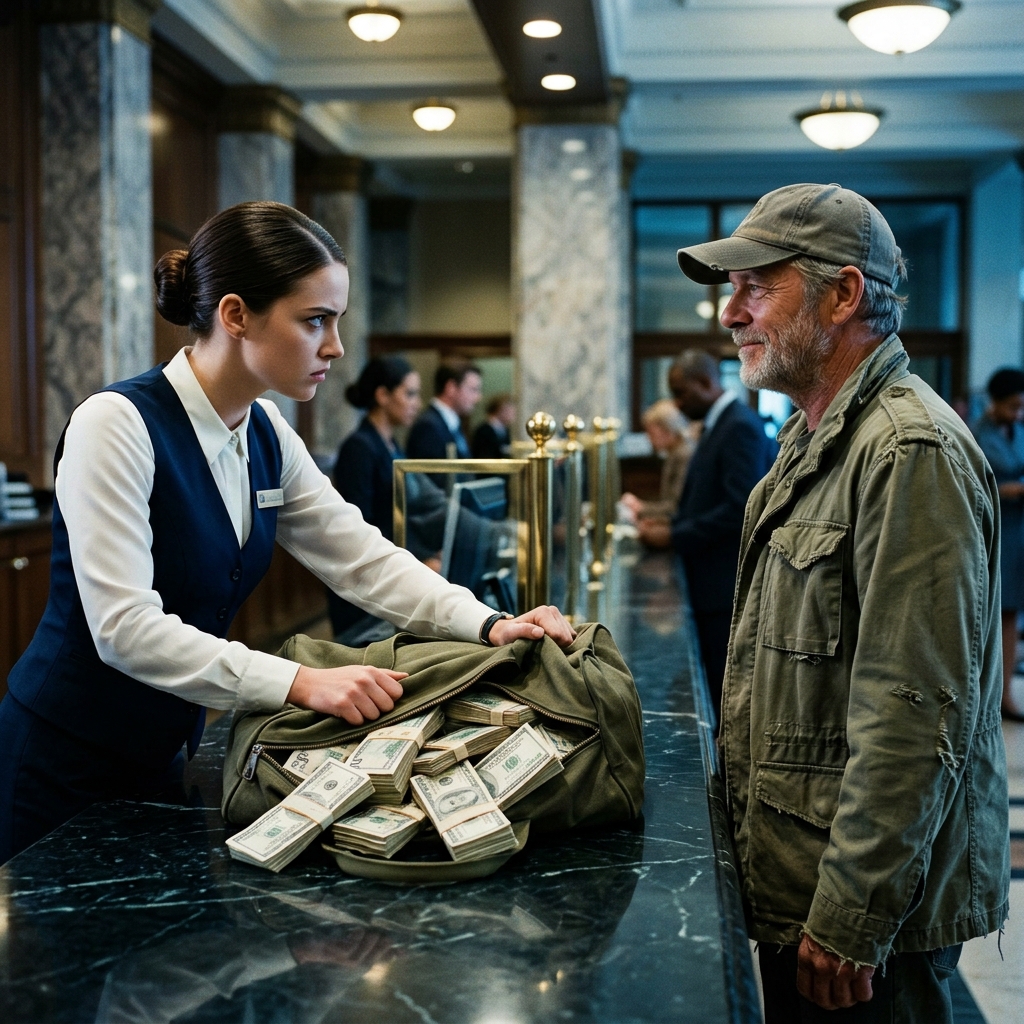
She felt the mechanical click beneath her skin. Somewhere three floors below, in the central monitoring station, a red LED flared to life on the dispatch board: STATION 03 — DURESS — TILL LEVEL ASSISTANCE REQUIRED.
“Hands on the counter, sir!” she shouted, her voice cutting through the vault like a whip. “Keep your hands where I can see them!”
The man stopped. His hand stayed inside his breast pocket. He looked at her, his brow furrowing not with terror, but with a profound, bewildered sadness that caught her completely off guard.
“Now you’ve gone and done it,” he murmured. “You’ve made a chore out of a simple chore.”
The heavy mahogany door of the executive suite—the one with the frosted glass pane that read DONALD R. VANCE, SENIOR VICE PRESIDENT & MANAGING DIRECTOR—didn’t just open; it flew back against the wall with a hollow bang that made the crystal sconces on the wood paneling chatter.
Donald Vance didn’t walk; he stumbled out onto the lobby carpet.
At fifty-four, Donald Vance was a man constructed entirely of high-grade wool, hair tonic, and institutional terror. His silk tie was half-loosened, his graying temples glistening with the slick perspiration of a man who had spent forty-five minutes on a speakerphone with the chairman’s office in Charlotte explaining why his branch’s quarterly deposit growth had flatlined.
He took three frantic strides toward the cages, his wingtips skidding on the wet travertine where the umbrellas had dripped, nearly pitching him headlong into the queue velvet.
“What is the signal?” Vance gasped, his voice cracking like a schoolboy’s. “Sarah! What is the—”
He stopped dead in his tracks.
His eyes, wide and bloodshot behind gold-rimmed bifocals, dropped from the alarm light above the wicket, down to the canvas sea bag, across the scuffed Red Wing boots, and finally arrived at the faded tractor cap.
The breath left Donald Vance’s body in a long, whistling hiss that sounded like a punctured tire.
Every drop of color abandoned his jowls, leaving them the shade of cold mutton fat. His hands, which had been raised to his collar, dropped to his sides as if his tendons had been clipped with garden shears.
“Mr… Mr. Sterling,” he whispered.
The word was so small, so thin, that it barely carried across the marble.
Sarah froze. Her hand remained beneath the counter, her finger still mashed against the rubber button that had already summoned two patrol cars from the Central Station.
“Mr. Vance,” she said, her voice tight, strained to the breaking point. “This individual has brought fifty pounds of unverified currency into the branch. He has no identification, he refuses to provide commercial documentation, and he is demanding an immediate credit to an unverified—”
“Shut up, Sarah,” Vance said.
He didn’t yell. The words were delivered in a strangled, desperate rasp that was infinitely worse than a scream.
The bank manager stumbled forward, his knees trembling so violently that the cuffs of his trousers fluttered. He didn’t look at Sarah. He didn’t look at Miller. He approached Counter Three with his head bowed, his hands coming together in front of his belt in a gesture that was so nakedly devotional it made Sarah’s stomach lurch.
“Arthur,” Vance breathed, his voice trembling like a dry leaf. “Arthur, please. For the love of God, why didn’t you ring the private line from the gate? I would have sent the security detail down to the truck. I would have brought the trolley out myself. You shouldn’t be carrying this weight through the street in this weather.”
The old man in the frayed jacket looked at the bank manager. He pulled his hand out of his pocket—not with a weapon, but with an old silver pocketknife whose bone handle was held together with copper wire. He began paring an apple he had produced from the other pocket, slicing a wedge of yellow fruit and offering it to the manager on the flat of the carbon-steel blade.
“Truck runs fine, Donald,” Arthur Sterling said. “Heater’s out on the driver’s side, but the defrost works if you keep your foot on the floor. Didn’t want to bother you. You were in with the regional people, weren’t you?”
“They can wait,” Vance said, his face slick with sweat as he grabbed the edge of the marble counter for support. “They can wait until the second coming, Arthur. You know that.”
The manager turned his head toward Sarah.
His eyes were no longer those of an executive; they were the eyes of a cornered dog looking at the person who had left the gate open.
“Release the gate,” Vance hissed through his teeth. “Release the wicket gate right now, Sarah.”
“Mr. Vance,” Sarah said, her voice shaking with an indignation that was rapidly curdling into cold, sickening dread. “The alarm has been tripped. The municipal squad—”
“I said open the gate!” Vance roared, slamming his open palm onto the brass ledger plate with enough force to sting his flesh. “And cancel the auxiliary alert! Kowalski, get on the horn to the dispatcher! Tell them it was a maintenance test on the teller line! Tell them the contractor tripped the relay! Move your fat legs, man!”
Kowalski blinked, looked at the old man, looked at the manager, and then turned on his heel, half-jogging toward the security console with his hand clutching his duty belt.
Sarah stood motionless. The world had tilted twenty degrees to the port side, and every landmark she had used to navigate her life for four years had disappeared beneath the gray water.
She reached for the electric release button. The heavy steel-and-oak gate beside Counter One clicked open with a dull, pneumatic groan.





