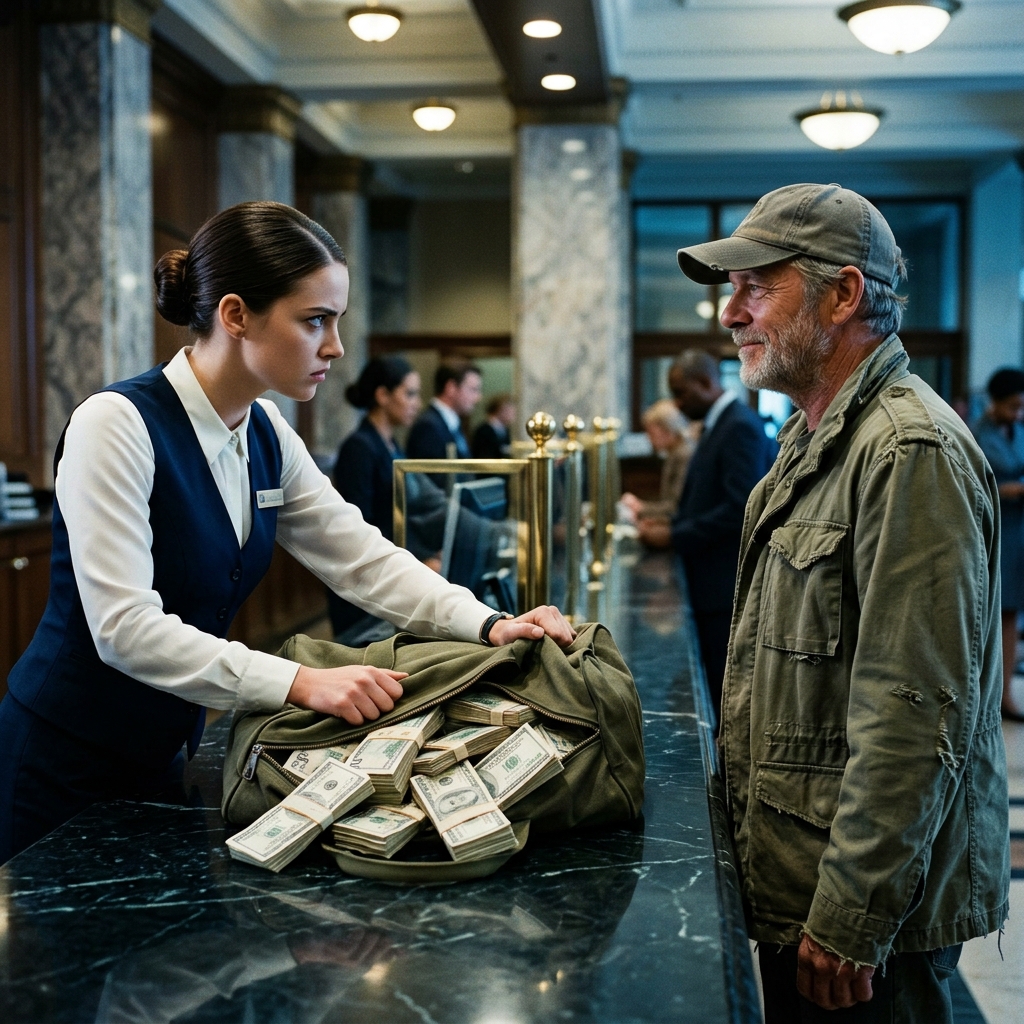
The man didn’t look at Kowalski. He didn’t look at the vaulted ceiling with its gilded acanthus leaves, nor at the oil portraits of nineteenth-century clipper captains that lined the north gallery. His pale, washed-out blue eyes—surrounded by crow’s feet so deep they looked like scars—fixed directly on Counter Three.
He walked past Miller’s empty lane, bypassed the express deposit chute, and came to a halt two feet from Sarah’s barrier.
The smell arrived before he spoke: wet canvas, cold garden loam, pine sawdust, and the bitter, sharp tang of stale copper.
With a grunt that had more iron in it than fatigue, the man hoisted the sea bag with both arms and dropped it onto the travertine counter.
The impact was loud. It wasn’t the soft rustle of money or the hollow thump of paper; it was a bone-jarring clack that vibrated through the marble, rattled the brass paperclip tray beside Sarah’s left hand, and set the teller call-bell ringing once with a high, clear note that died instantly in the vaulted ceiling.
“Afternoon, miss,” the man said.
His voice was like two flat stones being scraped together over gravel. Not hostile, but heavy, with the unhurried cadence of someone who hadn’t spoken to another human being since sunrise.
Sarah didn’t retreat. She didn’t drop her hands from the keyboard. She let her gaze travel from the frayed brim of his tractor cap, down the bridge of a nose that had clearly been broken and poorly reset in his youth, across the grease stains on his field jacket, and finally down to the canvas bag resting on her pristine stone.
“Sir,” she said, her voice dropping into the flat, icy register prescribed by Section 4 of the frontline safety manual. “The counter is for transaction documents and check wallets. If you have an oversized parcel, it must be cleared through security at the south desk.”
The man didn’t move the bag. He rested his right hand on it—his fingers were thick as sausages, the nails flat and rimmed with indelible black earth, the skin across his knuckles split by the cold.
“Don’t need the south desk,” he said. He reached down with his left hand, caught the tab of the zipper, and dragged it back.
The brass teeth parted with a dry, ripping shriek.
Sarah’s breath caught in the notch of her throat.
The bag wasn’t packed with laundry or tools. It was filled to the brass grommets with paper currency.
Not neat, bank-banded bricks from the Federal Reserve vault. These were loose, thick bundles of fifties and hundreds, crammed into the canvas like autumn leaves into a grain sack. They were bound with thick orange rubber bands that had begun to perish and split, held together with butcher’s twine, or simply stuffed into brown grocery bags whose tops had been torn away to reveal the green engraving. Some of the bills were crisp and new, smelling of ink, but most were limp, damp, stained with dark thumbprints, and frayed at the margins.
A single stack of hundreds, bound with a green rubber band from a bunch of market celery, had slipped out from the zipper’s mouth, resting against the lip of Sarah’s deposit tray. The top note was an old Series 1996 portrait of Benjamin Franklin, his oval face obscured by a greasy smear of black dirt.
Beside her, Miller made a small, strangled sound in the back of his throat.
“Jesus,” Miller whispered, his voice cracking.
“Miller, step back from the partition,” Sarah said without taking her eyes off the man’s hands.
Her left hand was already drifting beneath the walnut ledge of her station. Her middle finger found the small, square rubber stud of the silent alarm—the duress toggle that connected directly to the central precinct switchboard on Grant Avenue.
The protocols were flashing through her mind like neon signs in a blackout: Structuring. Currency Transaction Report avoidance. Suspicious Activity Report threshold exceedance. Unverified bulk transport.
The volume alone was forty or fifty pounds. At sixty dollars to the ounce for mixed denominations, that was half a million dollars minimum. Cash. In an unarmored canvas bag, carried through the front door of a commercial bank by a man whose boots looked like they had just been pulled out of an irrigation ditch.
“I need to put this into an account,” the man said, as casually as if he were handing her a coupon for ten cents off a loaf of sourdough.
Sarah’s spine felt like it had been replaced with an iron rod. She kept her finger half an inch from the duress button, the tip of her nail touching the cold steel mounting plate.
“Sir,” she said, each word falling like an ice cube onto the stone. “Do you have an account with Pacific Merchants?”
The man tilted his head back slightly, looking through the lower half of his bifocals—inexpensive drugstore glasses with wire frames that were missing one plastic nose pad, replaced by a wrap of adhesive tape.
“I do,” he said. “Main checking. Or the reserve. Doesn’t matter which one, as long as it gets out of my truck before five o’clock. Parked in the red zone by the hydrant, and the meter maid on Fourth has got an itch for a chalk stick.”
“I see,” Sarah said. She reached for a standard withdrawal-deposit slip with her right hand, holding it with two fingers like a contaminated swab. “And what is the name on the account?”
“Sterling,” the man said. “Arthur Sterling.”
The name registered in her mind, but it didn’t pierce the armor of her suspicion; it bounced off the grease stains on his sleeves. Arthur Sterling was an old name in California—there were three Sterling foundations in the phone book, an agricultural cooperative up in the valley, and a line of packaged nuts in the grocery stores. Anyone with a library card and a newspaper could pick a dead name off a civic monument.
“Do you have government-issued identification, Mr. Sterling?”





