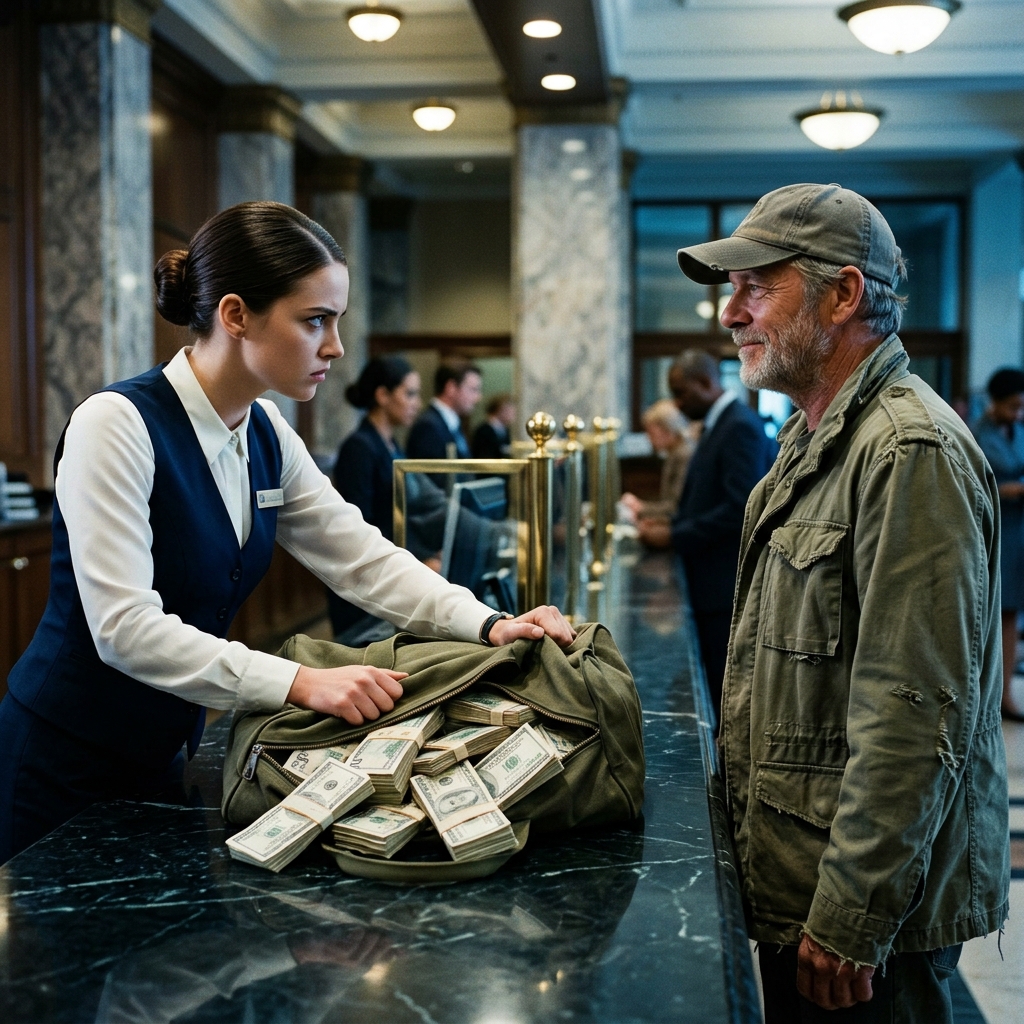
The man began patting his pockets. He tapped his left chest pocket—nothing but a pack of spearmint gum and a wooden carpenter’s pencil. He checked his hip pockets. From the right one, he pulled a crumpled blue bandana, a brass key to an old padlock, and an empty plastic seed packet.
“Must’ve left the wallet on the dash of the Ford,” he said, not a trace of apology in his tone. “Drove down from the delta this morning. Left the farm at three. Had to dodge the washed-out culvert on Route 12.”
Sarah let out a slow, controlled breath through her nostrils. Her fingers tightened on the desk ledger.
“Sir, under federal law—specifically Title 31 of the United States Code and the Bank Secrecy Act—any cash transaction exceeding ten thousand dollars requires verified identification and the completion of Form 112, the Currency Transaction Report. Furthermore, for a deposit of this magnitude, the branch is required to verify the provenance of the funds.”
The man stopped looking for his wallet. He leaned both forearms on the canvas bag, his shoulders dropping two inches as he looked at her through the security glass. His eyes were neither angry nor frightened; they were merely old, gray, and exceedingly tired.
“The provenance,” he repeated slowly. “You mean where did it come from?”
“I mean where did it come from,” Sarah said, her tone sharpening. “We do not accept unverified bulk cash from the street without documentation. Bills of sale, tax returns, manifests of commercial receipt. If you are operating a cash-intensive business, you are required to have an armored carrier contract.”
“Didn’t have time for an armored car,” he said. “The banks in Stockton were closed on account of the storm yesterday, and I wasn’t going to leave half a million dollars sitting in an apple crate in the barn with three hired hands who haven’t seen their families since August. It’s retail money, miss. People come out to the market, they buy the melons, they buy the corn, they buy the dry-cured bacon, they pay with greenbacks. They don’t use the plastic.”
“A farmers’ market,” Sarah said. Her voice dropped half an octave into sheer incredulity. “You expect me to believe you generated six hundred thousand dollars in small-denomination currency selling vegetables?”
The man stared at her. A faint, dry twitch appeared at the corner of his mustache.
“Pumpkins, mostly,” he said. “And late-crop walnuts. Walnuts bring a fair price when you shell them yourself.”
At Counter Two, Miller let out a nervous, squeaking chuckle, then choked it off when Sarah cut him with a sideways glance that could have split firewood.
“Mr. Sterling,” Sarah said, leaning forward until her nose was two inches from the acrylic speaking grille. “I have worked at this institution for four years. I have processed transactions for produce distributors from the produce market down on the Embarcadero. A high-volume distributor clears sixty thousand a week in cash during peak harvest, and they arrive in a Brinks van with three bonded guards and a four-part bill of lading stamped by the Department of Agriculture.”
She pointed a rigid forefinger at the canvas duffel.
“This is not a produce receipt. This is an uncounted, unstructured pile of currency that has been transported across county lines in the footwell of a farm truck. You have no identification. You have no corporate documentation. And you are asking me to credit an account without so much as a driver’s license.”
The man didn’t flinch. He looked down at the bag, then back at her. His gaze was steady, heavy with the weight of an ox that had been hit with a whip and had simply decided not to notice.
“You’re thorough, young lady,” he said. “The bank didn’t waste its money on your training.”
“Do not patronize me, sir,” Sarah said, the color rising in her neck, hot and prickly under her starched collar. “I am not being thorough. I am complying with federal statute. If I take this bag into my till without a SAR narrative and an identity verification, I am personally liable for an administrative penalty of up to two hundred and fifty thousand dollars and five years in federal custody. Now, step away from the counter.”
Her finger moved from the metal plate. It settled squarely over the black rubber button of the silent alarm.
“Call the manager,” the man said.
“Step away, sir.”
“I told you,” he repeated, his voice dropping an octave, losing its conversational gravel and taking on the flat, immutable authority of an iron hinge swinging shut. “Call your manager. Call Donald. He’s in that corner office with the walnut door and the green leather chairs that cost four thousand dollars apiece. Tell him Arthur is at Counter Three with the weekend receipts. He’ll sign whatever paper you need to keep your federal people happy.”
Sarah’s lip curled. “Mr. Vance is currently in a credit review with the regional vice president. He does not handle routine teller transactions, and he certainly does not override Title 31 compliance for unidentified walk-in clients.”
“He handles mine,” the man said.
“Sir, if you do not remove your hands from that bag and step back toward the center of the lobby, I will signal Officer Kowalski to escort you to the vestibule until the municipal police arrive to secure this parcel.”
Across the lobby, Kowalski had seen the tension. His heavy hand had already unsnapped the thumb-break on his holster. He was moving across the marble with his rolling, arthritic hitch, his eyes fixed on the man’s field jacket.
“Sarah?” Miller whispered, his face chalk-white. “Sarah, look at his boot. There’s something in his sock.”
Sarah didn’t look. She didn’t have to. The man was reaching into his khaki jacket again, his hand disappearing beneath the heavy olive canvas.
Sarah’s knuckle went white against the wood. Her finger drove down onto the rubber button.





