Her career was gone. The junior examiner post in Seattle, the medical lien on her mother’s house, the starched shirts, the four years of perfect till balances—all of it had been incinerated by thirty seconds of rigid, self-righteous adherence to a red-bound binder that had been written for other people.
Her throat moved, but her voice was nothing more than a dry croak. “I… I did not recognize him, sir.”
“Of course you didn’t recognize him!” Vance shouted, throwing his hands toward the ceiling. “Because you don’t look at people, Sarah! You look at rules! You look at the world through a three-inch sheet of plastic and think that because someone isn’t wearing a two-thousand-dollar suit, they must be a criminal! You have the interpersonal instincts of an adding machine!”
“Donald.”
The word was quiet, but it had the weight of an eight-pound sledgehammer.
Arthur Sterling had not moved from the fender. He had taken a short piece of dried cedar kindling from the wood basket and was using his pocketknife to shave thin, curly ribbons of white wood into the hearth.
The manager stopped mid-breath, his mouth hanging half-open, his face freezing in mid-tirade.
“Arthur,” Vance stammered, his posture collapsing back into that grotesque, supplicating curve. “I’m sorry. I’m handling this. She will be terminated before the close of business. Her personnel file will reflect gross negligence—”
“Sit down, Donald,” Sterling said.
He didn’t look up from his whittling. The knife moved with steady, geometric precision, the shavings falling into the red embers with small, fragrant puffs of gray smoke.
Vance blinked. “Arthur, the bank’s policy regarding client dignity—”
“I said sit down.”
The manager didn’t argue a third time. He pulled back his high-backed leather swivel chair and dropped into it, his fingers nervously smoothing the rumpled lapels of his suit.
Arthur Sterling closed the knife. He set the wood down, rested his forearms on his knees, and looked up at Sarah.
Under the warm light of the hearth fire, his face didn’t look like a portrait on a boardroom wall. It looked like an old hillside that had been cleared of timber fifty years ago and left to the brambles and the weather. His eyes were small, clear, and pale as sea glass, surrounded by skin that was lined with grease and the white scars of wire cuts.
“Come here, miss,” he said.
Sarah’s feet moved because her brain had ceased to offer alternatives. She walked to the edge of the Persian rug, stopping two feet from the duffel bag, her head bowed, her hands still pinned behind her back.
“Look at me,” the old man said.
She lifted her chin. It took every ounce of discipline she possessed not to drop her gaze to his boots.
“Why didn’t you take the cash?” he asked.
The question wasn’t what she expected. There was no mockery in it, no corporate trap, no administrative bait. It was the same tone her grandfather had used when asking why the steering box on the tractor had sheared its pin.
Sarah swallowed. The knot in her throat felt like dry bread.
“Because the regulations state that unverified currency over ten thousand dollars must have documented origin,” she said, her voice thin but clear. “And because if the currency is illicit, the teller who facilitates the entry into the financial system is legally an accessory to the placement phase of the transaction.”
“You thought I was a crook,” he said.
“Yes, sir.”
“A drug man? A smuggler?”
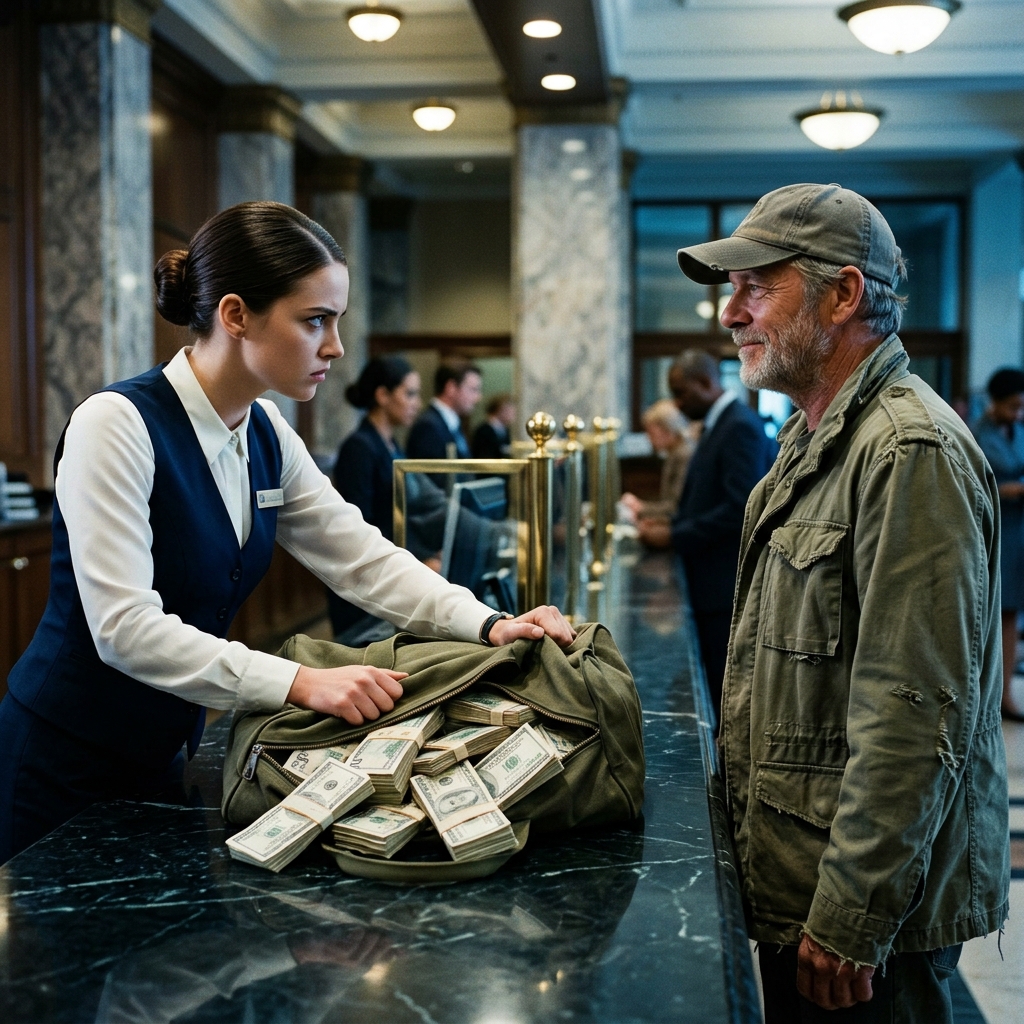
“I didn’t know, sir,” she said, her knuckles turning white behind her back. “I knew you were carrying sixty pounds of small bills in an unsealed bag, you had no identification, and you told me you made half a million dollars selling pumpkins.”
A sudden, sharp bark of laughter exploded from the fireplace.
Arthur Sterling slapped his knee with his calloused palm, the sound echoing through the paneled room like a pistol shot. He threw his head back, his silver beard bristling, his shoulders shaking with a deep, rumbling belly laugh that showed two gold fillings in the back of his mouth.
Donald Vance stared at him, his mouth open, looking between the old man and the teller as if they had both begun speaking Aramaic.
“Pumpkins!” Sterling wheezed, wiping a tear from the corner of his eye with the sleeve of his khaki jacket. “By God, Donald, she’s got you there. Half a million in pumpkins would take thirty acres of sugar-pies and four hundred Mexican pickers working through the frost with headlamps.”
He stopped laughing, though the crow’s feet around his eyes remained crinkled with amusement. He reached down into the mouth of the canvas bag, caught a handful of the rubber-banded fifties, and let them spill through his fingers like dry grain.
“It’s not produce money, miss,” he said quietly. “Not directly.”
Sarah didn’t answer. She couldn’t.
“Every year,” Sterling said, looking into the fire, “the second weekend of November, we hold the harvest market up at the delta ranch. We open the gates on Friday morning. We sell the fruit, we sell the cider, we sell the smoked hams from the heritage Berkshire hogs. People come up from the city, they come down from Sacramento, they bring their children, they buy the pies, they pay five dollars to ride the hay wagon through the river pasture.”
He tapped the canvas bag with his Red Wing boot.
“Every dime of that gate money—every five-dollar bill, every fifty, every crumpled one that some kid pulled out of his piggy bank to buy a jar of clover honey—goes into the Samuel Sterling Memorial Trust. It funds the trade school scholarships for the sons and daughters of the farm laborers in San Joaquin and Stanislaus counties. Pays their tuition, buys their tool kits, buys their books, keeps the diesel in their trucks while they learn how to weld, how to wire a three-phase motor, how to turn a piece of cold steel on an engine lathe.”





