He looked back up at her, his pale blue eyes pinning her to the floorboards.
“They pay in cash because farm workers don’t carry American Express cards, miss. And the people who come to buy from them bring the money they took out of the grocery envelope behind the clock on the mantelpiece. By Sunday night, there’s seven hundred thousand dollars sitting on my kitchen table in tomato lugs and lard tins. My wife and my daughters spend three days with the rubber bands and the butcher’s twine, bundling it up so the bank doesn’t have to hire three extra girls to count it.”
He paused. The log in the hearth snapped, throwing a shower of orange sparks against the wire screen.
“I’ve brought that money through that front door every November for thirty-four years,” Sterling said. “Used to carry it in an old milk can until the handles rusted off back in ninety-eight. Old Thomas Vance—Donald’s father—used to meet me at the curb with a bottle of Scotch and an umbrella. He knew where every nickel came from because he’d been up to the ranch and seen the kids working the lathe.”
He looked at Donald Vance. The manager shrank back into his leather chair, his face burning with a dull, shameful red.
“Donald doesn’t come up to the ranch,” Sterling said softly. “Donald has got golf to play in Monterey. Donald likes the numbers on the computer screen because they don’t smell like cow manure and wet alfalfa.”
He turned back to Sarah.
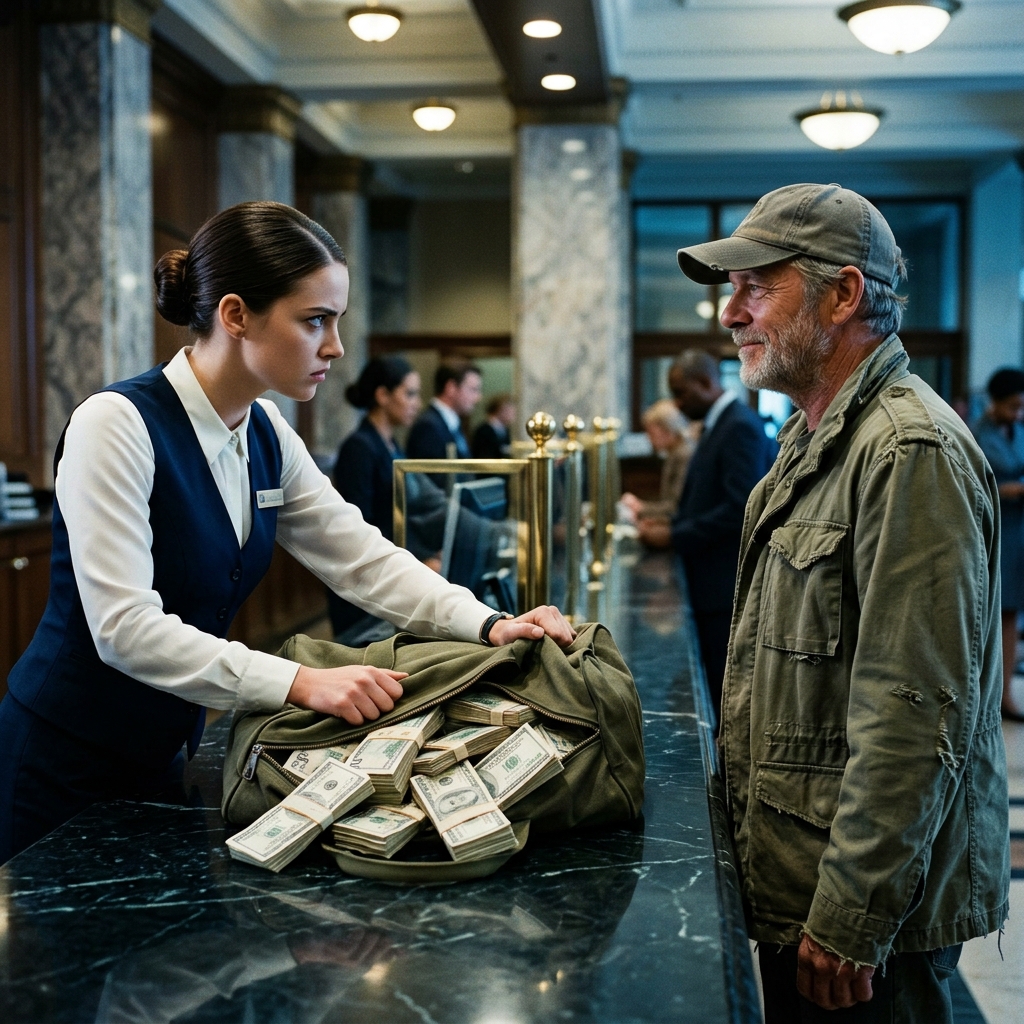
“You didn’t know me from Adam,” Sterling said. “You saw an old tramp with dirt on his boots and an army bag full of dead presidents, and you stood behind your counter and told him to go to hell because that’s what the law told you to do.”
Sarah felt a tear prick the corner of her left eye. She didn’t blink it away; she let it burn there, cold against her lash.
“Yes, sir,” she whispered.
Arthur Sterling stood up from the fender. He was not a tall man, but standing before the fire, his broad shoulders filling the khaki jacket, he seemed to take up all the air between the hearth and the mahogany ceiling.
He walked over to Donald Vance’s desk.
“Donald,” he said.
“Yes, Arthur?” Vance replied, his voice small, terrified.
“You’re going to open the Samuel Sterling Scholarship account ledger right now,” the old man said. “You’re going to take this young lady’s counter stamp, and you’re going to credit this five hundred and forty-two thousand dollars to the principal balance.”
“Immediately, Arthur. Right away.”
“And then,” Sterling said, resting his thick, soil-stained palm on the desk blotter, “you’re going to fill out the federal paperwork. Every line of it. You’re going to write down that the funds were verified by Arthur Sterling, delivered in person, originating from the annual agricultural retail distribution at the Rio Vista holding. You’re going to attach the State Board of Equalization sales tax return from my truck—the one I forgot on the dashboard—which I will bring in after I move the damn Ford away from the fire hydrant.”
He paused, his eyes narrowing as he looked down at the managing director.
“And if I find out,” Sterling added, his voice dropping into that low, terrible rasp of an old master who had seen through every trick in the county, “that this girl receives so much as an administrative reprimand on her personnel record—if her till variance is flagged, if her name is removed from the promotion list for the compliance division, or if she spends another forty-eight hours sitting in the draft at Counter Three—I will move the agricultural operating accounts to the Bank of Stockton before the clearinghouse opens on Monday morning.”
Donald Vance looked like he had been struck across the face with a wet flounder. He opened his mouth, closed it, and then nodded with the frantic, spastic jerk of a marionette whose strings had been yanked.
“Of course, Arthur,” Vance croaked. “Of course. Sarah is… she’s one of our most promising frontline officers. We had already slated her for the regional compliance oversight panel in the spring. Her vigilance today… it was exemplary. Truly exemplary.”
“Don’t lie to me, Donald,” Sterling said, not even looking at him. “It makes your tie look crooked.”
The old man turned back to Sarah.
He reached into his pocket one last time. He didn’t pull out the knife, and he didn’t pull out an apple. He took her right hand—her cold, ink-stained hand with its trimmed nails—and laid something into her palm.
It was a walnut.
It was large, round, its shell deeply grooved and black with the dried hull that hadn’t been washed away. It was heavy, dense, and cold from the autumn rain.
“Hartley variety,” Arthur Sterling said, his rough fingers closing hers over the shell with a firm, dry pressure that felt like seasoned oak. “Plant it in a five-gallon bucket with some good loam and keep the frost off it until March. By the time you’re sitting up on that seventh floor with the lawyers and the computer screens, it’ll be knee-high. Remind you where the green comes from.”
He tapped his tractor cap with two fingers, turned on his Red Wing boots, and walked out of the office.
The heavy walnut door swung open.
The banking hall outside was still silent. The customers were still standing by the stanchions; Kowalski was still leaning against the security desk; young Miller was still clutching his overseas draft like a shield.
Arthur Sterling didn’t look at any of them. He walked through the center of the lobby, his field jacket swaying with his slow, heavy stride, his boots squeaking against the wet marble until he reached the revolving doors.
The brass housing turned with its familiar, hydraulic groan, and then he was gone—swallowed by the gray, sweeping fog of Montgomery Street.
Sarah stood in the center of the managing director’s office.





