50 Missed Calls: Alexander.4 Missed Calls: Moretti Residence (Landline).
For five foolish, human seconds—the kind of seconds you only allow yourself when you are thirty-one years old, shivering under a thin cotton hospital blanket with wet wool socks still stuffed in a plastic belongings bag beside your hip, and married to a man whose name carries the weight of a small sovereign treasury—a warm, dizzying rush of relief flooded my chest.
Someone from the museum called his office, I thought, my thumb trembling slightly as I swiped to unlock the screen. Dr. Alistair or the security desk called the Moretti Holdings switchboard when the ambulance pulled onto Fifth Avenue. He doesn’t know which hospital they brought me to. He’s out of his mind trying to track the ambulance.
I hit the return call icon before the fifty-first ring could go to voicemail and lifted the phone to my ear, an instinctive apology already forming on my tongue for scaring him in the middle of his quarterly board review.
“Alexander, I’m so sorry, my bag was on the floor while they were setting—”
“Where the hell have you been, Claire?”
The voice that came through the receiver did not belong to a frantic husband searching emergency rooms.
Alexander Moretti’s baritone was clipped, controlled, and vibrating with the cold, imperious irritation he usually reserved for subcontractors who missed a steel delivery deadline on his waterfront high-rises. In the background, I couldn’t hear the siren-swept traffic of Midtown Manhattan or the murmur of his forty-second-floor executive suite. I heard the soft, familiar crackle of birch logs burning in the limestone hearth of our Greenwich library, and beneath that, the faint, rhythmic clinking of a silver spoon against porcelain.
“Do you have any idea what time it is?” Alexander continued, not giving me half a breath to speak. “I’ve been calling your cell since two-fifteen. Olivia has been sitting on the sunroom sofa under three cashmere blankets waiting for you for two hours.”
The apology died in the back of my throat. It didn’t dissolve; it calcified into something small, sharp, and chalky.
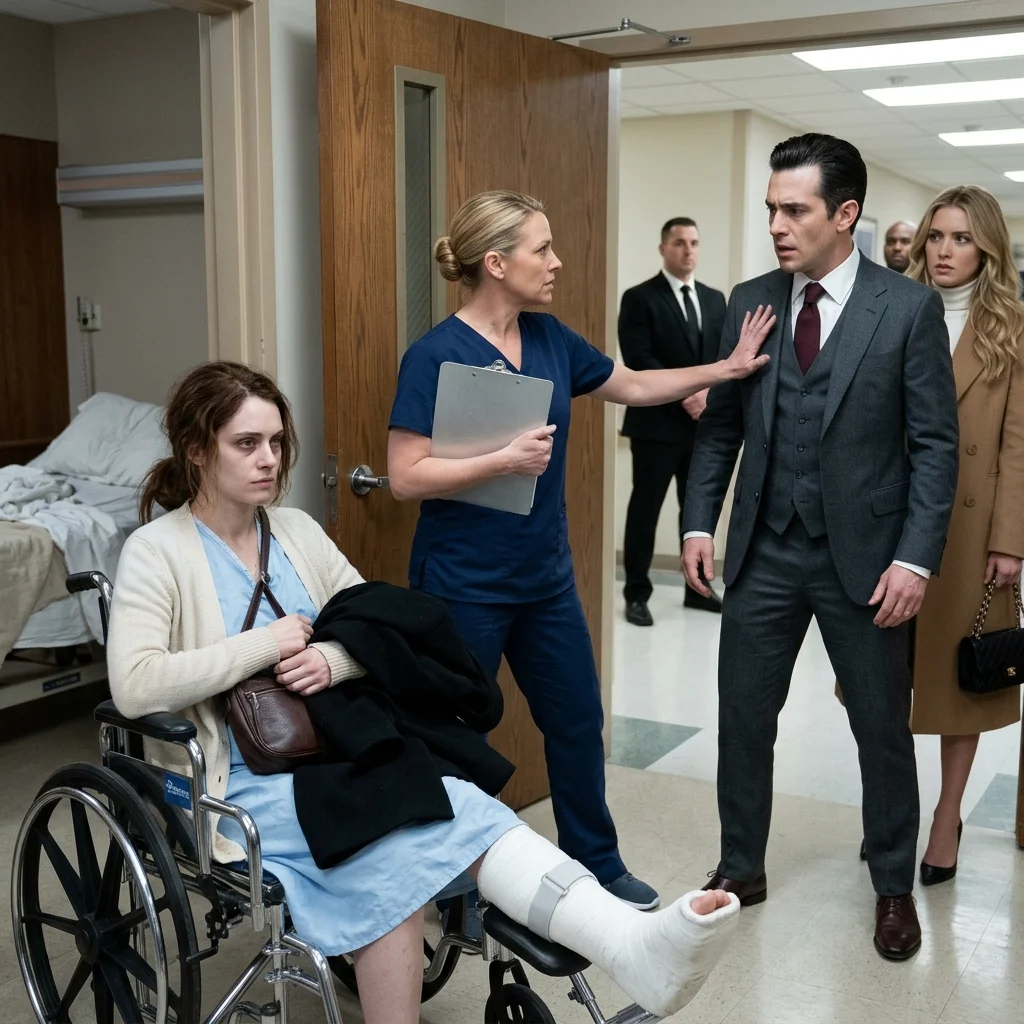
I looked down at my right leg, propped on two foam elevation wedges, encased from the base of my swollen, purple-bruised toes to the hollow of my knee in rigid blue fiberglass.
“Olivia,” I repeated.
Olivia Hayes. Twenty-six years old, with the delicate, translucent complexion of a porcelain figurine and a congenital talent for developing mysterious, low-grade viral collapses precisely forty-eight hours before any weekend Alexander and I were scheduled to leave the state. Her late father had been the head groundskeeper and personal driver for Alexander’s grandfather on the Long Island estate; she and Alexander had grown up sharing pony rides and summer dock space, a piece of sentimental mythology that Alexander wielded like a papal bull whenever I questioned why a grown woman with a trust fund of her own had a biometric thumbprint programmed into the front deadbolt of our marital home.
“Whenever I tell her no, Claire, I feel like I’m slamming the door on old Thomas,” Alexander had told me during our first year of marriage, back when I still thought boundaries were things you could negotiate with words. “She’s like a little sister to me. She’s fragile. You’re strong—you’ve never needed anybody to hold your hand Crossing the street.”
Eight months ago, on a Tuesday morning when I was up on a scaffolding rig at the Metropolitan Annex re-attaching flaking gold leaf to a Renaissance altarpiece with a pair of micro-tweezers, my phone had rung three times through the gallery supervisor’s desk. I had climbed down thirty feet of aluminum ladder in a respirator mask, convinced there had been a fire, only to find Alexander on the line calling me from his Manhattan boardroom—because Olivia was standing in our kitchen in Greenwich, staring at a pot of chicken broth our housekeeper, Mrs. Gable, had simmered, and Olivia had called Alexander at work to ask him to call me at work to find out the exact ratio of Meyer lemon juice to egg yolk I used in my avgolemono soup.
“Mrs. Gable’s version is too heavy, Alec,” I had heard Olivia’s breathy voice sighing over a conference-bridged line that day. “Only Claire’s doesn’t upset my stomach.”
I had stood at the base of that scaffolding with turpentine on my wrists and dictated the measurements to my billionaire husband—three tablespoons of fresh Meyer lemon juice, two pasture-raised yolks tempered with a ladle of hot stock at a hundred and forty degrees so the protein wouldn’t curdle—and listened to Alexander repeat the numbers back to me in his deep, boardroom baritone while writing them down on a sheet of gold-embossed Moretti Holdings stationery.
Now, sitting under the harsh fluorescent lights of Mount Sinai’s orthopedic bay, I pressed my free hand against the cramping muscles of my ribs.
“I’m not at the museum, Alexander,” I said. “I’m at Mount Sinai on Madison. I slipped on black ice on the north loading ramp while we were bringing in the donor crates. I broke my leg.”
There was a pause on the other end of the line.
It lasted three full seconds. In the quiet of the orthopedic bay, I heard the rustle of wool as Alexander shifted his weight. For one final, pathetic beat of my four-year marriage, my brain supplied an image to match the silence: Alexander standing up from the leather wingchair by the fire, his dark eyes widening in shock, his hand reaching into his pocket for the keys to the Maybach.
“You didn’t break your hands, Claire,” Alexander said.
The fluorescent lights overhead seemed to hum at a higher, shriller pitch.
Beside the gurney, Paul the orthopedic tech—who had been wiping down the cast-saw cart three feet away and couldn’t help catching the sharp, tinny projection of Alexander’s voice through the receiver in the quiet room—stopped moving his rag. His eyes flicked up to my face, then politely, awkwardly away.





