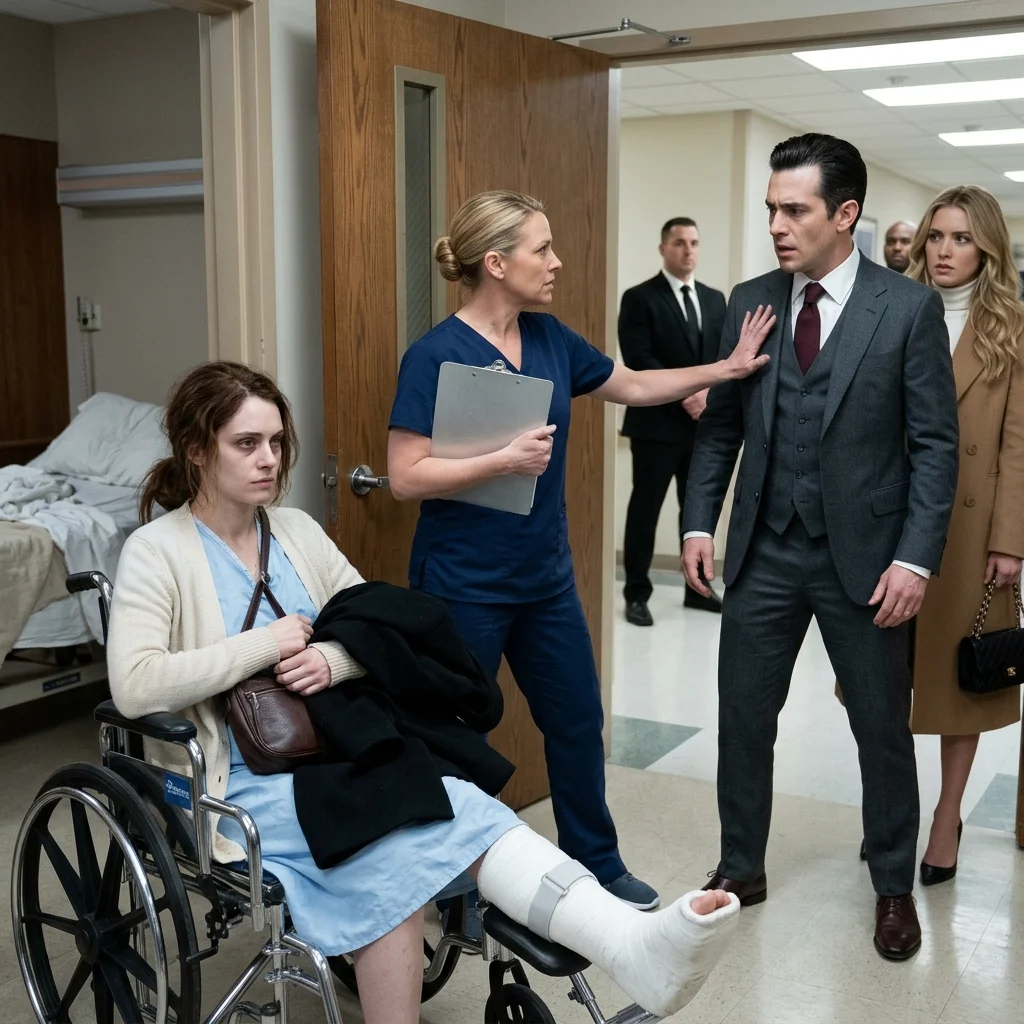
Finally, for the first time since he had walked into the room, his gaze dropped to the thick blue fiberglass encasing my right leg.
A short, incredulous breath left his nose—almost a laugh, though there was no humor in it.
“Over soup, Claire?” he said, pitching his voice in that low, soothing, condescending baritone that had made me doubt my own sanity in a hundred quiet arguments over the past forty-eight months. “You’re going to sit in a public hospital corridor with hydromorphone in your system and threaten to end our marriage over a bowl of soup?”
“No,” I said, looking straight up into his dark eyes without blinking. “Not over soup. Over the fact that you brought two armed men to wheel your wife out of an orthopedic trauma bay with two broken bones so she could stand at a stove for a woman who isn’t sick.”
Alexander’s jaw tightened by a fraction of an inch. He tossed the cashmere coat over his left shoulder and took a half-step back toward the side of the chair, reaching out with his free hand to peel my fingers off the steel doorframe. “You’re in shock from the fall, and the painkillers are making you theatrical. Take your hands off the wall. We are going to the car, we are going to Greenwich, and you can go straight upstairs to bed. Mrs. Gable will handle the kitchen.”
“Don’t touch my hand, Alexander.”
Down the corridor, Nurse Evelyn rounded the corner from the central station carrying a manila discharge packet and two blue hospital pharmacy bags.
Her brisk stride slowed instantly when she saw the tableau at the door of Bay 4: the two massive bodyguards flanking the threshold, the tall man in the custom suit reaching toward the wheelchair, and me with both hands still locked white-knuckled onto the steel door jamb, my blue cast exposed to the cold hallway air.
Evelyn didn’t look at Alexander’s suit, and she didn’t flinch at Dante’s two-hundred-and-forty-pound frame blocking half the corridor. She walked straight up to the edge of the wheelchair and kept her dark, steady eyes fixed exclusively on my face.
“Mrs. Moretti,” Evelyn said calmly. “Are you ready to be discharged?”
“She’s coming home right now,” Alexander answered for me, pulling a platinum Amex clip from his trouser pocket as if he were settling a restaurant tab. “Give the paperwork to my man here. My car is in the ambulance bay.”
Nurse Evelyn did not turn her head a single degree toward Alexander. She didn’t even blink at the card in his hand. In a New York City trauma center, nurses had a protocol for dominant spouses who spoke over patients in wheelchairs, and Evelyn executed it with thirty years of granite authority.
“I wasn’t addressing you, sir,” Evelyn said, her voice flat and resonant. She looked back down at me. “Claire, Dr. Chen’s twenty-three-hour inpatient observation order is still active in the system if your pain isn’t controlled or if you don’t have safe support at home. What do you want to do?”
My right hand was beginning to cramp against the painted steel of the doorframe, the tendons in my forearm trembling from the isometric strain of holding the chair against the incline of the floor.
Slowly, deliberately, I uncurled my fingers from the metal jamb and rested them in my lap.
“I’m staying overnight, Evelyn,” I said clearly. “And I’d like to update my HIPAA privacy intake form right now to revoke my husband’s medical proxy and visitor access. Could you please ask him and his employees to wait outside the unit?”
The silence in the corridor went crystalline.
Behind me inside the bay, Viktor took an immediate, instinctive step backward toward the hallway—no private security contractor with a state pistol license wanted his name on an NYPD hospital-trespass report alongside a patient’s revoked consent.
Alexander stood frozen in the threshold for three full seconds, staring down at me. For the first time in four years, the suave, untouchable patriarch of Moretti Holdings looked genuinely disoriented—as if the marble floor of his own lobby had suddenly liquefied beneath his heels. In his world, people did not say no to Alexander Moretti in front of witnesses, and his quiet, accommodating wife certainly did not revoke his name from a legal document while sitting in a hospital gown.
“Claire,” Alexander said softly, dropping his voice so only the four of us could hear, a cold warning glinting beneath the surface. “Don’t make a spectacle you can’t walk back tomorrow morning.”
“Nurse Evelyn?” I said, not looking at him. “My leg is throbbing. I’d like to go back inside the room now.”
Evelyn stepped squarely between Alexander and the wheelchair, raising her left hand toward the ceiling camera above the nurses’ station where two uniformed Mount Sinai hospital police officers were already standing up from their desk fifty feet away, hands resting on their utility belts as they watched the doorway.
“Sir,” Evelyn said to Alexander, “you are now in a restricted clinical area without patient consent. Step past the double fire doors at the end of the hall, or security will escort you off the property.”
For one razor-thin heartbeat, I thought Alexander’s pride would make him stand his ground. His nostrils flared; his dark eyes locked onto mine with a cold, furious promise that said We will finish this when your head clears.
Then he turned on his heel without another word, strode down the polished corridor toward the elevators with his cashmere coat over his arm, and let the heavy fire doors swing shut behind Dante and Viktor.
Evelyn let out a slow breath, walked behind my chair, and gently unlocked the wheels.
“Where would you like the chair, sweetheart?” she asked quietly.
“Back by the bed, please,” I said.
She waited until my hands were tucked safely inside the armrests before she wheeled me back into the quiet bay and pulled the privacy curtain closed across the doorway.





