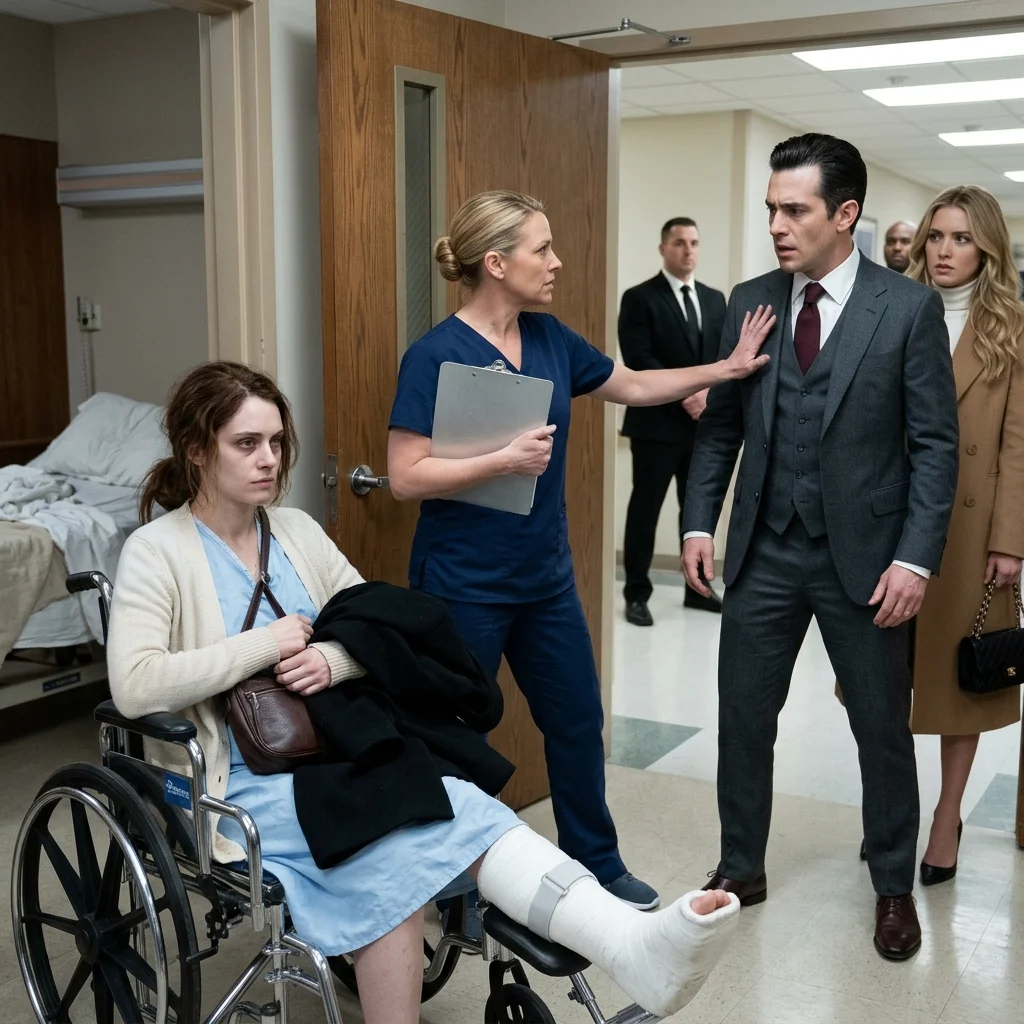
“Her fever just broke twenty minutes ago, and she finally feels like keeping something down,” Alexander went on, his tone smoothing out into the brisk, problem-solving cadence of a man dispatching a courier. “Mrs. Gable tried making that lemon broth at noon and Olivia took one spoonful and pushed the bowl away. She says the acidity is wrong. Just sign the discharge paperwork, take a cab up to the estate, and put a pot on the stove. You can prop your foot on the kitchen stool while it simmers.”
We had a Michelin-trained private chef on retainer in Stamford who could be at the house in twenty-five minutes. We had Mrs. Gable and two kitchen maids. And in the top right drawer of the walnut secretary desk in the very library where Alexander was standing, folded inside a leather recipe binder, was the exact sheet of Moretti Holdings letterhead on which Alexander himself had written down “3 tbsp Meyer lemon, 2 yolks tempered slow” in his own fountain-pen ink eight months ago.
He hadn’t forgotten the recipe. It simply hadn’t occurred to him that a pot of soup made by any hands other than mine—or the physical inconvenience of a shattered tibia—weighed more on the scale than Olivia Hayes’s afternoon appetite.
“Did you hear me say I fell, Alexander?” I asked. My voice was very quiet. “Both bones in my lower right leg are fractured. The orthopedist had to reduce a displaced tibia before casting it.”
“I heard you, Claire,” he said, and there was a faint edge of martyrdom in his sigh, as if I were deliberately complicating his afternoon schedule. “Nobody is asking you to run a marathon. You’re sitting in a cab and standing by a burner for twenty minutes. How much longer until they process your paperwork?”
I looked at the call timer on the screen: 01:42.
Four years of marriage. Four years of managing his philanthropic foundation’s galas without taking a salary; four years of hosting his loud, dismissive cousins from Milan who treated me like an American decorative object; four years of sleeping on the far left edge of a king-sized mattress while his phone lit up at two in the morning with texts from Olivia claiming she had heard a noise outside her carriage house or was having a panic attack over a thunderstorm.
I didn’t yell. I didn’t explain the anatomy of a spiral tibial fracture, or the fact that putting my leg in a dependent position beside a hot stove within six hours of reduction risked compartment syndrome.
I lowered the phone from my ear and pressed the red End Call button with my thumb.
The silence that followed was clean and vast.
Paul cleared his throat softly by the sink. “Look, Mrs. Moretti… Dr. Chen wrote you for a twenty-three-hour observation stay if you want it. With a displaced dual fracture and the amount of swelling we’re seeing around the ankle mortise, nobody on this floor is going to rush you out the door today.”
“No,” I said, setting the phone face-down inside my canvas tote and zipping it shut. My hands weren’t shaking anymore. “I’ll need to go home eventually to pack some things. Can you show me how to transfer into the wheelchair without bearing weight?”
It took two tries.
Even with Paul bracing the gait belt around my waist and locking the rubber wheels of the hospital transport chair, the simple act of pivoting on my left heel and lowering my hips into the vinyl seat sent a white-hot, sickening surge of hydrostatic pressure rushing down into the cast as my leg dropped below the level of my heart. Black spots danced across my vision; sweat broke out instantly along my collarbone beneath the thin cotton hospital gown and my cardigan.
Paul knelt quickly and cranked the ratcheting metal leg-rest upward until my cast was elevated horizontally again, sliding a folded hospital pillow beneath my calf until the tearing traction behind my knee subsided to a dull, rhythmic hammer.
“Easy does it,” the nurse, a tall woman in her fifties with calm dark eyes named Evelyn, said as she walked in carrying a plastic clipboard and a pair of aluminum axillary crutches adjusted to my five-foot-six frame. “Your blood pressure just dipped twenty points on that transfer, honey. Give your nervous system five minutes to settle. I’m going down to the central desk to print your thrombosis prophylaxis instructions and call the pharmacy for your Enoxaparin syringes. Is somebody coming up to help you into a vehicle, or do I need to call patient transport?”
I thought of the front entrance of the Greenwich estate—three wide, shallow steps of flamed granite leading up to the heavy bronze-and-glass double doors, with no handrail because Alexander’s architect had thought wrought-iron railings ruined the neo-Palladian symmetry of the facade. While waiting for the cast to dry, I had found myself mentally calculating the span between the stone pillars and the mahogany console table inside the foyer, trying to figure out how I would hop across polished marble on one foot without slipping while Mrs. Gable had her afternoon off.
“I’ll arrange a ride,” I told Nurse Evelyn. “Thank you.”
She gave me a long, measuring look—the look of a veteran emergency-room nurse who had seen ten thousand husbands and knew exactly what an empty visitor’s chair meant after four hours—then nodded once and stepped out into the corridor.
Ten minutes passed.
I sat alone in the quiet bay, staring at the pale blue fiberglass encasing my foot. My right big toe looked small and pale sticking out of the plaster cutout, still stained along the cuticle with a smudge of Prussian blue pigment from the restoration lab.
Then the heavy fire doors at the end of the orthopedic wing hissed open on their hydraulic hinges.
Even before I heard his voice, I heard the cadence of the shoes: three pairs of custom leather soles moving in a tight, triangular wedge down the polished linoleum corridor, scattering the nurses and medical residents out of the center lane with the effortless, bulldozing entitlement of extreme wealth.





