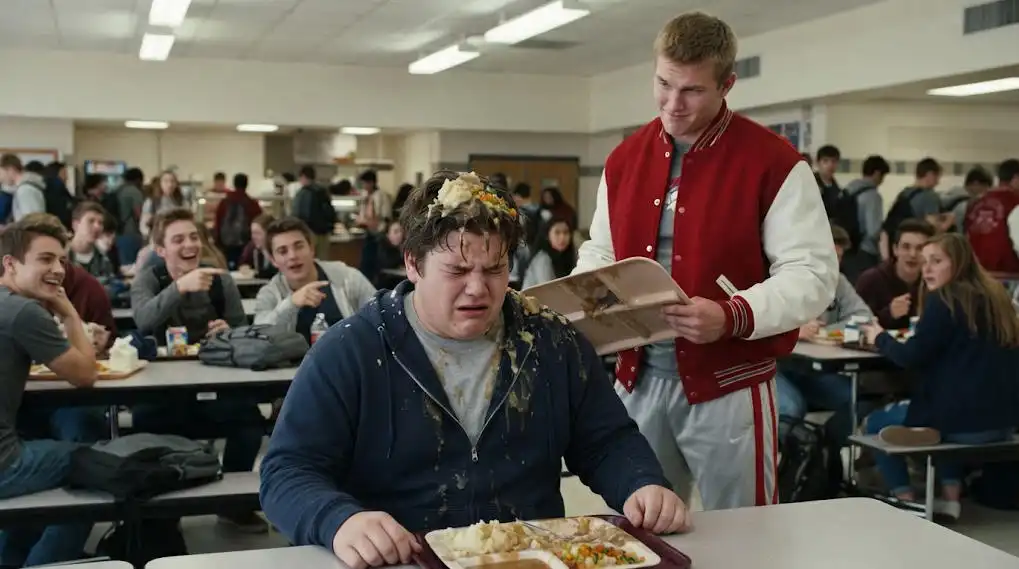
Mason Reed had once dumped a tray of cafeteria leftovers over Ethan Miller’s head in front of dozens of students.
Three weeks later, Mason sat in the front row of the school’s public-day assembly, staring at a folder on the principal’s table.
Ethan stood beside the microphone, his hands trembling so badly that he had to grip the stand with both hands.
The principal had promised to announce the disciplinary decision after Ethan spoke.
Then she looked at him and said, “Ethan, what do you want everyone here to understand?”
Ethan swallowed.
For a moment, the faces in the audience blurred together. He could almost hear the laughter from that Tuesday afternoon again.
To understand why standing at that microphone mattered so much, it helps to understand what had happened before.
Three weeks earlier, Ethan had been the kind of student who tried to occupy as little space as possible.
He was sixteen, a new transfer student at Westbrook High, and painfully uncomfortable in his own body.
He hated the way his shirts clung to him after gym class. He hated seeing himself in the reflective glass of the school doors. When other boys compared their muscles or talked about football, Ethan found reasons to look somewhere else.
Some mornings, getting out of bed felt harder than it should have.
He still went to school. He completed his assignments. He tried to be polite.
But he rarely volunteered answers in class, and he usually ate lunch alone.
He had convinced himself that if he stayed quiet enough, nobody would notice him.
Mason Reed noticed him anyway.
Mason was seventeen, tall, athletic, and the vice-captain of the varsity football team. Teachers knew him. Younger students admired him. His teammates saved him a place at their tables.
He was used to being listened to.
And he had decided that Ethan was an easy person to make fun of.
At first, it was small things.
Mason would look at Ethan’s lunch and make a joke about how much he was eating. He would imitate the way Ethan spoke when he answered a question. Sometimes, when Ethan sat down, Mason would nudge a chair out of place and laugh when Ethan had to move it back.
Every incident was followed by the same excuse.
“Relax. It’s a joke.”
When Ethan didn’t laugh, Mason would grin.
“Come on, man. Don’t be so sensitive.”
The other students learned that laughing along was easier than becoming Mason’s next target.
Ethan learned something else.
He learned to look at the floor.
He learned to eat quickly.
He learned to calculate where Mason was sitting before choosing a place for lunch.
And he began to believe that something about him really did deserve this treatment.
That was the part nobody could see.
Then came Tuesday.
Ethan had just opened his lunch when Mason walked toward his table carrying a tray of unfinished food.
Ethan saw him coming.
His stomach tightened.
“Hey, new kid,” Mason said.
Ethan kept his eyes on his lunch.
Mason stopped beside him.
“You know, I think you should be grateful I saved you a seat.”
Before Ethan could answer, Mason tilted the tray.
The leftovers slid over Ethan’s head.
Mashed potatoes landed in his hair. Brown gravy streaked down his forehead. Vegetables struck his shoulder and fell onto his lap. A splash of soup ran down the front of his navy hoodie.
For half a second, the cafeteria went quiet.
Then the laughter began.
It spread from Mason’s table to the students behind him. Someone slapped the tabletop. Two boys nearly doubled over laughing.
Mason held the empty tray and smiled at his audience.
Ethan sat frozen.
He could feel the wet food in his hair. He could feel the warmth of his face. He could hear every laugh, every snicker, every whispered comment.
“You should be grateful I saved you a seat,” Mason repeated.
Ethan wanted to hit him.
He wanted to shout.
He wanted to ask every person in that room what was so funny about watching another human being humiliated.
Instead, he pushed back his chair.
The scrape of its legs sounded painfully loud.
He took a paper napkin, wiped his face, and walked away.
He didn’t run.
But he came close.
He made it to the restroom before the tears began. He locked himself in a stall and pressed both hands against his eyes.
For several minutes, he could barely breathe normally.
He wasn’t crying because of the food.
He was crying because he had spent weeks trying to become invisible, and the one time everyone noticed him, they had laughed.
He washed his hair as best he could. He scrubbed at the stain on his hoodie until the fabric became damp.
Then he looked in the mirror.
His reflection looked exhausted.
“I can’t keep doing this,” he whispered.
For once, he didn’t mean that he couldn’t keep going to school.
He meant that he couldn’t keep pretending the bullying wasn’t hurting him.
After cleaning himself up, Ethan went to the school counselor’s office.
Mrs. Alvarez was sitting at her desk when he appeared in the doorway.
She looked at his stained hoodie, his reddened eyes, and the way he kept twisting a paper napkin between his fingers.
“Ethan,” she said gently. “Come sit down.”
He sat.
For a while, he couldn’t find the words.
Then he told her what Mason had done.
He told her about the laughter.
And once he started talking, the other incidents came out, too.
The comments about his body.
The jokes in the hallways.
The times Mason had made him feel ridiculous for simply being present.
“I know I should probably just ignore him,” Ethan said. “Maybe if I weren’t so sensitive, it wouldn’t bother me.”
Mrs. Alvarez leaned forward.
“Ethan, being hurt by humiliation does not make you weak.”
He stared at the floor.
“What if everyone thinks I’m a joke?”





