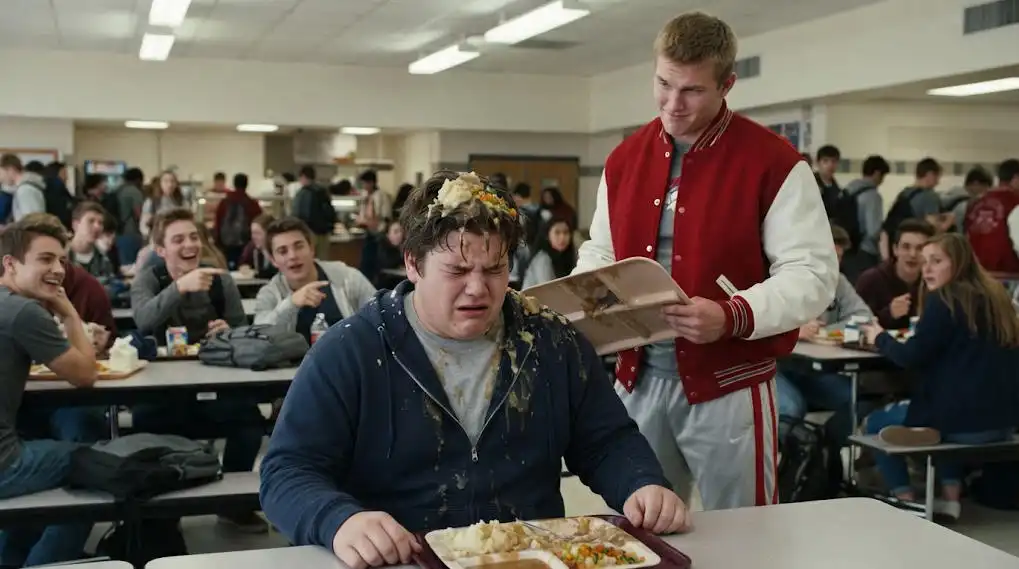
The next day, the whispered comments didn’t stop; they simply mutated. Now, as Ethan walked past the lockers, players from the junior varsity squad would mutter under their breath: “Watch out, don’t drop your fork around Miller, he’ll call the board.” Or: “Careful, don’t look at the delicate flower, he might cry to Alvarez.”
He spent his third-period study halls hiding in the library stacks, his stomach knotted so tight he couldn’t swallow water. The justice was on paper; the isolation remained in the air.
Mrs. Alvarez saw it. She didn’t offer empty platitudes about how time healed everything. Instead, on a drizzly Thursday afternoon, she walked him out the rear exit of the science building, across the gravel delivery lane, and stopped before an old glass-and-aluminum structure tucked between the boiler exhaust and the soccer shed.
“You need to get out of your head, Ethan,” she said, pulling a brass key from her ring. “And you need to stop spending your afternoons looking at the floor.”
The door to the greenhouse creaked open.
The air inside was twenty degrees warmer than the autumn drizzle outside. It was thick with the scent of damp peat moss, cedar mulch, and the sweet, green respiration of living leaves. Sunlight, pale and diffused through corrugated acrylic panels, fell across long cedar benches filled with seedling trays, ceramic pots, and terracotta saucers.
At the far end of the central aisle, a girl with short, messy dark hair and dirt on the bridge of her nose was wrestling with a fifty-pound sack of potting soil. Beside her stood a tall, gangly boy with glasses held together at the hinge with blue electrical tape, attempting to balance three plastic watering cans on a wheeled cart.
Ava Brooks wiped her forearm across her forehead, leaving a smudge of dark loam above her eyebrow. “Alvarez, if you brought us more biology club overflow, tell them the aphids are unionized and they refuse to leave the geraniums.”
“I brought you Ethan,” Mrs. Alvarez said, stepping back into the doorway. “He’s volunteering for the campus maintenance credit.”
The gangly boy, Jordan Price, looked up from his watering cans. He took in Ethan’s oversized flannel shirt, his guarded posture, and the way his hands stayed shoved deep into his pockets. Jordan didn’t ask what grade he was in. He didn’t ask if he played sports.
“Good,” Jordan said, gesturing with a plastic nozzle toward a flat of dry plastic cell-packs. “Take the hose on the north wall. Turn the brass valve three-quarters of a turn—if you go all the way, the gasket blows and you’ll get drenched. Plants don’t care about your GPA, man. They just want clean water.”
Ava offered a small, crooked smile. “And don’t listen to him about the fertilizer ratios. He nearly gassed the spider plants last Tuesday because he thought double nitrogen meant double flowers.”
“It was an honest chemical calculation,” Jordan muttered.
Ethan stood in the aisle for a moment, the tension in his collarbones refusing to drop. He waited for the look—the slight, calculating flick of the eyes that registered his weight, his cheap boots, his awkward silence.
It didn’t come.
Ava tossed him a pair of green canvas work gloves with rubberized palms. “Come on, Miller. Help me lift the peat. My lumbar spine is currently filing a formal grievance.”
He caught the gloves out of the air. The rough canvas felt solid, real, and uncomplicated.
That afternoon, he didn’t think about Mason Reed once.
He learned that seedling roots were terrified of air pockets; you had to tap the plastic cells against the wooden bench with a rhythmic, gentle cadence to settle the soil around them. He learned that the greenhouse was quiet in a way the school library never was—not an enforced, fragile quiet where every chair scrape sounded like a gunshot, but an organic silence filled with the slow, persistent work of cells dividing in the dark.
He came back on Friday. He came back the following Monday.
Within ten days, the greenhouse became his sanctuary. After the final bell rang, while the rest of the school surged toward the parking lots and the football field, Ethan crossed the gravel lane, kicked off his muddy boots in the vestibule, and pulled on his canvas gloves.
Jordan was quick-tongued, sarcastic, and endlessly cynical about high school social politics. “Look at the varsity squad,” Jordan remarked one afternoon, leaning against a bench while repotting jade cuttings. “They think high school is Rome and they’re the senators. In four years, half of them will be selling commercial insurance in Altoona and talking about that one time they stopped a sweep against Shaler. It’s pathetic, honestly.”
“They don’t feel pathetic when they’re standing over you,” Ethan murmured, his thumbs smoothing a layer of vermiculite over a tray of winter herbs.
“That’s because you’re looking up at them,” Ava said from the potting bench. She was twenty minutes into separating root-bound ferns, her fingers working with surgical precision through the white, tangled fibers. “You spend all your energy trying not to be seen, Ethan. You walk down the C-wing like you’re trying to dodge raindrops. When people see someone trying that hard to be invisible, the cruel ones take it as an invitation.”
Ethan paused, a plastic garden trowel hovering over his tray. “It’s easy to say that when you don’t mind being looked at.”
“I have vitiligo, Ethan,” Ava said, turning her wrist to show the pale, chalk-white patches that mottled the brown skin of her forearm and neck. “When I was in seventh grade, kids told me I was turning into a cow. I spent two years wearing turtlenecks in July until I realized I was slowly suffocating myself just to make ignorant people comfortable. The world is big, Ethan. This building is a very small, very dumb room. Don’t let the noise inside it convince you that there’s no sky outside.”





