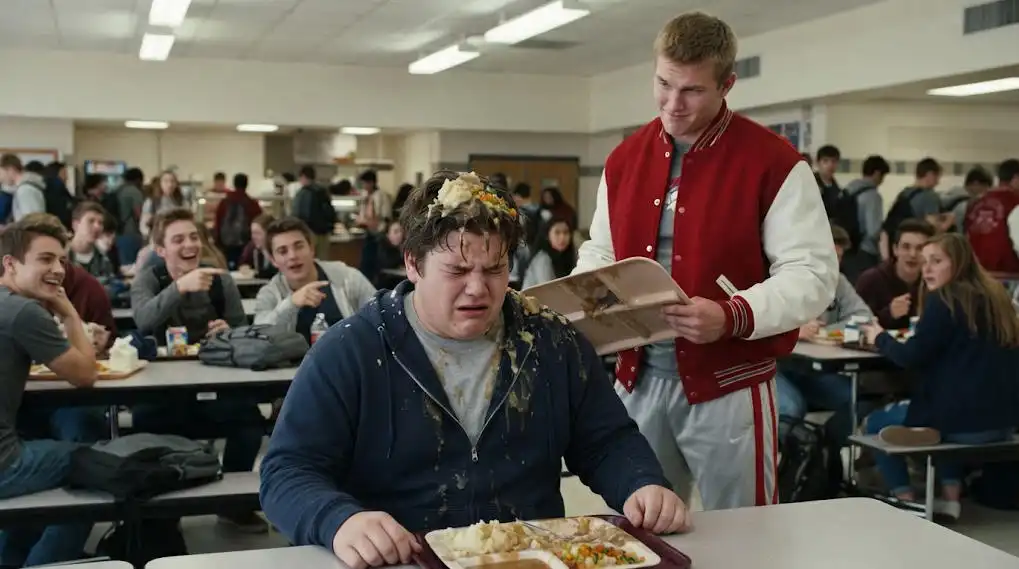
When the door clicked open and Ethan stood in the frame, wearing only his undershirt, his hair still wet and smelling faintly of poultry broth, the guidance counselor didn’t gasp. She didn’t offer a patronizing look of shock. She set her blue pen down, took off her reading glasses, and gestured toward the cloth armchair beside her filing cabinet.
“Sit down, Ethan,” she said.
Ethan sat. For the first two minutes, he couldn’t speak. He gripped a clean box of tissues she pushed across the desk, turning it over and over in his calloused fingers until the cardboard buckled.
Then, the dam broke.
He told her about the tray. He told her about the sound of the room laughing. But once the words started coming, he couldn’t stop them from reaching backward into the weeks before. He told her about Mason nudging his desk in third-period history so his pencil rolled onto the floor. He told her about the comments outside the locker room—“Watch out, hallway’s narrow today, Miller’s taking up two lanes.” He told her about the way he had stopped eating breakfast because he convinced himself that if he ate less, his body would shrink, his footprint would vanish, and the boys with the gold jackets would look past him.
“I know I’m an easy target,” Ethan finished, his voice cracked and thin, staring at his socks. “I know I should have just laughed it off. That’s what Derek said in the hall last week. He said I have no sense of humor.”
Mrs. Alvarez leaned across her desk. Her face was dark with an old, settled anger that had nothing to do with Ethan and everything to do with the culture she had fought for fifteen years.
“Ethan, look at me,” she commanded gently.
He lifted his head.
“Humiliation is not humor,” she said, her voice dropping into a firm, unyielding cadence. “Cruelty does not become a joke simply because an athlete smiles while he does it. And you being hurt by an assault—because that is what dumping boiling-hot broth and food waste on a person is—does not make you weak. It makes you human.”
“Everyone laughed,” Ethan whispered.
“Crowds are cowardly, Ethan. People laugh because they are relieved that the fire isn’t burning them. That does not make the fire right.”
She opened a fresh incident log on her computer screen. “We have cameras in the common area, Ethan. High-definition security feeds installed two summers ago under the state safety grant. If you give me permission to file an official grievance with Dr. Bennett, those hard drives will be locked down this afternoon. But I need to know if you’re willing to make a formal statement.”
Ethan hesitated. The old fear, cold and familiar, coiled in his gut. “What if his friends… what if they make it worse?”
“Mason Reed does not own this school,” Mrs. Alvarez said, her eyes pinning his with an intensity that gave him an anchor. “And you do not have to buy your safety with silence.”
Ethan took a slow breath. He looked down at his bare, pale forearms, then back at the counselor. “Do it.”
The administration moved with an efficiency that surprised him, though it did not immediately heal the ache in his chest.
By three o’clock, the digital forensics coordinator had pulled the footage from Camera 4-South, which sat directly above the cafeteria tray-return window. The file was pristine. It caught Mason’s approach from twenty feet out; it recorded the deliberate pause, the two-handed tilt of the tray, the downward thrust, and the wide, triumphant sneer on Mason’s face as Ethan sat submerged in grease. It showed Derek Hollis slapping the table; it showed the shock and the sudden, performative explosion of mockery.
Principal Bennett called an emergency disciplinary conference the following morning.
Mason arrived flanked by his father—a wealthy real-estate developer who sat on the town’s zoning board—and Coach Miller, the varsity football coach. Ethan sat in the adjacent ante-room with his mother, who had taken two hours of unpaid leave from her shift at the dry cleaners, her coat still smelling of chemical steam.
Through the heavy oak door, the voices drifted into the hallway.
“It was high spirits, Margaret,” Mason’s father was saying, his voice booming with the practiced authority of a man used to getting variances approved. “The boys were amped up after the win against North Allegheny. It was a harmless locker-room prank that spilled over into the dining hall. Mason is a seventeen-year-old kid with college scouts coming down from Syracuse next month. You don’t derail a boy’s scholarship over spilled gravy.”
Dr. Bennett’s reply was razor-sharp and cold as lake ice. “Spilled gravy is an accident, Mr. Reed. Dumping three pounds of food waste onto an unresisting sophomore who was sitting quietly with his back turned is battery under district code. The video shows no high spirits. It shows premeditated public humiliation.”
“The team has traditions—” Coach Miller began.
“The team represents Westbrook High School,” Dr. Bennett interrupted, her voice rising half an octave. “And if this is the culture the athletic department is cultivating in my building, then perhaps the athletic department requires an external state audit. Mason, look at me.”
A silence followed.
“Would you consider it a harmless joke if Ethan Miller had stood behind your son at his country club, tipped a bucket of refuse over his head, and filmed it for his peers?”
Mason didn’t answer. Ethan could hear the leather chair creak as the boy shifted his weight.
The preliminary sanctions were issued before lunch: a mandatory four-game athletic suspension, immediate stripping of Mason’s vice-captaincy for the remainder of the season, and enrollment in an intensive eight-week restorative justice seminar conducted by the county youth services bureau.
The punishment was real, but for Ethan, the hallway did not suddenly become easy.





