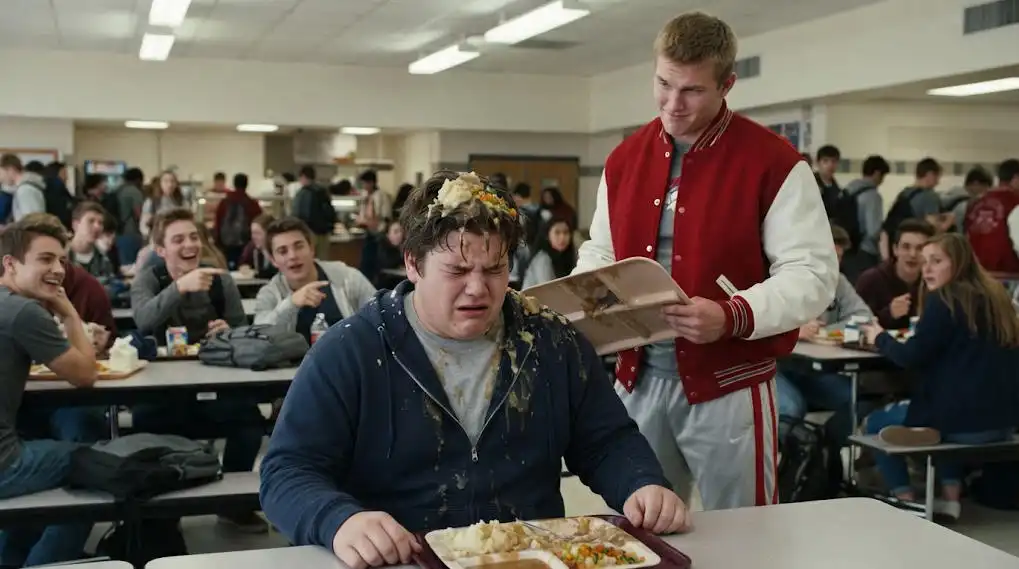
Ethan kept his eyes pinned to his wax paper. “Please,” he muttered, the word catching in his dry throat. “I’m just eating.”
“I know you’re eating, big guy,” Mason said, leaning down so his face was level with Ethan’s shoulder. His smile was broad, theatrical, designed entirely for the fifty pairs of eyes that had already begun turning toward Table Fourteen. “That’s what you do, right? You consume. But you look lonely down here by the dumpsters. The team wanted to make sure our newest recruit got a proper pre-game feast.”
“I don’t play football, Mason.”
“That’s your mistake, Miller,” Mason replied, his tone sliding from playful into that hard, testing cadence that bullies use to see how much resistance they will meet. “With that mass, you could plug the A-gap. But you gotta keep your energy up. You gotta clean the plate.”
Ethan reached out with a trembling hand to fold his wax paper back over his sandwich. He moved to stand up, his chair legs squealing against the speckled tile floor. “I’m going to the library.”
“Sit down,” Mason said.
The word was not loud, but it was dropped like a concrete block.
Before Ethan’s knees could fully straighten, Mason’s hand moved.
It was not a bump. It was not a trip or a clumsy stumble. Mason took the heavy plastic tray with both hands, inverted it forty-five degrees, and brought it down directly above Ethan’s head.
The cold weight hit his skull first. A thick, gelatinous avalanche of lukewarm mashed potatoes and congealed brown gravy smeared through his hair, matted against his scalp, and cascaded down the sides of his neck. Next came the vegetable soup—carrots, peas, and shreds of gray chicken skin sliding across his forehead, burning his eyes with salt, and soaking into the collar of his navy hoodie. The chocolate milk splashed across his lap, turning his faded denim dark and heavy between his knees.
For half a second, the vast cafeteria fell into a breathless, suspended silence.
Then the room detonated.
It began at the varsity table—a sharp bark of laughter from Derek, followed by someone slapping the surface of a metal bench so hard it rang like a bell. Within three seconds, the sound spread through the rows like a brushfire. Kids stood up on the benches to get a better view. Phones were ripped from hoodie pockets, screens catching the fluorescent glare as cameras opened. Two sophomore girls by the milk cooler doubled over, shrieking with hilarity.
Mason stood directly over Ethan, holding the empty plastic tray like a shield, turning his head to acknowledge the applause. His grin was radiant.
“Eat up, Miller!” someone shouted from Table Eight. “He saved you the protein!”
Ethan sat completely still.
His hands remained flat against the laminate surface. He could feel the gravy cooling against his ears. A piece of boiled celery hung from his left collarbone. The soup had soaked through his undershirt, clinging to his chest with an oily, freezing grip. His face burned with a heat so intense, so violent, that he thought his skin might blister under the humiliation.
He didn’t yell. He didn’t throw his fists. The impulse to fight was there, screaming inside his diaphragm, but it was smothered instantly by an overwhelming, suffocating shame. He was raw meat thrown into a pit for five hundred people to laugh at.
He pushed back his chair. The metal legs screeched again, cutting through the laughter like a dull saw.
He didn’t run. Running would give them another spectacle. He took a single, thin brown paper napkin from his sack, wiped the crust of potatoes from his eyes so he could see the floorboards, and walked toward the exit.
“Hey, Ethan!” Mason called after him, his voice echoing off the concrete rafters. “Don’t forget your vitamins tomorrow!”
The laughter followed him through the double doors, out into the linoleum corridor, and down the west hallway until the heavy fire doors swung shut behind him.
He made it to the boys’ bathroom near the boiler room before his knees buckled.
He locked himself inside the handicap stall, collapsed onto the porcelain seat, and buried his face in his forearms. The sobs that came out of him were ugly, dry, and jagged, rattling his ribs. He sat there for ten minutes, his hands shaking so violently he couldn’t undo the zipper of his hoodie. The smell of gravy and sour dairy was everywhere—in his nostrils, behind his ears, under his fingernails.
When the bell rang for sixth period, signaling that the hallway was clear, Ethan crept to the sinks.
The mirror above the porcelain was merciless. His hair was plastered to his forehead in stiff, greasy spikes. The navy cotton of his sweatshirt was stained an irregular, dark walnut brown across the chest and shoulders. He took paper towels, soaked them in lukewarm water from the automated faucet, and scrubbed at his neck until the skin turned raw and scarlet.
He looked at his reflection—the wide, red-rimmed eyes, the unathletic slope of his jaw, the water dripping from his chin onto the rusted drain.
“I can’t keep doing this,” he whispered into the empty tiles.
The words did not mean he wanted to leave Westbrook High. They did not mean he wanted to skip classes. For the first time in sixteen years, they meant something deeper: he was tired of pretending that he was small enough to hide, and he was tired of agreeing with the people who treated him like dirt.
He took off the ruined hoodie, balled it up, and threw it directly into the heavy wire trash can beneath the hand dryer. In his plain white undershirt, his chest exposed to the drafty corridor, he walked straight past his locker and turned toward the administration wing.
Mrs. Alvarez’s office was small, windowless, and jammed between the attendance clerk’s desk and the faculty lounge. It smelled of peppermint tea and old paper.





