The fluorescent tubes humming inside the vaulted ceiling of Westbrook High’s gymnasium cast a stark, white glare across five hundred folding chairs. The morning air smelled of floor wax, cedar sweeping compound, and damp winter coats. Up on the raised stage, three microphones stood on iron bases, their chrome necks angled toward an expanse of bleachers filled with parents, faculty, and board members who had gathered for the district’s annual public policy forum.
In the front row of the student section sat Mason Reed.
He wore his navy-and-gold varsity letterman jacket with the collar turned flat, his leather sleeves resting against his thighs. For three years, that jacket had operated as a personal passport through every corridor in the building. It conferred an unspoken immunity—the kind earned through seventy-yard touchdown passes under Friday night floodlights and photographs framed in the trophy case near the main foyer. But that morning, his hands stayed tucked inside his pockets, his fingers clenched so hard into fists that the knuckles turned white against the lining. He stared down at his sneakers, avoiding the gaze of Principal Bennett, who stood behind the school board’s mahogany table with an unyielding posture and a thick, dark folder lying unopened before her.
Beside the center microphone, Ethan Miller took his place.
He was sixteen years old, broad-framed, his shoulders habitually curving inward as if trying to fold his body into a smaller, less offensive silhouette. His fingers gripped the steel tube of the stand. The metal was freezing, but his palms were slick with nervous heat. A tremor worked its way up through his forearms, setting the black foam head of the microphone into a microscopic, visible quiver.
Three weeks earlier, Ethan had believed that survival at Westbrook meant becoming a ghost. He had believed that if he kept his head down, walked the baseboards of the hallways, and wore heavy oversized hoodies even when the radiators hissed with stifling heat, the world might simply forget to notice him.
He had been wrong. Cruelty rarely required a target to be loud; often, it sought out silence because silence made no immediate noise when struck.
Dr. Bennett adjusted the small lapel microphone pinned to her blazer. Her voice carried across the hush of the gymnasium, even and devoid of theatricality. “Before the board reviews the athletic department’s mid-season conduct audit and the disciplinary actions regarding our extracurricular programs, we have granted the floor to Ethan Miller. Ethan, take your time.”
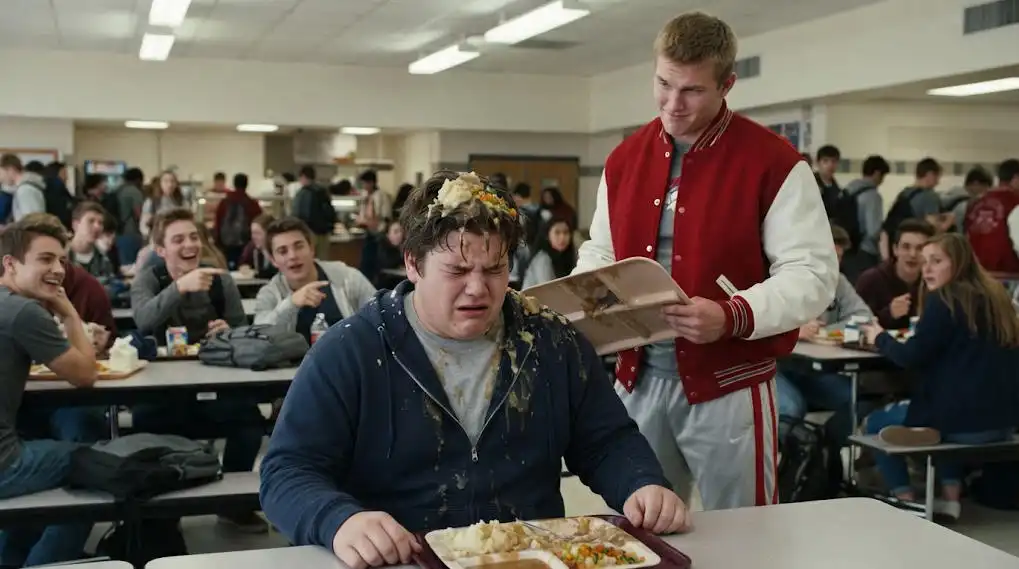
Ethan looked out over the rows. For an instant, the five hundred faces blurred into a single, terrifying smudge of gray wool and white skin. Behind his eyes, a phantom scent flared up with sickening clarity: the sour tang of industrial vegetable soup, the greasy weight of cold chicken skin, and the cloying, floury paste of institutional gravy clinging to the roots of his hair.
The Tuesday that broke him had begun like every other school day since his family relocated from rural Pennsylvania in late September.
His father had taken a maintenance supervisor job at the rail yard east of the river, trading their drafty farmhouse for a vinyl-sided rental duplex that smelled of somebody else’s cigarette smoke. Ethan’s transition to Westbrook High had been silent and awkward. At sixteen, he carried himself with an apology in his step. His frame had outgrown his confidence two years prior; he had thick wrists, broad hips, and a rounded, soft midsection that made PE class an exercise in quiet dread. While other boys stripped down carelessly in the locker room, boasting about deadlifts and junior varsity reps, Ethan changed in the single private bathroom stall near the laundry chutes, his heart hammering against his ribs until he could pull his faded gray gym shirt over his torso.
He had memorized the school’s geography through a lens of avoidance. He knew which water fountains had low pressure that forced you to put your face too close to the porcelain. He knew that the third-floor stairwell was usually deserted between third and fourth period. Most of all, he knew the cafeteria.
The cafeteria at Westbrook was an echoing, cinder-block cavern illuminated by buzzing daylight bulbs. It smelled of bleached laminate tables, fryer grease, and damp mop heads. The social architecture was as rigid as the concrete pillars: the varsity athletes and cheerleaders held the sunlit tables along the south-facing windows; the drama students and band kids occupied the linoleum center; and near the back wall, by the metal trash receptacles and the swinging double doors to the dishwashing room, sat the loners, the quiet transfers, and the kids who wanted to eat their sandwiches without being seen.
Ethan sat alone at the edge of Table Fourteen. He had unpacked his brown paper sack: a turkey sandwich wrapped in wax paper, an apple with a bruised shoulder, and a plastic thermos of cold tap water.
He was halfway through his second bite when the shadows at his perimeter shifted.
“Look at the discipline,” a voice said, pitched loud enough to carry across the neighboring tables. “Strictly clean fuel. Man’s in training.”
Ethan didn’t have to look up to know who it was. The scent of designer cologne—something sharp, synthetic, and expensive—arrived before the boots did.
Mason Reed stood over him. At seventeen, Mason was a junior whose jawline seemed carved for a recruitment billboard. He had wide, athletic shoulders, easy posture, and an incandescent smile that routinely disarmed hall monitors and vice principals alike. Flanking him were Derek Hollis, a junior linebacker with a shaved head and a constant sneer, and Tyler Scott, whose father was the head of the athletic booster club.
Mason wasn’t carrying an empty hand. He held a brown plastic tray loaded with the wreckage of fifth-period lunch: a half-eaten bowl of chicken vegetable stew, three cold dinner rolls soggy with beef gravy, a pile of lukewarm mashed potatoes, and two opened cartons of chocolate milk that had sloshed into the paper napkins.





