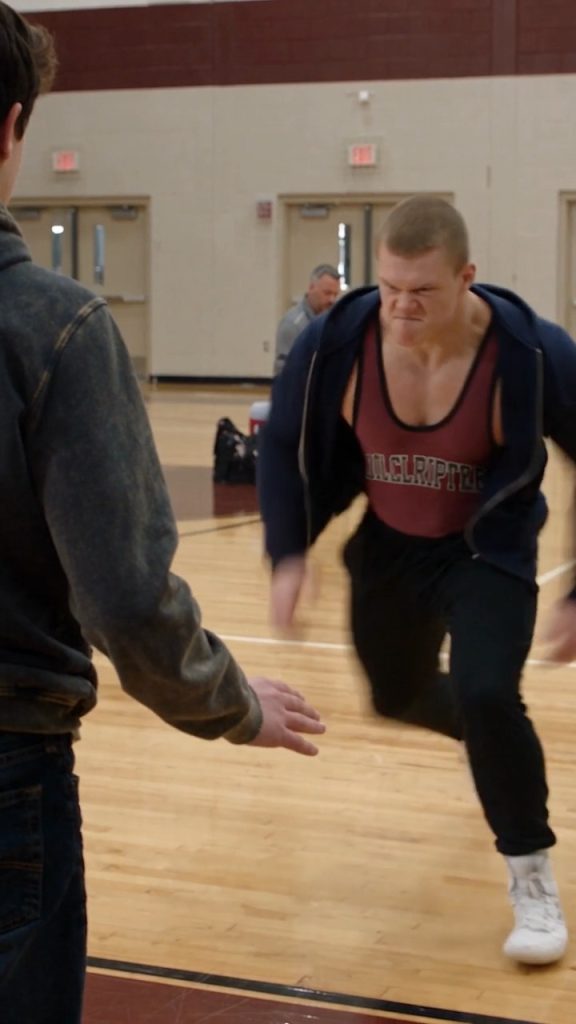
A little later, Coach Voss joined the meeting. He sat at the far end of the table in the same gray coaching polo he’d worn Thursday. It took me a moment to realize how much I disliked being in a room with him. He hadn’t grabbed me or called me names. Somehow that made the feeling harder to explain.
Mercer asked him to describe what he’d seen.
“Two boys were escalating,” he said. “Trent was upset. Reyes made a movement that put Trent on the floor. I documented the contact so we would have a record.”
“When did you begin recording?” Mom asked.
Voss glanced at Mercer. “When it was clear there was a confrontation.”
“Why didn’t you stand up?” I asked.
He looked at me directly. “I was trying to make sure there was evidence instead of another disagreement about who did what.”
I thought of the emails saying no adult had witnessed anything before. I wondered whether he believed he was helping a school that needed proof. But he’d been there, not separated by a locked door or a crowded hallway. There was room for him to speak, to call for assistance, to stop the demand before Trent charged.
“Your evidence starts after he grabbed me,” I said.
“The excerpt I provided highlights the physical contact,” Voss replied.
“Contact he started.”
“I’m not saying Trent had no responsibility,” the coach said. “I’m saying Reyes also used force.”
“Only to get free.”
He folded his hands. “That is your interpretation.”
I looked at the notebook before me. I could feel my face warming, and I knew that if I raised my voice he could add disruptive to whatever words he was already using. I wanted to tell him that fear wasn’t an interpretation. The bruised part of my back hadn’t imagined the bleacher. Neither had the microphone on Maya’s phone.
Instead I asked, “Did you watch the longer video?”
“Yes.”
“Then did you hear me say I didn’t want to fight?”
Voss shifted in his chair. “I heard that.”
“And did you see me move away after Trent went down?”
“I saw you move toward the doors.”
“Then why do you keep calling it an attack?”
Mercer intervened before he answered. She reminded us that the meeting wasn’t a cross-examination and that the school would make a formal assessment. I leaned back, frustrated with myself, though I’d asked only what the pictures made me need to ask.
After Voss left, Mercer explained that the conduct office was considering a provisional finding of mutual fighting, subject to final review. It would mean a short school-based sanction and a notation if upheld. She said the staff believed both students had used physical actions in a dangerous environment.
“Did you find Nolan initiated any attack?” Mom asked.
“The question is broader than who initiated,” Mercer said.
“Then please explain the difference between fighting and trying to get out of someone’s grip.”
Mercer said a final decision hadn’t been issued and there would be an opportunity to submit a response to Dr. Elaine Ford, the head of school. The meeting ended with that route written on a sheet of paper. I had arrived thinking a complete video would change everything immediately. Now I understood that even when the evidence changed, people could hold on to the explanation they’d built before seeing it.
Outside, Mom and I walked through the quiet corridor. A maintenance worker was changing a burned-out ceiling light. He had a small ladder, a fresh bulb, and a way to know when his job was done. I envied him for a second.
“I thought they’d see it,” I said.
“They saw it,” Mom answered. “They haven’t understood it yet.”
“Maybe they never will.”
“Then we keep asking them to explain their decision against the full facts.”
I wanted to believe that was enough. I also knew Mom had to return to work early the next morning. Her tiredness showed at the corners of her eyes. There was no one in our family with a donation plaque or a reserved space outside the gym. There was just us, a set of documents, and a girl who’d made a difficult choice to tell the truth.
At home I called Maya to thank her, not to ask her to do anything else. She said she’d been nervous all day because one of Trent’s teammates had asked whether she’d given the school a video. She’d answered that she was cooperating with a school review and had told her mother. I asked if she felt safe. She said she did, but that she’d appreciate the counselor knowing about the question. With her permission, I included it in my next note to Mercer, carefully describing only what Maya said had happened.
After we hung up, I thought of the way Trent had looked when I bowed: furious that I wouldn’t play the part he’d written for me. The school wasn’t Trent. The adults weren’t trying to make me kneel in a gym. But the provisional finding asked me to accept a story in which my resistance was equal to his aggression.
I wasn’t willing to do that.
Before going to bed, I opened Dr. Ford’s review instructions and began a new letter. This one did not ask anyone to believe I was a good student, or to trust that my family had raised me well. It asked the school to look at the first thirty-four seconds before judging the last seven—and to decide what a student was supposed to do when the adult responsible for him held up a phone instead of helping.





