By Wednesday, I had learned that there were two kinds of exhaustion. One came from doing too much. The other came from waiting for people to decide what your life meant.
The second kind didn’t go away after sleep.
At breakfast, Mom was counting the minutes until she had to leave for the hospital, making sure her own schedule could survive another trip to Briarwood. Grandpa stood at the stove turning an egg in a skillet. I had my laptop open beside a bowl of cereal going soft, checking the spelling of names in a statement I’d already read enough times to memorize.
“Eat first,” Grandpa said.
“I am eating.”
“You’ve moved the spoon three times and swallowed nothing.”
I took a bite. It tasted like wet cardboard. He didn’t say I told you so. He never needed to.
Mom finished a call with a coworker who’d agreed to trade a shift so she could attend the final review. “Thursday is covered,” she said, looking relieved and angry at once. “I wish it didn’t take a favor every time the school needed to speak to us.”
“I can go by myself,” I said.
“You can speak for yourself. You shouldn’t have to do it without someone in your corner.”
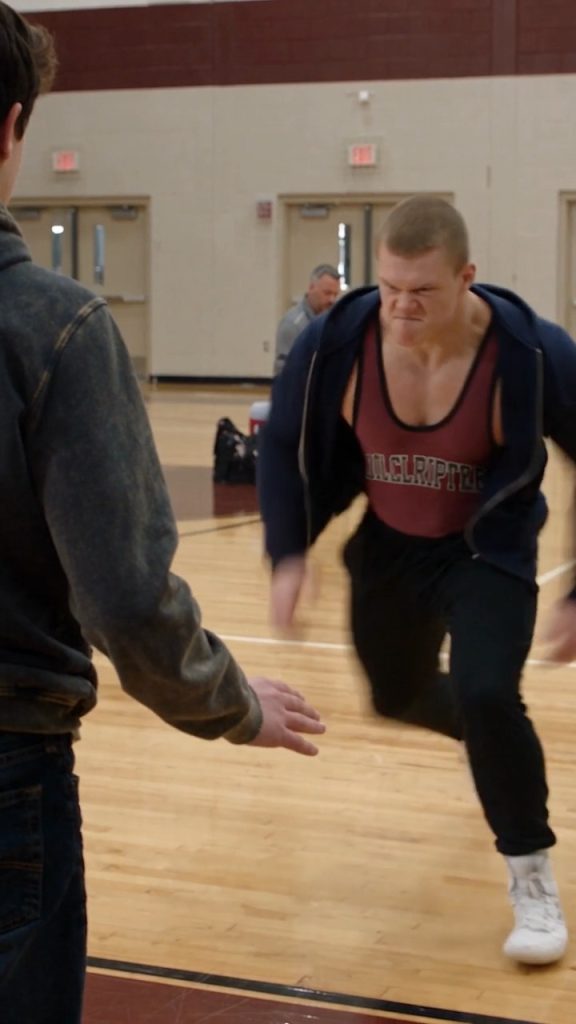
I wanted to argue that I was old enough. Then I remembered being six inches from Trent’s face while the coach sat thirty feet away, and the argument died. Being sixteen was old enough to know when adults had failed. It wasn’t old enough to make their responsibilities disappear.
We had organized the evidence in three groups. First were the earlier reports: my description of the hallway insults, the hidden backpack, the locker shove, the screenshot of the shoe jokes, and Mom’s unanswered request for protective steps. Second were the things created on Thursday: my note at 4:08, the hoodie photo, the office record, the initial conduct notice. Third were the videos, which described only the gym and only what each camera could see.
Mom insisted on the separation. “If we pile everything together, they can say we’re treating unrelated things as one event,” she said. “If we leave the history out, they can pretend Thursday came from nowhere.”
That was the problem in twelve words.
Maya met us at the school office before classes with her mother and the phone that had recorded the gym. She looked younger than usual without the plaid overshirt, wearing a plain cream sweater and carrying her books against her chest. Her mother explained that Maya was willing to show a staff member the original file on her device and confirm the transfer method. The school had requested it, and Maya had agreed. Nobody was taking her phone away; she would be present while the file was checked.
I thanked her again. She gave me a tired smile.
“It’s weird,” she said. “I filmed because I thought somebody would put it in a chat. Now I spend all my time hoping nobody does.”
“I’m glad you didn’t,” I told her.
The staff member asked us to wait while Maya and her mother completed the intake. Through the glass wall I could see the school technician sitting beside them and a form on the table. I couldn’t read it. I didn’t need to. I knew what the file contained. The point was that someone besides Maya and me would know where the file had come from, that it had been supplied as a continuous original and not as a secret edited answer to Voss.
A few minutes later, Maya emerged looking relieved. “They watched it straight through,” she said. “They asked when I pressed record and whether I’d changed anything. I said no.”
“That’s enough,” Mom said. “Thank you for telling only what you know.”
Maya laughed weakly. “I don’t feel like I know much.”
“You know what you saw,” Mom replied. “That’s a lot more useful than pretending to know everything.”
The same principle worked on me later that morning when I sat with Ms. Ellis. She showed me the biology assignment sheet with the randomized partner list and the original submission date. Emily and I had been assigned to the same project; the work itself documented no romance, no argument, no anything except research and an ordinary grade. I asked Ms. Ellis whether she could confirm those facts if Dr. Ford requested them.
“Yes,” she said. “And only those facts. I wasn’t there when Trent confronted you.”
“I know.”
“It’s important to keep that boundary clear.”
“People keep telling me that.”
“Is it making you feel unheard?”
I hadn’t expected the question. I stared at the classroom’s colored diagram of a cell. “Sometimes,” I said. “I just want someone to say it was wrong.”
Ms. Ellis turned her chair to face me fully. “What you’ve described about being grabbed and threatened was wrong. And if I see any student doing that, my job is to act. The formal review is about what happened and how the school responds, but you deserve to hear that much without waiting for a committee.”
I sat very still. The statement didn’t decide the case. She wasn’t claiming to have seen what she hadn’t. She was naming a rule that should have been simple from the beginning.
“Thank you,” I said.
At lunch I almost turned toward the library automatically. I’d been eating there so often that the path through the west hallway felt like a groove worn into the floor. But the counselor’s temporary plan included the cafeteria as a place I could use, with staff aware of the no-contact directions. I didn’t want to start avoiding another room without even trying it.





