So I went through the cafeteria doors. The smell of baked potatoes and reheated pizza made me surprisingly hungry. Students were trading snacks, bending over homework, and arguing about a weekend football game. A lunch supervisor stood near the serving line, paying attention to the room instead of a phone. I got food and looked for a seat. Every table seemed to have a history I wasn’t part of.
I chose one near a window with a good view of the doors. I knew choosing it for the sightline meant I was still afraid. I also knew I was there instead of hiding in the library. Both things could be true. I took out my notebook, then put it away. I wanted to finish a meal without turning it into an assignment.
After a few minutes Maya passed carrying a tray. She stopped. “Is this seat taken?”
“Not unless somebody invisible has claimed it.”
She sat down. We talked about a history essay, then about an old movie she’d watched with her family. It took me a while to notice that we hadn’t mentioned the recording. That felt deliberate in the nicest possible way. Maya had done something difficult for me, but she didn’t owe me a conversation about it every time we met. I could be a person who liked books and disliked overcooked carrots, not just the boy whose worst afternoon lived on her phone.
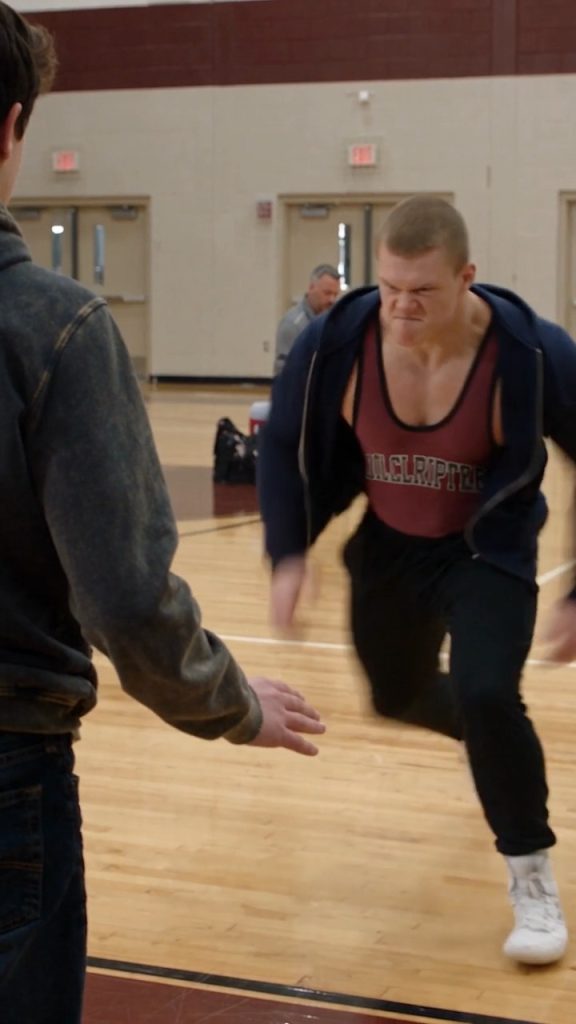
When two wrestlers entered on the other side of the room, my hand went still around my fork. They weren’t Trent, and they didn’t look toward us. I watched them anyway. Maya followed my gaze without turning it into a scene.
“You okay?” she asked.
“I’m trying to be.”
She nodded. “We can move if you want.”
I checked the space between the tables and the staff member at the serving line. My instinct was to gather my things immediately. Then I remembered that the counselor had offered a specific plan: if I was approached, I could go to the nearest adult and report it. I didn’t have to leave simply because someone wore a team jacket.
“Let’s finish lunch,” I said.
We did. No one confronted us. The absence of an incident didn’t erase the other ones, but it offered a different possibility for the next day. On the way out I thanked the lunch supervisor for keeping an eye on the room. She looked puzzled at first, then said, “Of course.” I wished the answer had always been that simple.
In the afternoon the counselor met with me to discuss the temporary safety plan. We mapped my actual day: first-period science, the second-floor history corridor, lunch, the library, the route to the bus. I explained that the locker room wasn’t a place I ordinarily visited and that I didn’t want to be made to leave early whenever wrestling ended. The counselor wrote the routes down and said she would coordinate with staff so I could use public school spaces without having to guess where Trent might be.
“If you’re concerned when you see him, contact the nearest adult and let me know,” she said. “You don’t have to handle it alone.”
“I did contact adults before.”
She didn’t pretend I hadn’t. “I read your earlier reports. The plan should have existed sooner. I’m sorry it didn’t.”
I felt my eyes sting and looked at the laminated schedule on her desk. An apology wasn’t a safety measure, but it was a start. If the school could name a failure, maybe it could also make a different choice next time.
After school Mom and I returned to Briarwood for a scheduled information meeting with Dr. Elaine Ford. Ford wore a charcoal blazer and square glasses that she took off when she wanted to read a document closely. Her office had a large window overlooking the central lawn. I had seen her at assemblies, usually speaking about academic excellence and building a respectful community. Up close she looked less like a person who gave speeches and more like a person who had read too many reports in one day.
She told us she would conduct the final internal review on Thursday after checking the original videos and meeting with the witnesses who had agreed to speak. She said the provisional finding was not a final decision, but that she understood it could still affect a student while pending.
“Have you decided I fought him?” I asked.
“No,” she said. “I’m reviewing whether your actions fall under the conduct rule the office initially applied. That requires us to look at context, not just contact.”
It was the answer I wanted Mercer to give on Friday.
Mom put the financial-aid letter on the table. “Nolan is worried this could affect his scholarship.”
Ford read it and turned to the section describing the ordinary terms. She said there was no automatic loss of aid because a complaint had been filed or a provisional conduct review was under way. Any serious change would have its own documented procedure, and nothing in the file before her amounted to an immediate scholarship decision.
I let out a breath so quietly I almost didn’t hear it myself. The relief was real, but it didn’t erase the possibility of having my record say I had fought another student.
“I don’t just want my tuition protected,” I said. “I want to come to school without being afraid of him.”
Ford nodded. “That’s a separate obligation, and it’s ours.”
Mom asked about Coach Voss. “Why did an adult film a threatening situation from a chair when he could have intervened?”
Ford looked directly at her. “That’s also being reviewed. I won’t speculate about his reasons before hearing them from him. But collecting evidence isn’t a substitute for protecting students when immediate action is possible.”





