At home we drafted my written statement. We began with the facts from Thursday’s note, compared them with the office chronology, and labeled what I knew and what I could only infer. I wrote that I’d seen Voss seated with a phone but hadn’t known he was recording. I described the two charges separately so they wouldn’t collapse into a single struggle. I explained that my contact with Trent was during an attempt to free my sleeve, not an attempt to take him down. The language was plain. Mom made me cross out a sentence saying the coach had wanted Trent to hurt me.
“You don’t know that,” she said. “You know he didn’t stop it. And now you know he recorded some of it. Those facts are serious enough.”
She was right. I hated having to be careful with the truth when the version on the laptop had been so careless with it.
Grandpa read my statement at the kitchen counter while a pot of beans warmed on the stove. He asked one question: “When he got down on his knee, what did you do?”
“Moved away.”
“Put that in. It’s important.”
“I already did.”
“Then leave it there.”
Later, at the recreation center, I sat on a bench watching younger students practice their first careful steps onto the mat. I usually helped Grandpa set out equipment on Fridays. I wasn’t ready to practice, and my back still ached, but I wanted to be in a room where nobody mistook a bow for surrender.
One little boy lost his balance and landed sitting on the mat. The other child reached out to help him stand. Grandpa stopped the exercise, thanked them both, and reminded the group that a partner’s safety mattered more than a point. I watched the children’s expressions, how quickly they understood the rule when an adult said it clearly and meant it.
I wondered what would have happened if Voss had stood the first time I looked at him.
The question followed me home. I checked the statement one last time and sent it to Mercer from my school email, copying Mom. I attached the earlier incident dates and asked the school to request the coach’s original file, not just the selected excerpt. I didn’t attach the blurry still frame someone had sent Mom as proof of anything beyond its narrow contents.
Mercer acknowledged receipt before dinner. She said the school would seek original recordings and interview students who had observed the gym. She also wrote that, pending review, a report of mutual physical engagement remained under consideration.
I read the phrase twice.
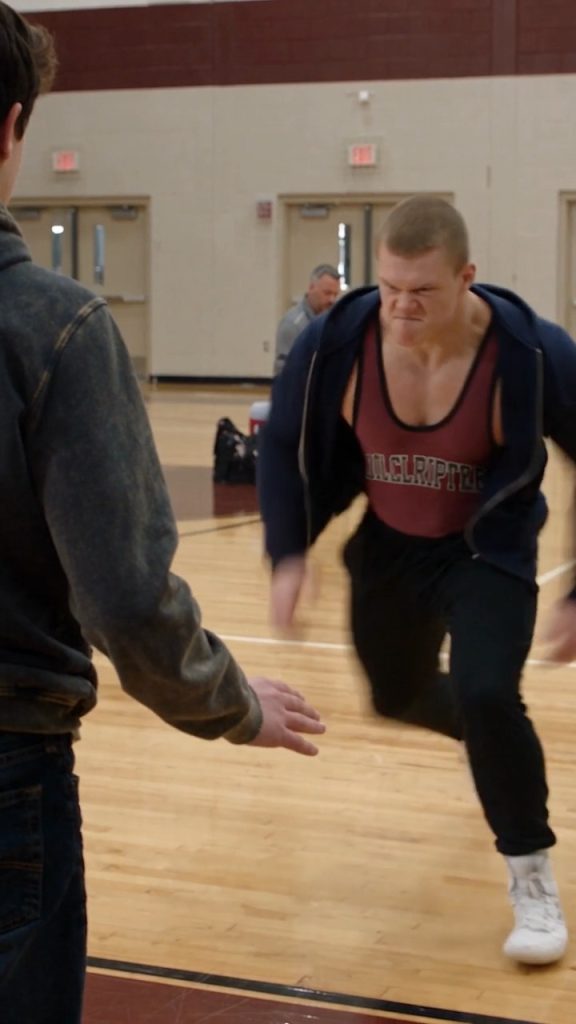
Mutual meant two people choosing the same thing. It meant a shared decision. I thought of Trent telling me to kneel, my open hands, the distance I’d tried to create, and his voice claiming I’d attacked him only after he’d fallen.
“What does mutual engagement mean?” Grandpa asked when I read the message aloud.
“It means they saw me touch him,” I said.
“Is that everything they saw?”
“No.”
“Then make sure they know there was a before.”
I went upstairs, opened a new document, and put seven words at the top: What happened before the seven seconds.
Underneath I began listing the details the coach’s clip had left out. Some were embarrassing. Some made me sound scared. I kept them all, because a story that only started when I defended myself wasn’t the story that had happened.
On Monday, I arrived at school early enough to stand outside the library before its doors opened. It was cold, the kind of November morning that made the metal zipper of my jacket feel like ice. I had slept badly through the weekend. Each time I closed my eyes I saw the same seven-second sequence, and each time it started with my hands already touching Trent.
There had been other moments in those forty or fifty seconds. There had been a demand. A shove. A bow. Two separate charges. A chance for the coach to stand. The trouble was that a missing beginning could become a missing truth if everybody stopped asking about it.
I used the empty time to read the report I’d sent Friday. It sounded almost like a laboratory write-up: time, location, observation, action. That might have been why I trusted it. In biology, Ms. Ellis was forever warning us not to make a conclusion stronger than the evidence allowed. You couldn’t call a stream polluted because one sample looked cloudy. You couldn’t call a person an attacker because one short clip started at the moment he was touched.
When Ms. Ellis unlocked the library side door on her way to a faculty meeting, she greeted me and asked whether I was doing all right. I told her I was trying to finish my Monday assignment. That was true. It was also a convenient way not to explain why my stomach hurt every time I imagined the next meeting with Mercer.
In first-period biology, Emily handed me a photocopy of our presentation rubric. “I thought you might need this,” she said. “It has both our names on it.”
I looked at the neat handwriting and the ordinary checkmarks. “Thanks.”
“Ms. Ellis has the assignment record too.”
“She can tell them we were partners?”
“She said she would if they ask.”
I lowered my voice. “You don’t have to explain your relationship to anyone.”
“I’m not,” Emily said. “I’m explaining that I went to the library twice for a project, not because we were having some secret meetings.”
Her face tightened. She had spent the weekend hearing that a boy she cared about had done something cruel and then insisted he’d been attacked. I didn’t know what she’d decided about Trent. I knew only that she’d chosen to bring me a sheet of paper no one could reasonably argue with.
“That’s all I’d ask,” I said.





