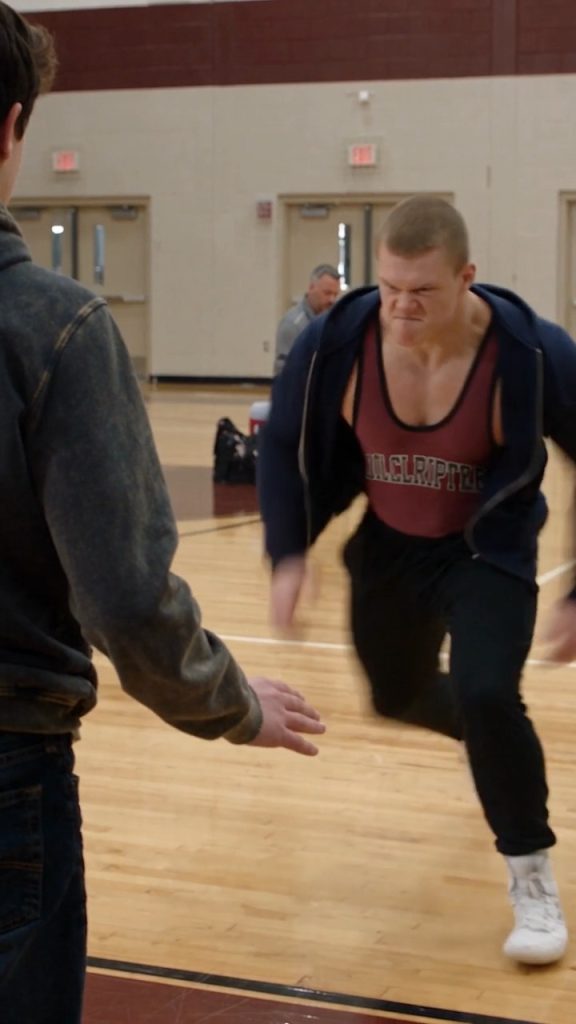
The office secretary found an administrator to check on me and offered an ice pack while I waited. My back ached but there was no serious injury apparent; Mom later insisted we watch for worsening pain and seek medical care if it changed. I sat in a plastic chair, holding the cold pack against the spot where the metal seat had struck me, trying to write down the sequence before my memory started rearranging it.
At 4:08 I opened a note on my phone: Trent grabbed front of hoodie. Pushed me into lowest bleachers. Six teammates at locker-room doors. Coach sat beside equipment box. Kneel demand. I slipped loose. Bowed once. Two rushes. First missed. Second caught sleeve. He went to one knee. I moved toward exit. Coach said both of us.
I read it twice. It seemed too flat for what had happened. No sentence contained the particular sound of twenty people watching you be afraid.
That wasn’t the beginning of the story, though. If it had been one strange afternoon, I might have been able to file it away as something that happened and ended. Instead it felt like every small thing I’d tried to survive had found its way into that gym.
In early October, Ms. Ellis had assigned the biology class a presentation about local watershed health. My partner was Emily Carter. We divided up the research, met twice in Briarwood’s library, made the slides, and gave our presentation. Emily was good at explaining data; I was better at organizing it. We earned a strong grade and went back to our separate lives.
I thought that was all there was to say about it.
Trent apparently disagreed.
He was Emily’s boyfriend and the wrestling captain, seventeen and a senior, broad across the shoulders with the confidence of somebody who had never needed to check the price tag on a new pair of shoes. His father owned car dealerships around Columbus and donated to Briarwood’s athletic programs. A wall near the gym celebrated community supporters; I had seen the Maddox name there often enough to stop looking at it.
The first insult had been almost casual. “Making moves on my girl, scholarship boy?” he asked between classes. I explained the assignment. He smiled as though the explanation was more insulting than a confession.
Then my backpack disappeared from the usual rack and turned up behind a janitor’s cart. A photo of my shoes landed in a student group chat with jokes beneath it. Somebody started calling me the clearance aisle. I couldn’t prove Trent had posted the photo, but he was among the students laughing when it circulated. He knocked a book out of my hands, then told the nearest teacher I’d dropped it. He shoved me against a locker at a moment when the corridor camera wasn’t the thing people were thinking about and no teacher was looking our way.
I told Assistant Principal Dana Mercer. The first time, she listened kindly and promised a conversation. The second time, she asked for names and dates. I gave them. After the locker incident she said nobody could verify it. I started keeping records, though record keeping turned out to be a hard thing to do when you were busy getting through the day.
Mom emailed the school asking for a meeting. The reply said the incidents couldn’t be substantiated because no adult had witnessed them. Those words lived in my head longer than the bruised feeling of the locker against my shoulder. No adult had witnessed them. As though adults were the only people whose eyes counted.
I changed routes between classes. At lunch I often brought my sandwich to the library, where nobody could easily gather an audience around me. Some days I did homework there to make the arrangement look like a choice.
My scholarship covered the tuition my family couldn’t have imagined paying. We rented a narrow house with peeling paint on the back steps, just far enough from Briarwood that the buses and schedules required planning. Mom worked at the hospital laundry facility, moving through long shifts in warm rooms that smelled faintly of detergent even after she came home and changed. Grandpa Luis lived with us, kept the household calendar on a paper pad by the refrigerator, and sometimes left pieces of fruit beside my schoolbooks without saying anything.
They had made a thousand decisions to let me attend Briarwood. Less money for repairs. More complicated work shifts. No weekend trips that cost anything. I liked school, and I was good at it, but sometimes I felt as though the scholarship letter weighed more than all my textbooks combined.
When I told Grandpa I was avoiding Trent, he never called me a coward. He’d taught judo at a neighborhood recreation center since before I could remember, and had taught me from the age of seven. He could describe balance in the same patient voice he used for fixing a dripping faucet.
“Getting home safely matters more than winning,” he told me whenever a practice partner got too eager to prove something.
I believed him. I also knew that staying safe had become harder at a school where a warning in the hallway could turn into a joke before I reached my next classroom.
The first time I had taken a complaint to Mercer, I’d practiced the words on the bus. Not because I planned to make a speech, but because I was embarrassed that something so small had become hard to explain. Someone had hidden my bag. Someone had laughed at my shoes. Each incident sounded minor when I pulled it away from the others. Together they had changed where I could stand without looking over my shoulder.





