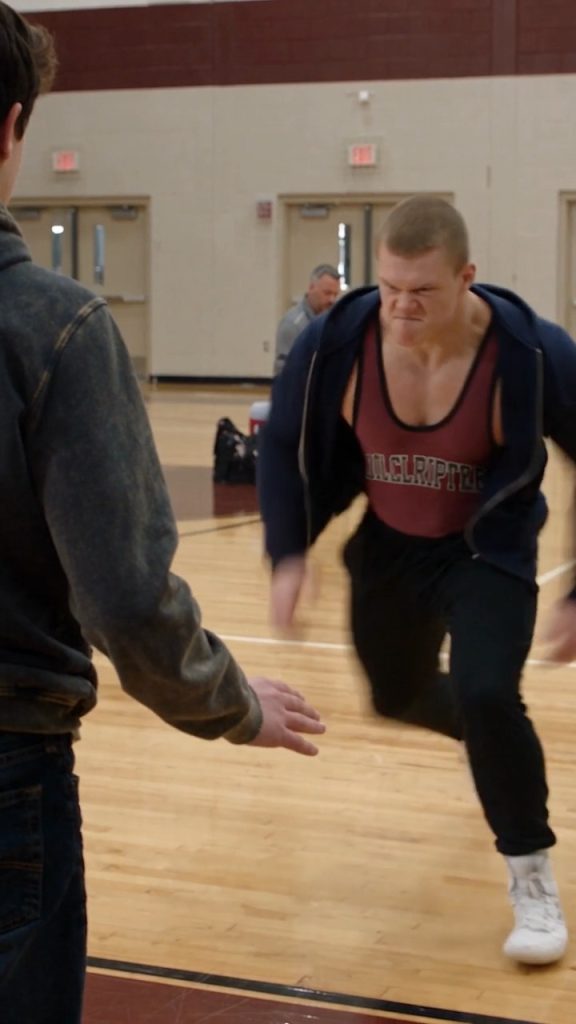
Mom made a simple chart of the times visible in the files we had. The phone recording didn’t have a magical certificate of truth; Maya could explain when she’d made it and show that the file on her device was the one she’d supplied. Its duration was continuous, the audio and action flowed naturally, and it didn’t jump from one part of the court to another. The school’s staff could assess that for themselves. We weren’t pretending a file could show what had happened in October, or what Coach Voss had thought behind his expression.
I wrote a short note to accompany it: The coach’s seven-second excerpt begins after the initial grip, shove, demand, bow, and first rush. My contact with Trent occurs only during his second attempt to grab me. I move away immediately afterward.
Mom read it aloud. “Good. No adjectives.”
“It’s not that I don’t have adjectives.”
“I know,” she said.
That evening I completed my biology assignment. I tested the data twice and corrected a mislabeled axis. It felt almost offensive that schoolwork still existed alongside the question of whether I’d be punished for something I had tried not to do. But finishing it gave me one small piece of my week that belonged to me.
I tried to study for an American literature discussion after dinner, but I kept going back to the video in my mind. Even when I wasn’t watching it, I could describe the angle of the bleachers and the way a spectator’s phone tilted when someone laughed. It bothered me that I was becoming an expert in the worst forty-one seconds of my school year. I didn’t want the rest of November to be measured in how often I proved those seconds had happened.
Mom noticed me staring at the open textbook. She sat across from me with a mug of tea and asked if I wanted to talk or work in silence. I said I didn’t know. She stayed, folding the clean laundry she’d brought home from the line in our basement and sorting socks into pairs. It was an ordinary action, and for a while the only sound was fabric sliding over the table.
“Do you think Maya will get blamed for helping?” I asked eventually.
“I think some people may be unkind. That’s why the school needs to protect witnesses too.”
“She told me her brother plays sports. What if she gets pushed out of things because of me?”
“Because of Trent’s actions,” Mom corrected. “And the choices other people make afterward. She deserves to make her own decision about telling the truth. You honored that.”
“I was relieved when she agreed.”
“Of course you were.”
“It makes me feel selfish.”
Mom folded a towel carefully. “Two people can both need something. You needed a fair hearing. Maya needed to decide what she could safely share. It’s not selfish to be grateful that those needs met.”
I looked at the untouched homework. “What if people only believe the recording? What if I’d been alone?”
“That scares me too,” she admitted. “The school should have helped before anyone needed a recording. You reported what was happening. You should not have had to wait until you were hurt in front of witnesses.”
Grandpa came in to find a glass of water and listened for a moment. He said that at the recreation center, when a child reported another child being rough, he didn’t tell the first child to come back with a video. He watched the next practice more closely, spoke with both students, and changed the activity if he needed to protect them. He wasn’t claiming that every story was automatically easy to resolve. He was saying supervision was something adults did in the present, not just a report they wrote afterward.
I asked why Briarwood made it feel so complicated.
“Sometimes people become more afraid of making a wrong decision than of making no decision,” he said. “But doing nothing is a decision too.”
That was something I wanted Ford to understand. I returned to my literature assignment, underlined a paragraph I’d missed twice, and wrote a response about how a narrator could tell the truth while still knowing only part of a story. I thought of Maya at one angle, Voss at another, and me in the middle, knowing what it felt like but unable to see the whole room. None of us had the entire answer by ourselves. A responsible review had to put those limits together rather than choose the most convenient seven seconds.
On Tuesday, Mercer asked Mom and me to attend a preliminary review meeting after classes. We entered the same room with the narrow windows. This time there was a second staff member taking notes. Mercer said they’d spoken with several students. Some had described the event as horseplay that got out of hand; some had said they saw Trent shove me. The statements were not identical. A student near the locker-room doors said he’d been standing there with the others but denied knowing they were blocking anything. Another acknowledged hearing the order to kneel but claimed he thought it was a joke.
I listened to that last sentence and felt the old anger return. A joke was apparently a thing that could be said by anyone as long as the person being hurt didn’t get to define it.
Mercer said the school had received Maya’s file and confirmed she was the person who recorded it from the east bleachers. “We are treating it as important evidence,” she said. “But we also have to consider everyone’s statements.”
“Of course,” Mom said. “Please consider what those statements describe, not just how the students label it.”





