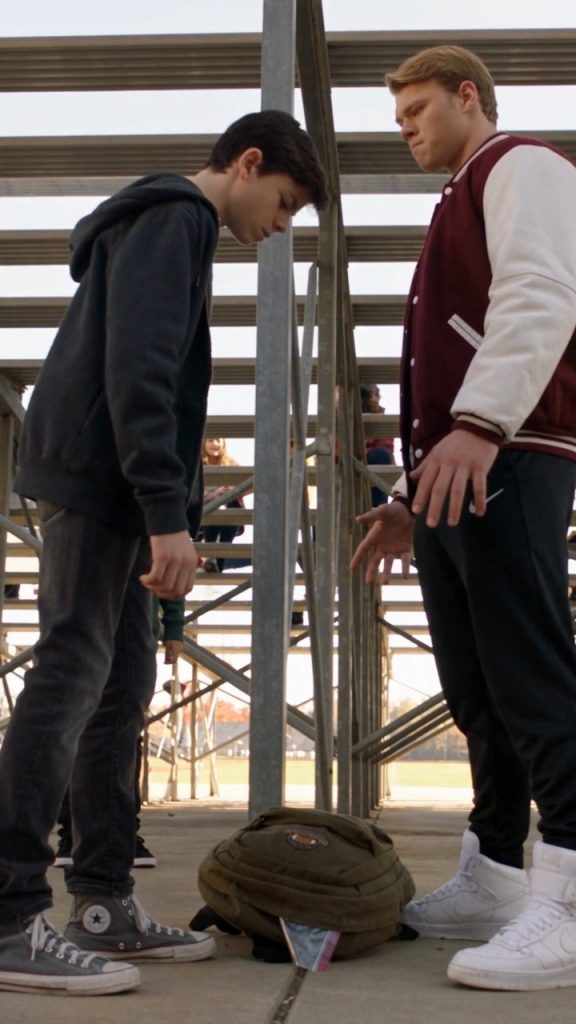
Friday morning, Blake was absent from the assembly announcement about the next game. His name still appeared on the roster posted near the gym, but somebody had removed the large photograph of the captain from the athletics-office display. I didn’t know whether that meant anything official, and I refused to guess. The temporary boundary between us remained in place.
At lunchtime Mason sat across from me with two cartons of milk and slid one over. “You look like you haven’t slept,” he said.
“I haven’t slept much.”
“Did something happen?”
I thought of Blake telling me about the envelope. Mason would have listened. He might even have kept it private. But the account involved a seventeen-year-old who hadn’t yet spoken to an investigator, and I had seen what happened when half a story escaped into the school. I shook my head.
“Something is being checked,” I said. “That’s all I can tell you.”
He accepted that more gracefully than I expected. We talked about a history project until the bell rang. It was a relief to spend ten minutes on something that didn’t involve the Nolan family.
After class, the district administrator who’d attended my meeting asked whether I still felt safe walking the main routes at school. I told her I did as long as the no-contact direction was enforced, but I wanted the athletics-area restriction reviewed because it made me look guilty for being cornered. She said the review was continuing and made a note of the request. It wasn’t a victory, exactly. It was another sentence in the record that nobody could later claim they’d never heard.
That afternoon I saw Blake across the parking lot. Coach Nolan was standing beside him near a dark truck, talking with clipped gestures. They were too far away for me to hear, and I turned toward the bus stop. A few minutes later Blake walked past me alone. His face was tight, and he stopped only long enough to say, “He says if they ask, this was my idea. The envelope. All of it.”
“Is that what happened?” I asked.
“No.”
“Then tell them.”
Blake looked back toward the truck. “He told me Aaron had already ruined the team. He said putting the money there would protect everybody else.”
I stared at him. He had used almost the same words about my brother when he grabbed me beneath the bleachers, as though Aaron were the danger and every cruel thing done to him were a defense.
“And now he’s saying you’re the one who did it,” I said.
Blake’s eyes glistened, but his face stayed rigid. “He’ll let them believe whatever saves him.”
He walked away before I could answer.
I hadn’t heard the conversation by the truck, and I could not testify to what Coach had said. All I knew was what Blake had just reported. But I saw the shape of the choice waiting for him. For fourteen months he had helped his father make somebody else carry the blame. Now his father appeared willing to leave that same burden with him.
By the time my bus came, I had decided not to run after Blake or ask for a promise. He had to choose whether his account would exist outside our two conversations. I could give the investigators my exact words and the dates. I could stand by Aaron. I couldn’t make another person tell the truth.
The first thing I learned the following Monday was that the words under review could mean almost anything. To my classmates, they meant the football program might lose a coach. To some parents, they meant a grant might be delayed. To me, they meant I still had to sit through algebra while the person who’d said he planted money in my brother’s locker decided whether to tell somebody who could check it.
I did not see Blake that morning. The administration had moved team leadership duties temporarily to other players, but the school refused to discuss whether he’d been interviewed. I understood the privacy rule even while it made my stomach ache. It was too easy to confuse a desire for information with a right to have it.
At breakfast Dad showed me a statement Coach Nolan had distributed through a parent mailing list. It said he welcomed a fair review, that an expelled student’s electronic files might be unreliable, and that he would never compromise the integrity of Northbridge athletics. He didn’t mention Aaron by name. He didn’t need to. Anyone who had lived through the previous year knew who the phrase expelled student meant.
“He thinks the more official he sounds, the more people will believe him,” I said.
Dad folded the printout. “He knows some of them will.”
“What if the files really can be challenged?”
“Then they should be challenged properly. That’s why Keller asked for the originals.”
That answer frustrated me because it was fair. The same standards I wanted applied to Aaron had to be applied to Coach Nolan. We couldn’t demand the school stop treating rumors like findings and then ask everyone to treat our suspicions as findings instead.
At school I passed the athletics trophy case. The glass still held photos of teams from years when Coach Nolan looked younger and nobody questioned his name. My brother appeared near the edge of a team equipment photo from the season before his expulsion, crouched by a pile of neatly arranged helmets. Somebody had placed a printed schedule over half the picture. For months I’d walked past without looking at it. That morning I stood there long enough to recognize Aaron’s careful handwriting on the equipment labels.
A student came up beside me. He was younger, carrying a folder decorated with band stickers. “I didn’t know your brother did all that stuff,” he said, pointing to the helmets.
“He did.”
“People only talk about the money.”
“I know.”





