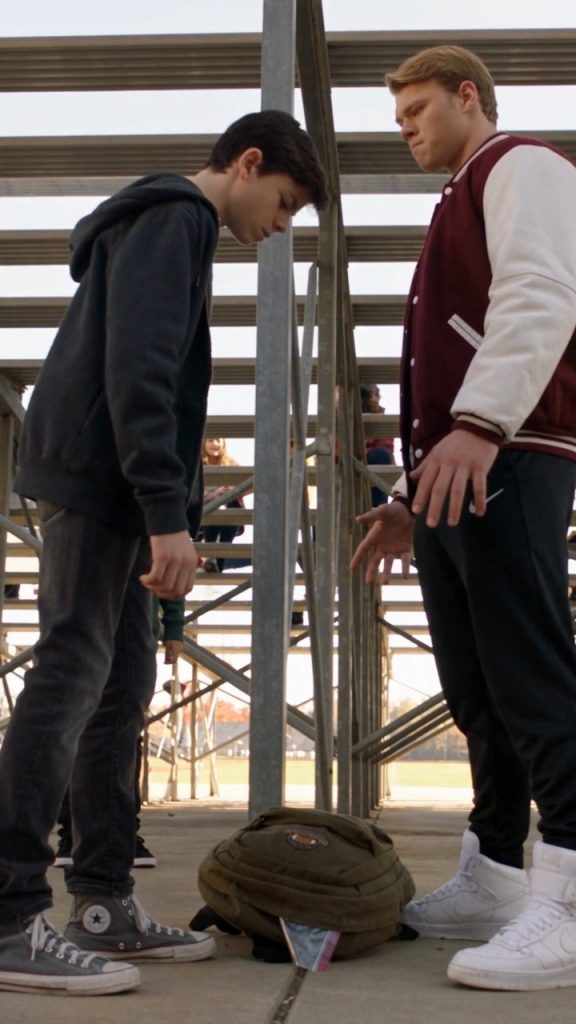
Blake stood. For a second I had the same instinct I’d had beneath the bleachers: step back, brace for the shove. He noticed and stopped moving.
“I’m not going to hurt you,” he said.
“You said you didn’t care about the backpack either.”
That landed. He looked away.
“I shouldn’t have grabbed you,” he said.
“No. You shouldn’t have.”
He didn’t apologize again. I hadn’t asked him to. When he walked toward the parking lot, I waited until he was gone before taking out my phone. My hands were shaking so badly that I couldn’t type a message to Dad. I called instead.
Dad arrived while I sat on the same bench Blake had occupied. He listened to my account without interrupting. Then he asked me to repeat exactly which things Blake said he’d done and which things he said his father had told him. We wrote the distinction down together. Dad did not call Blake a criminal or congratulate me for trapping him.
“We should notify the review contact,” he said. “Not the group chat. Not the football families.”
“He begged me not to.”
“You didn’t promise him that. And if his account is true, Aaron was hurt by a false statement. It’s not yours to conceal.”
I nodded, though I felt sick about what would happen to Blake. He had been cruel to me. He had helped destroy Aaron’s life. Neither fact made it pleasant to watch a frightened kid worry about his father.
That evening Keller spoke with Dad and me on a scheduled call. She didn’t treat my account as a completed finding. She asked where we had been standing, whether I had recorded the exchange, whether anyone else had been close enough to hear, and what exactly Blake had described. I admitted there was no recording and that I could have misunderstood a sentence. She thanked me for saying so. She explained that investigators could compare a firsthand statement with the original search documentation, school access records where retained, and the existing financial records, but that they would have to speak to Blake through appropriate channels.
“Should I ask him again?” I said.
“No,” she answered. “You’ve told us what you heard. Let us handle the interview.”
For once, being told to do less felt like being given a responsibility rather than being dismissed.
Aaron was harder to call. I knew how much he’d suffered because people believed the money had been in his locker for a reason. Hearing that the captain of the football team said he had put it there could sound like liberation. If Blake withdrew his story, it could become another humiliation. I didn’t want to offer my brother certainty I couldn’t deliver.
When I finally reached him, I said Blake had told me something important about the locker, but it wasn’t verified yet. Aaron listened. He didn’t ask me to repeat the claim three times or swear I was telling the truth. He asked whether Blake had admitted that the cash wasn’t his.
“He said he put an envelope there for his dad,” I answered. “He said he knew it hadn’t come from you.”
Aaron covered his mouth with one hand. On the screen he suddenly looked seventeen again, standing in our kitchen, unable to make any adult believe a word he said.
“I kept thinking there must be a way to show I never opened that locker after practice,” he said. “But I couldn’t. I was in and out of there all day. Everybody knew the locker was mine.”
“You didn’t have to prove somebody else could get into it,” I said. “They had to find out who put the money there.”
“They didn’t want to.”
His voice was quiet, but it contained more anger than I’d heard from him in a long time.
I asked why he’d waited so long to bring out the card. It was the question I had avoided since Friday. He sat back in his chair and looked toward the rain at his window.
“When the money showed up, I thought the card would settle it,” he said. “I told Warren I had a copy of the reconciliation, but he said any file I touched would be questioned until they finished looking at my laptop. Then they told me the laptop showed transfers. I’d used that laptop. I was terrified that if I handed over the copy, they’d say I made two sets of numbers.”
“So you hid it.”
“I put it in the lining before I left. I figured I’d come back when I was ready to fight. Then the recommendations disappeared, and I moved, and every day I waited made it harder to believe anyone would listen.”
He took a breath. “I kept seeing Coach Nolan on that interview saying I’d disappointed him. I started to hear it in my own head.”
“I never believed you stole it,” I said.
“You didn’t say much.”
“I know.”
There was no defense for that. I had never called him a thief, but I had let my fear make me distant. Sometimes when Mom talked about him I changed the subject. Sometimes I didn’t answer when he texted. I thought avoiding the hurt was the same as being loyal, and now I understood how lonely it must have felt from his side.
“I’m sorry,” I said.
“Me too,” Aaron answered. “I made you carry a secret without telling you what it was.”
We talked until the rain stopped streaking his window. He described the work he liked in Portland, including an inventory job at a small warehouse where every shipment was checked by two people. I told him about school, about the chemistry lab I’d almost failed, and about Mason trying to be a better friend than a better cameraman. It was the first call in more than a year that ended because we were tired, not because we couldn’t bear another sentence.





