“I know. I’m saying they want me to explain what it is.”
“Don’t. We don’t even know what it proves.”
There was a pause. “My cousin says Nolan should go to jail.”
“Your cousin wasn’t there fourteen months ago. Neither were most of these people.”
“I was there today.”
“Then tell them what you saw today. Nothing else.”
Mason exhaled. I could hear a game playing in the background at his house. “You’re mad I filmed it.”
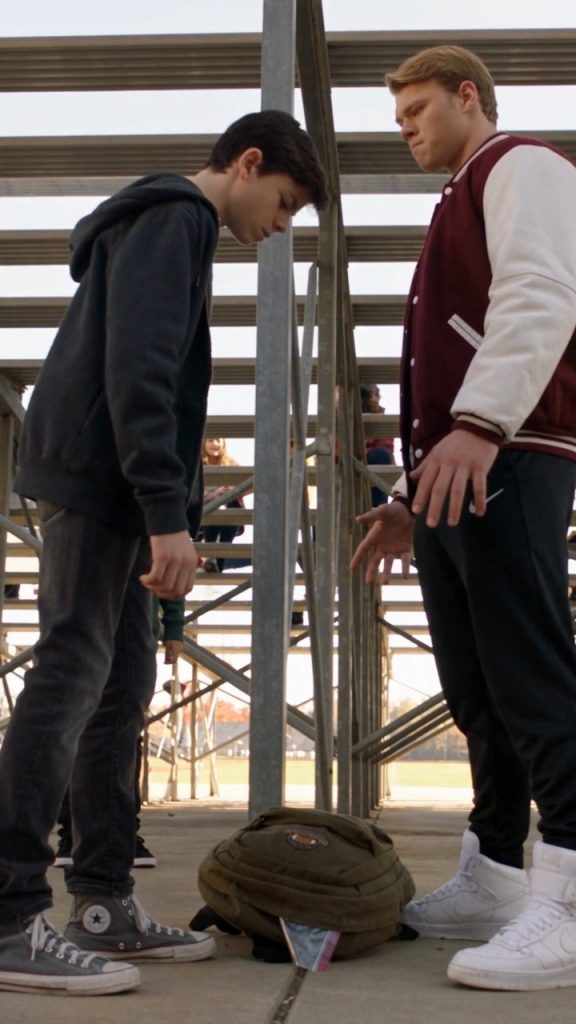
“I was. When Blake grabbed me, I thought you were just collecting another embarrassing clip.”
“I started because I thought he was going to shove you,” Mason said. “Then it happened fast. I should’ve yelled sooner.”
That admission mattered more than his audience count. He promised to preserve the original local recording, including the moments before the bag hit the ground, and not to add music or captions that made it look as if he knew what the evidence proved. If the school asked for it, he would give a copy to the right adults. I asked him to tell me before uploading anything else, and he agreed.
I turned my phone facedown. I kept thinking about the difference between people seeing something and understanding it. Hundreds had watched my brother’s bag hit concrete. Millions could watch, and not one of them would know who moved the money without records somebody was willing to examine.
Aaron called Saturday morning. He asked whether Mom had told me about the note. When I said yes, he sounded relieved, then worried again. “I should’ve asked if you were willing to carry it,” he said. “I made it sound like an errand.”
“You thought I would say no?”
“I thought you’d ask questions I was scared to answer.”
He told me more about the autumn before he left. He had been comparing equipment deliveries to invoices, a job so unglamorous that most people overlooked it. There were four purchase entries for uniforms and protective gear that hadn’t appeared in his inventory. At first he’d assumed a late shipment or a mistake in the storage room. Then an approval message and a payment entry stopped lining up, and he saved a dated copy of the reconciliation and the messages he had legitimate access to as equipment manager.
“Why a card?” I asked.
“Because I kept losing access to the school folders whenever they changed permissions. I wanted a copy of what I’d actually seen. I wasn’t expecting the whole thing to become a case against me.”
He said Blake had once walked into the equipment area while he was copying files and had asked what he was doing. Aaron told him he was checking purchase records. Blake saw the card and made a joke about Aaron’s private collection of spreadsheets. Aaron assumed he’d forgotten the encounter. Only after Friday did that memory seem important.
“It explains his face,” I said.
“Maybe,” Aaron answered. “Or maybe he just knows his dad hates anyone looking at the old case. Don’t turn a guess into a fact, Ethan. That’s how this happened to me.”
I wrote those words in the notebook Dad had started: Don’t turn a guess into a fact. It was harder advice to follow than it sounded. I wanted Blake and his father to have done everything because a single villain would make the past easier to arrange. I hated not knowing.
That night I tried to write down the Friday confrontation as if I’d never met anyone involved. I got as far as the bag landing patch-up and Blake’s expression changing before the page filled with words like terrified, guilty, and caught. Those were interpretations, not camera angles. I crossed them out and wrote what I’d actually seen: his hand stopped; his eyes went to the torn seam; he ordered me not to touch the bag. Mason could confirm some of those things from his recording. The rest was my memory, which could be honestly told but not made infallible.
I showed the page to Dad. He asked me to keep the crossed-out version rather than destroy it. “It shows you’re checking yourself,” he said. “You don’t have to pretend you felt nothing.” That surprised me. I had thought careful evidence meant making every human response disappear. Dad was teaching me that I could be frightened and angry while still keeping track of what happened in front of me.
On Sunday, Dad and I put the backpack inside a clean canvas tote so the broken seam wouldn’t catch on anything. I found the place where Aaron had doubled the strap stitching and remembered a summer afternoon when he’d taught me how to fix a torn textbook cover with tape. He had always been patient with things that could be repaired. I wondered whether he’d stopped believing people could be repaired after Northbridge expelled him.
Monday morning I walked through the same school doors and discovered that evidence didn’t make a rumor disappear. It multiplied the versions people told. One student said the card contained a confession from Coach Nolan. Another insisted the cash in Aaron’s locker had been planted by an undercover investigator. Someone had clipped my shout into a loop that made me look furious and Blake look startled, but hid Mason stepping between us. None of those stories was true as far as I knew.
A teacher redirected students gathering in the hallway and asked whether I needed a quieter route to class. I said I didn’t want to be hidden away. She said I didn’t have to be; I could still come to her if somebody blocked my path. The offer was small, but it was the first time since Friday an adult at school had asked what would make me feel safe.
Before second period the office called me downstairs. Mom and Dad were already there. Principal Warren sat with a district student-services administrator and an unopened folder. Warren looked more tired than he had on Friday, though his voice remained formal.





