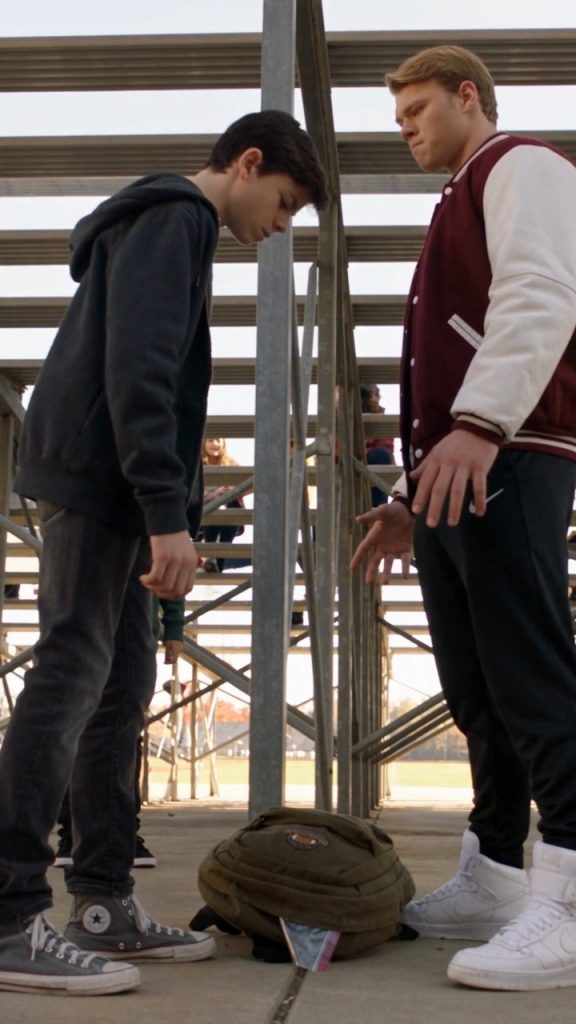
He wouldn’t say what was in the bag. He asked me not to open it myself and not to give it to Coach Nolan or anyone on the athletics staff. His instructions sounded unreasonable, even dramatic. But I remembered the way people had looked at him when he tried to explain himself. I said I’d bring it.
Friday morning, I carried his bag over one shoulder with my textbooks in my own smaller pack. Mom stood by the kitchen counter watching me lace my shoes. She looked at the olive canvas, then quickly looked away. When I asked whether something was wrong, she said she was just worried about the weather, even though the forecast called for dry skies.
By second period Blake had seen it. He stood with two football players outside the science hall, his broad shoulders filling the doorway. When I passed, he took one look at the patch and stopped talking. I expected a joke. Instead he watched me until I turned the corner.
At lunch, people started asking why I was carrying Aaron’s bag. A freshman at the next table asked whether it was supposed to be a protest. Somebody else muttered that the Coles were trying to make trouble before the stadium grant review. I ate half my sandwich, then put it away. My stomach had already decided it didn’t want food.
The football assembly pulled most of us to the stadium after lunch. Northbridge liked to call the gatherings community events, though for some of us they were simply scheduled reminders of who mattered here. I had almost reached the stairwell leading to the stands when Blake stepped into my path beneath the east bleachers. The concrete smelled faintly of rain that hadn’t fallen that day. Voices floated down through the aluminum seats.
“You think bringing that here is funny?” he asked.
“It’s my brother’s.”
“Your brother doesn’t go here.”
I started around him. He caught my shirt in one fist and pulled me back. The old bag slid off my shoulder into his other hand. I remember the sting of fabric at my collar and how humiliating it felt to realize people were watching while I was unable to do much more than stand still.
Then he threw it.
Now, back in the present, Dr. Keller had the card, and the people who had once been so certain about Aaron were arguing about who was allowed to look at it.
“Ethan, come with us,” Principal Warren said. “We’ll sort out this disturbance inside.”
“Am I in trouble?” I asked.
He hesitated. “That depends on whether you cooperate.”
Mason lowered his phone but didn’t put it away. “He didn’t start anything. I saw Blake grab him.”
“Students need to return to the assembly,” Warren told him.
“I’ll give you the video,” Mason said. “The whole thing.”
Dr. Keller asked whether I had a parent she could call and whether Aaron would agree to a preliminary examination of the card. Those questions felt different from the ones people asked fourteen months earlier. She wasn’t asking me to admit somebody else’s guilt. She was asking who had a right to the information and how to keep it from being altered.
We went into a conference room off the administration hallway. Coach and Blake weren’t invited. Principal Warren stayed, standing so close to the door that I wondered whether he was waiting for a chance to leave. I phoned Aaron. My first call went to voicemail; the second connected.
“They have it,” I told him.
“Who?”
“Dr. Keller. The seam broke. Blake threw your bag.”
He made a sound like someone sitting down too hard. “Are you hurt?”
“No. Mason stepped in.”
I put the phone on speaker with Aaron’s permission. Dr. Keller introduced herself, explained that she would preserve the original card and use a controlled copy to see what it contained, and asked whether he had made the files in the course of his equipment work. Aaron said he had copied his own authorized purchase reconciliation while he was still the manager. He didn’t claim that every number on it had to be believed. He asked her to compare it with what the district still held.
For the first time since his expulsion, I heard my brother sound like the person who used to count helmets in our garage.
A staff technology officer brought a district computer into the secure room; Keller documented the sleeve and kept us away from the original while an examination copy was prepared. Nobody jammed the tiny card into a random laptop or announced a verdict after one click. I sat with Aaron still on the phone and watched Keller review an initial directory listing on the copy. It held dated purchasing exports, receipt-reconciliation files, and saved approvals for a supplier called Fieldline Athletic Supply.
“These dates are from before the school reported the transfer spreadsheets,” Keller said. “There are discrepancies worth checking.”
“Does that mean he didn’t steal it?” I asked.
“It means we’ve found records that may contradict the basis of the accusation,” she said. “We need independent originals before drawing conclusions.”
Aaron didn’t speak for several seconds. Then he asked, almost timidly, “Are the approval records there?”
“They appear to be. I won’t characterize them beyond that yet.”
I understood more than I had when the bag split open, but not nearly enough. A dated file didn’t tell us who had placed six thousand dollars in Aaron’s locker. It didn’t explain how the school laptop had ended up looking like a confession. It wasn’t a public pardon, and it wasn’t proof that Blake’s fear meant his father was guilty. But it was the first time an adult had looked at Aaron’s version of events without turning away.
One detail bothered me. The card had supposedly been hidden for fourteen months. The note, though, named Dr. Keller, who had only recently been assigned to the grant review. I started to ask Aaron about it, but Warren interrupted.





