“I do. But after you say that enough times, you start wondering whether people can hear anything else.”
I told him I hadn’t known what to do when our friends quit calling. “I thought if I said something, they’d ask me to prove it. So I just stopped talking about you.”
He looked away from the camera. “I thought you were embarrassed by me.”
“I was scared for you. And for us.”
For a while we listened to the quiet at both ends. He finally said that he was glad I had kept the bag, but he didn’t want me making Northbridge the center of my life. I almost promised that would be easy. Then I remembered the way I had looked over my shoulder in the hallway that morning and told him the truth: it was already the center of more days than I wanted.
On Wednesday, Keller arranged a brief call with our parents present. She was still verifying the provenance of the card against district records; the existence of two versions of a spreadsheet wasn’t enough to assign responsibility. But a preliminary comparison of approvals and delivery logs had raised a different problem.
“There are four paid invoices under the same supplier name,” she said. “Their amounts add to thirty-two thousand dollars. The approvals exist, but the inventory records we’ve received show no matching delivery of the listed equipment.”
Dad asked whether the district could simply have misplaced the gear.
“We’re testing that possibility,” Keller answered. “The next step is to confirm the payment details and locate any receiving records held elsewhere. A missing receipt is not the same thing as proof of a stolen payment. But four unsupported payments require an explanation.”
Aaron asked who had approved them. Keller said the original authorization trail was part of the ongoing comparison and she wouldn’t assign blame on an incomplete record. I watched him press his lips together. He’d been saying there was no equipment for those purchases for fourteen months, and even now he didn’t get the answer he wanted. He did, however, get something he had never received from the school: an investigator treating that absence as a real question.
When the call ended, Dad wrote the four amounts in his notebook, leaving room beneath each for a delivery date or confirmation. The blank lines looked ordinary. They were also the first thing we’d seen that belonged to the missing thirty-two thousand dollars instead of to the story people told about Aaron.
I closed the notebook and thought of Blake flinching at the split seam. The card could tell us what the school had paid. Someone still had to tell us how six thousand dollars had appeared in a locked equipment locker. The old case was no longer a single accusation. It was two problems, and at least one person at Northbridge knew more about the second than he’d admitted.
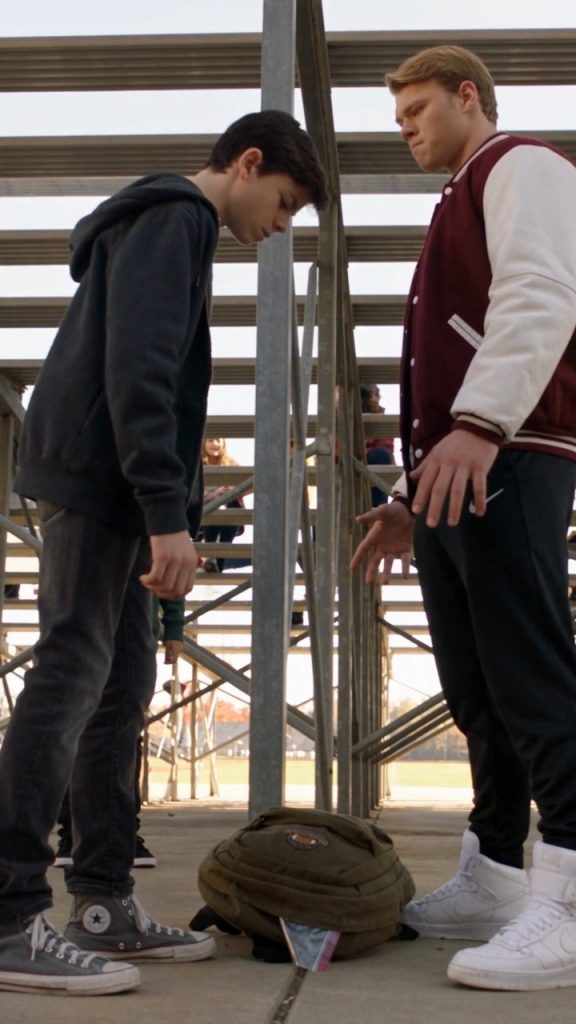
On Thursday the temporary restriction kept me away from the equipment corridor, which was fine with me. I had spent fourteen months avoiding that part of the campus on my own. It was strange to see the avoidance become an official rule, stamped into a letter with my name on it, while the person who had grabbed me still walked through the halls with a varsity jacket on.
Blake had stopped acting as though the school belonged to him. He went to class and practice, but I no longer heard his voice rising above everybody else’s in the lunchroom. When our paths crossed, he looked down at the floor. That might have meant guilt. It might have meant fear of the video. I remembered what Aaron had told me and tried not to decide which until I knew.
The English assignment that week was about reliable narrators. We were supposed to explain how a reader could tell the difference between what a character witnessed and what the character believed. I sat over the worksheet for half an hour. In the end I wrote that the hardest part was noticing when a person wanted a conclusion so badly that it started to look like a memory.
I didn’t turn the paper in. I folded it into my notebook behind the list of the four unsupported invoices.
At lunch Mason showed me a message he’d received from a person he didn’t recognize, offering to pay for the original confrontation video. Mason had declined. Another message called Blake a monster and wanted Mason to identify his home address. Mason reported that one and blocked the account.
“A week ago I’d have thought all this attention was great,” he said. “Now every time my phone buzzes I feel like I’ve made things worse.”
“You didn’t make Blake throw the bag.”
“No. But I made it easy for strangers to decide what kind of person everybody in that clip is.”
We stood beside a school window overlooking the empty practice field. Gray clouds had come in from the west, and the white yard lines looked bright against the wet-looking grass. Mason asked whether I wanted him to post a clarification saying there hadn’t been any official finding yet. I said he could remind people not to harass anyone, but we should leave the actual investigation to people with records.
“That’s not going to get many views,” he said.
“I think that’s the point.”
He put his phone away. Then he told me Blake had asked where I would be after school. The question made my chest tighten.
“Did he say why?”
“No. I told him to talk to an adult if it’s about Friday.”
I looked out at the field and tried to imagine what I would do if Blake approached me again. I wanted the courage to say something devastating and final, the kind of line people would quote afterward. I suspected what I would actually do was shake.





