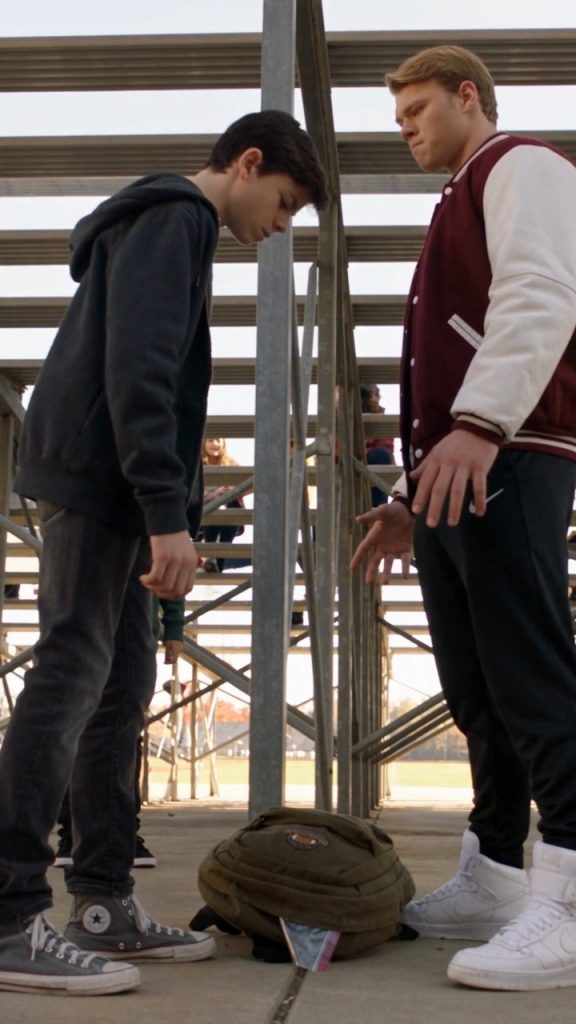
At three-fifteen, I left through the main entrance instead of taking my usual shortcut near the stadium. Blake was standing by a covered bench a little way down the public walkway. No one had to guess whether he was waiting for me. He straightened when I came through the door.
“Ethan. Can we talk?”
I stopped where the glass doors and the office windows were still in view. “You’re supposed to stay away from me.”
“I know. I won’t touch you.”
“Then you can say whatever it is from there.”
He looked behind him, searching for his usual audience and apparently wishing he didn’t have one. Two students passed at a distance. He waited until they were gone.
“My dad says that card doesn’t mean anything,” he began.
“Then why are you here?”
“Because I remember something. About Aaron.”
Blake lowered himself onto one end of the bench. He looked too big for it, knees sticking out, shoulders hunched beneath his jacket. I stayed standing.
“Last year,” he said, “I went into the equipment room to get my gloves. Aaron had his laptop out, and he was putting this tiny card into an adapter. He said he was saving purchase records. I asked why. He said because the numbers didn’t match what we’d gotten.”
I thought of the way Aaron had laughed off that encounter on Saturday. “You saw the card?”
“I saw something like it. I saw where he put it after. Into that backpack. I didn’t know what was on it.”
“But you recognized the bag when I brought it in.”
Blake nodded. His eyes stayed on his hands.
“You threw it because you thought the card might be there.”
“I threw it because I was scared and angry,” he said. “I didn’t know the seam would open.”
There was a difference between that explanation and an excuse, though he hadn’t earned the right to decide which I would hear. I made myself ask the question that had sat beside the number six thousand for more than a year.
“What do you know about the cash in Aaron’s locker?”
He looked up so sharply that I knew the question had found something. For several seconds he didn’t answer. The doors behind me opened, and a teacher passed with a stack of folders. I stepped farther from the bench but stayed within sight of the school.
“I carried it,” Blake said quietly.
“Carried what?”
“An envelope. The money.”
It was tempting to believe everything from that moment onward. I wanted the whole story to crack open as cleanly as the seam had. But I’d spent too long watching people treat a dramatic answer as the end of an investigation.
For a moment I remembered the day police had gone into the equipment room. I hadn’t been there for the search. I had only seen what came afterward: Mom gripping the phone beside the refrigerator, Dad asking somebody why an envelope found in a locker automatically belonged to its assigned user. The answer he’d brought home was that the finding would be investigated, yet the public announcement treated it as the explanation for everything. I had been thirteen words into an argument with a classmate when he showed me a photograph of the school’s notice and said, “They found the cash.” Like that settled a question neither of us knew how to ask.
Now Blake was offering the opposite certainty. If I seized it without checking, I’d be doing a different version of the same thing. I wanted to believe him because his admission hurt him, but pain didn’t make details automatically true. I needed to know whether he meant he’d actually opened Aaron’s locker or had only handled an envelope somewhere else. I needed to know which parts he remembered and which he’d learned from his father after the fact.
“Tell me exactly what you mean,” I said.
He rubbed his palms over his knees. The night before police searched Aaron’s locker, he said, his father had given him a thick sealed envelope and directed him to put it in the equipment room. Coach Nolan had told him Aaron had been taking money and that the envelope was part of a way to make him admit it. Blake hadn’t counted the cash. He had not known exactly what it would be called the next day, but he understood by the time the news spread. He’d slipped the envelope into Aaron’s locker while the room was otherwise empty and Aaron was away.
“You knew it wasn’t Aaron’s money,” I said.
“I knew it hadn’t come from him.”
“And you let everyone believe it had.”
He nodded once.
I felt light-headed. Six thousand dollars had seemed enormous to me when the police found it. It had made every denial from Aaron sound impossible to people who had never asked who else could reach his locker. Now I was hearing Blake describe moving the envelope as if it had been an ordinary equipment errand, one more task for his father.
“Why would you do that?” I asked.
“Because he told me to.”
“You’re seventeen, Blake. You know that’s not an answer.”
He flinched. “I know that now.”
“You knew it was wrong then.”
A long silence followed. At last he said, “Yeah. I did.”
I wanted to call Aaron immediately. I wanted to walk back into the office and repeat every word before Blake could pretend it hadn’t happened. But all I actually had was a conversation nobody else had heard clearly, between two students who had every reason to distrust each other.
“You need to tell Keller,” I said.
“No.”
“Your story matters only if somebody can check it.”
“My dad will say I’m lying.”
“Maybe. Then investigators can ask about the locker search, the envelope, and where you were. I can’t fix that for you.”





