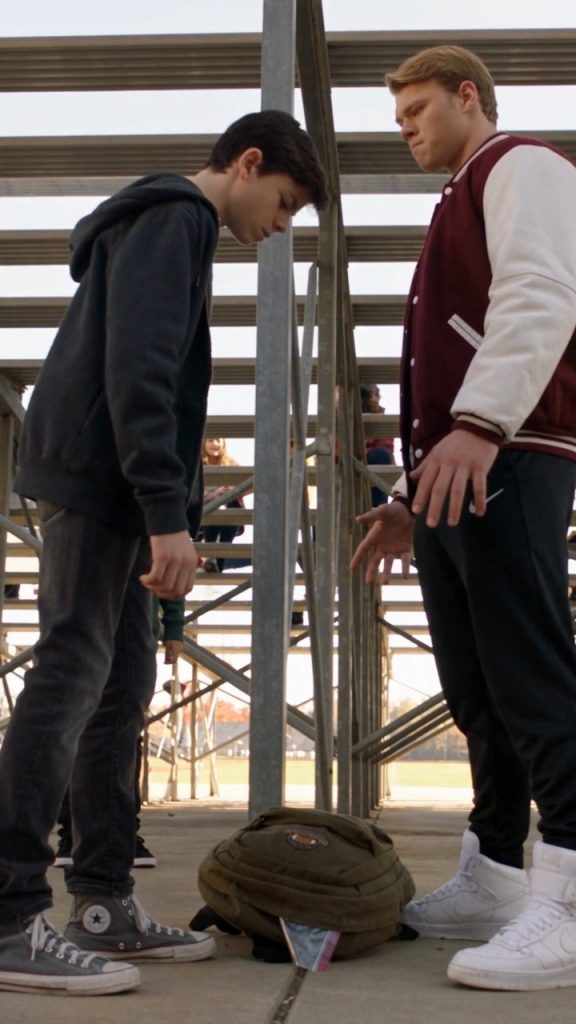
A school could have a proud tradition and still fail someone. It could produce winning teams and still permit bad accounting. Those truths didn’t cancel each other. Coach’s reputation might explain why adults deferred to him, but it couldn’t serve as a missing delivery receipt. If anything, the trust he’d accumulated made the duty to ask questions greater. I wished we had learned that before Aaron had to leave town.
Blake returned to class without the captain’s jacket. He wore a plain gray sweatshirt and looked exhausted. When he passed my desk, he didn’t speak. I didn’t speak either. There were things he owed Aaron that couldn’t be paid through one hallway apology, and there was nothing useful to be gained by turning his fear into a performance for my classmates.
Late that week a district student-services representative told my parents that Blake had provided a documented account concerning the locker cash in a supervised, voluntary interview. He had been offered appropriate support and an opportunity to clarify what he personally knew, separate from the questioned coach. His account was consistent on material points with what I had reported hearing. Investigators had checked the timing against retained records of the original discovery. The district still wasn’t calling that interview a criminal verdict, but it was not treating it as playground gossip either.
I phoned Aaron. He was quiet while I explained the update.
“Did he say he knew?” Aaron asked.
“He admitted he placed the envelope and understood you hadn’t put it there. That’s what they’re checking and recording.”
“I used to see him every practice,” Aaron said. “I’d hand him clean pads, and he’d complain about the size. I never once imagined he was putting anything in my locker.”
“I’m sorry.”
“Stop apologizing for him,” Aaron said gently. “You already did more than you had to.”
I stared at my desk. “I wish I could be there when they tell you what they decide.”
“You will be. Even if it’s through a screen.”
On the eve of the review, Principal Warren asked to speak with our family. We met in a district conference room rather than his school office. He wore the same charcoal jacket he’d worn the day of the assembly. Without the desk and the school trophies around him, he looked like a tired man who had run out of prepared answers.
“I should have asked harder questions when the original matter came to me,” he said. “I relied on the internal findings and didn’t insist on an independent reconciliation.”
Dad didn’t let him turn the sentence into a neat apology. “You expelled our son. You announced a finding that followed him out of town. What happens now isn’t only about how you feel about the process.”
Warren nodded. “The panel will decide the record correction. I don’t have authority to promise that outcome before they meet.”
“Then what can you promise?” Mom asked.
He looked at her folder, thick with letters he’d never answered properly. “That the school will follow the panel’s decision, and that I will correct what I publicly said if the finding is set aside.”
I heard myself speak before I had fully decided to. “A correction can’t just be a note where nobody sees it. Everyone heard Coach call Aaron a disappointment. Everyone heard you accept the findings.”
Warren turned to me. “What would you want us to say?”
“The truth,” I said. “The same truth you would have wanted the first time.”
He didn’t respond immediately. For once, I took his silence as a pause to think rather than a reason to be afraid.
That night our family sat around the kitchen table with Aaron on the phone. Dad had rehearsed what he wanted to say at the review and crossed out half of it. Mom had kept every school letter in date order. I had a page describing only what I’d witnessed on Friday and what Blake had later said directly to me. Aaron had his own account of how he obtained the records and how the accusations had changed his life.
We were better prepared than we had been fourteen months earlier, but preparation couldn’t make the decision for us. The panel would meet behind closed doors. It would have the audit findings, the statements, the old case file, and the responsibility Northbridge had avoided the first time.
When we ended the call, I looked at the backpack lying inside its canvas tote by the pantry. It had begun all this by breaking open in public. Now the truth inside it had been checked against records that existed before Blake threw it. The mystery had an answer. What remained uncertain was whether the institution that had ruined my brother’s name would have the courage to write that answer down.
The review panel met on a Tuesday morning while Northbridge High carried on as though it were a Tuesday like any other. Students arrived late to class, teachers chased missing assignments, and the football team’s practice schedule remained posted beside the gym. I found that ordinary rhythm almost unbearable. My brother’s future was being discussed in a district conference room, and outside its walls people were arguing about a quiz.
Mom and Dad went to the hearing. I attended the portion for which the district had asked for my account, then waited in a separate room while the panel heard other material. Aaron joined remotely from Portland, wearing a washed denim jacket over a gray flannel shirt. He’d borrowed a quiet room so he wouldn’t have to speak about the worst year of his life with other people passing behind him.
Before we went in, Dad checked the tie he’d worn to job interviews when I was small. He hadn’t tied one in years, and one end hung too low. Aaron noticed it on the screen and smiled.
“Dad, you used to teach me to do that,” he said.
“You never learned.”
“Neither did you, apparently.”





