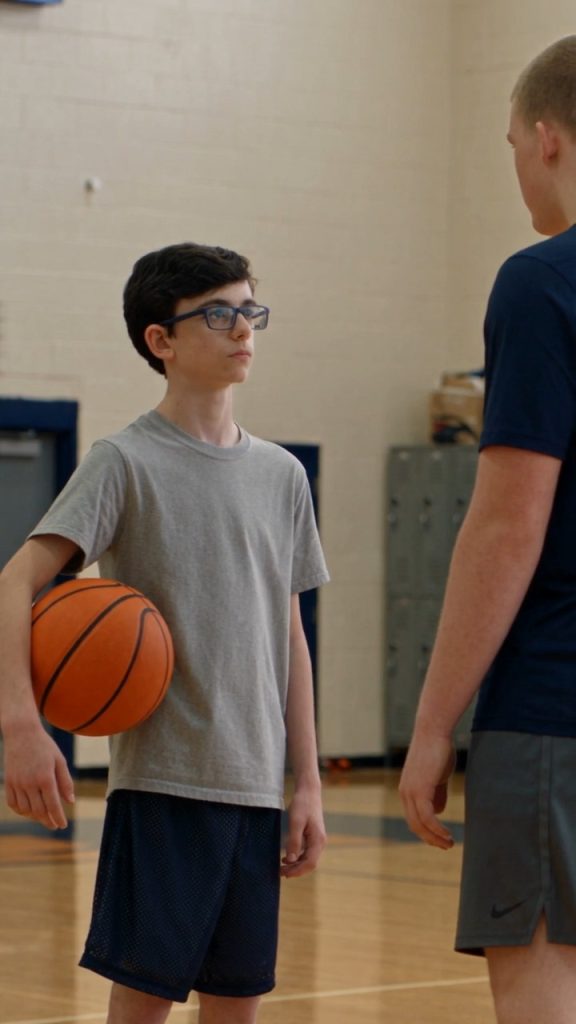
The basketball struck the floor hard enough to turn heads on the other side of the gym. It bounced toward Eli Navarro’s right sneaker, a bright orange blur against the pale wood, and came up almost to his knee. He shifted his foot, caught the ball against the floor with his palm, and looked at the boy who had sent it.
Mason Rourke stood a stride closer to center court, shoulders filling his dark navy PE shirt. At six-foot-one, he seemed even taller when he planted his feet and waited for a reaction. Around the west sideline, classmates drifted toward the folded bleachers, drawn by the familiar tone of his voice before he even spoke.
“One-on-one. Don’t chicken out.”
Somebody gave an expectant little laugh. Eli couldn’t tell who. He saw Zoe Park near the sideline, her chin-length dark hair tucked behind one ear, her expression sharpening from curiosity to discomfort. Behind her, other students were already making room for the spectacle.
Eli could have rolled the ball back and walked away. In another situation, that might have been the smartest thing to do. But Mason had spent weeks making any ordinary refusal into evidence of cowardice, and the crowd had learned its part: wait for Eli to look ashamed, then pretend it was only a joke.
He picked up the ball with his right hand. The gym’s lights glimmered across the lenses of his navy rectangular glasses. He leaned forward slightly, lowered his chin, and pressed the bridge of the frames back into place with two fingers of his left hand. It was a motion he made when he needed to see clearly, nothing more. Today he let the moment last long enough to remember that he could decide what happened with his own face.
He straightened. Mason’s smile faltered.
“Same rules for both of us,” Eli said.
For a second Mason didn’t answer. Eli held the ball against his right hip. The north basket hung beyond them, and the west bleachers framed a semicircle of waiting faces. Whatever Mason had expected, it wasn’t a condition stated in a calm voice.
“Fine. First to three.” Mason thrust out a hand for the ball. “Unless counting’s too hard for you.”
“One point a basket,” Eli said. “You keep it if you make it. Miss, and it switches.”
“Everybody knows how to play.”
“Then we’re agreed.”
Eli put the ball in Mason’s hand. Giving him the opening possession mattered. He didn’t want anyone to say later that he’d arranged a trick. More than that, he wanted to prove to himself that he could make a choice without first searching Mason’s face for permission.
The gathered students stepped clear of the north half of the court. Zoe stayed outside the west sideline. Eli noticed Noah Reed standing a little apart, arms folded, his burgundy PE shirt dark against the bleachers. Noah wasn’t laughing. Neither was Tessa Morgan, whose lavender shirt stood out among the darker uniforms. She glanced toward Mason’s friends and then toward the floor, as if she wished she had somewhere else to look.
Mason drove straight toward the basket. Eli moved with him but couldn’t match his reach. Mason put up a short shot that struck the backboard and dropped through.
“One,” someone called.
Mason collected the ball, because he’d made it, and came down the lane again. Eli tried to give him space without surrendering the basket altogether. The second shot went in from close range. Mason raised two fingers, grinning at the crowd.
“Two,” Zoe said, quietly but clearly.
Eli’s stomach sank. This was the part Mason had intended to display: the smaller boy helplessly following the bigger one across a painted rectangle while classmates kept score. Eli could feel the heat rising beneath his gray PE shirt. His glasses slipped a fraction with sweat.
He thought of the city recreation center on warm evenings since June, of the small, ordinary comfort of being there when nobody kept a tally except him. His cousin Nico had come along a few times, mostly to shoot at the next hoop and remind Eli to keep his feet underneath him. On other evenings Eli worked alone. A hundred unremarkable attempts at the short bank shot, a hundred rebounds gathered off the floor, a hundred chances to learn that missing was not the same thing as failing in front of an audience. He had never been a star player. He simply knew what a basketball felt like when it was allowed to be a basketball.
Mason took his third attempt too quickly. The shot hit the front of the rim and came out. Eli gathered the rebound below chest height.
“My ball,” he said.
Mason gave a theatrical bow and backed up. “Show us something, glasses.”
Eli didn’t chase him. He dribbled once, settled his feet a few steps from the basket, and looked at the upper corner of the square on the backboard. At the rec center, he liked that little mark because it stayed in the same place no matter who was watching. He pushed the ball upward. It touched glass and fell through.
“Two-one,” Zoe said.
Mason’s grin stayed in place, but Eli saw him shift forward. Eli kept the ball for the next possession, as they’d agreed. Mason raised his arms to fill the space. Eli moved laterally, not fast enough to impress anyone, just far enough to earn a cleaner angle. His second short bank shot bounced once on the rim before settling through the net.
“Two-two,” Zoe said.
There were no cheers. The crowd had expected a predictable ending, and it was beginning to understand that a different one was possible. Eli caught the ball and waited while Mason set his feet. The silence made Eli more nervous than the laughter had, but he kept his breath even. The last shot was nothing extraordinary: a set shot from near the lane, elbows tucked, feet balanced. It rose in a plain, careful arc.





