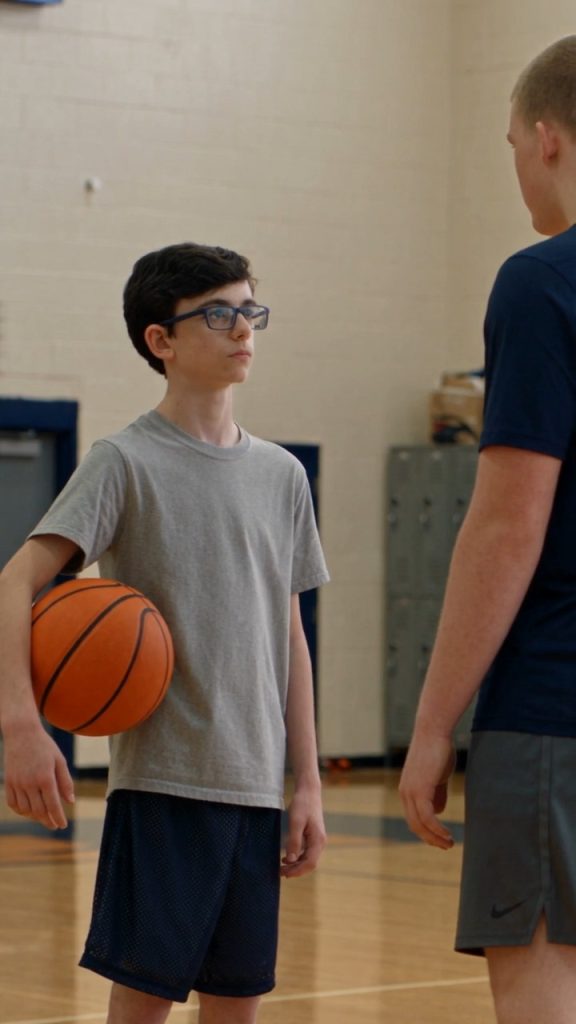
On Sunday, he walked to the outdoor courts behind the recreation center. The gym inside was booked, so he didn’t go in. He stood beyond the fence and watched two younger kids try to make a shot into a basket with a bent net. Each miss sent the ball skidding toward the grass; each time they chased it and argued about whose turn was next. Nobody had to earn permission to keep trying. Eli remembered summers at the rec center when he’d missed so often that he couldn’t imagine hitting three shots in a row with an audience watching. Those repetitions hadn’t made him invincible. They had made one particular skill familiar enough to reach for under pressure.
He came home before dark and put his notebook away for the evening. There was still uncertainty waiting at school on Monday, but the weekend had held more than dread. His mother had cooked, he’d completed his algebra homework, and a basketball had remained an ordinary thing for part of an afternoon. He didn’t want Mason to take those hours, too.
On Monday, October 19, Eli arrived with a strange feeling that the weekend had been both too long and not long enough. Without school he’d been safe from the immediate noise, but he’d spent hours anticipating what it would sound like again. In the cafeteria before homeroom he saw Noah carrying a carton of milk and looking as though he might pass Eli’s table twice before deciding whether to stop.
“Hey,” Noah said, taking a seat on the opposite bench. “I heard you talked to Brooks.”
“I did.”
Noah peeled the edge of the milk carton without opening it. “I was there the day Mason made me do that drill again. The whole thing. It wasn’t Coach who told me to repeat it.”
“I remember some of it.”
“He said if I didn’t go again, he’d tell everyone I was too out of shape to finish.” Noah looked toward the cafeteria doors. “I thought doing it was easier than giving him another joke.”
Eli recognized the reasoning so perfectly that it hurt. He wanted to say, Tell her. Tell everything. Instead he asked, “Did you tell Coach?”
“No. I thought I’d look stupid for believing Mason could order me around.”
“You wouldn’t.”
“Maybe not to you.” Noah finally opened the carton. “Everyone else was laughing.”
Eli understood then that his decision to report hadn’t made him the only person who had to choose. He could make his own name appear on a page. He couldn’t make Noah comfortable putting his there. And a school process that needed real witnesses would ask something of Noah that a basketball contest never had.
“If I tell them about mine,” Noah asked, “will they use my name?”
Eli took a moment to answer. He could have promised no, and Noah would have looked relieved. But Ms. Brooks had been careful about what privacy could mean, and Eli had begun to appreciate the difference between an answer that soothed somebody and one that helped them decide.
“I don’t know exactly who would see it,” he said. “You should ask Brooks before you decide. She told me they try to keep things limited to people who need to know, but she didn’t promise nobody would figure it out.”
Noah nodded slowly. The unopened part of his breakfast had gone cold.
Eli looked at him across the table and saw how little a dramatic win could settle. Noah wasn’t asking how to make a final shot. He was asking whether telling the truth would make tomorrow worse. Eli wished he had a simpler answer, but he knew he’d rather be somebody Noah could trust with uncertainty than somebody who sold him a certainty he didn’t own.
Noah did not go straight from the cafeteria to the counselor’s office. Eli had not expected him to. He watched him leave Monday morning with his backpack pulled high on one shoulder, stopping once to let a group of louder students push through the doorway. Noah seemed to be measuring how much space he had permission to take up.
For the rest of the morning Eli resisted the urge to ask whether he’d decided. Every conversation felt like an opportunity to persuade, and persuasion carried a risk Eli was beginning to recognize: he might turn somebody else’s difficult decision into one more thing being demanded of them. That was what Mason had done, in a different form. Eli didn’t want his own need for support to become a command.
Ms. Brooks called Eli out of study hall shortly before lunch. The office door was open when he arrived, and she gave him the choice of leaving it slightly ajar or closing it. He chose to close it. He still didn’t like walking into that room, but he was learning that the room itself wasn’t an accusation.
“I’ve spoken separately with Zoe,” she said. “I can’t share the contents of someone else’s conversation, but I can tell you we’ve started gathering accounts. Mr. Price will oversee the review.”
“So there’s really a review?”
“There is. That doesn’t tell us what the conclusion will be.”
Eli nodded. She had a way of placing the hopeful part and the uncertain part side by side so he couldn’t grab one and ignore the other.
“Before we go further, I want you to look over what you wrote and tell me if there’s anything you need to clarify,” she said. “You’re not being tested on a perfect memory. We want accuracy.”
Eli opened his notebook. Reading it again after a weekend, he felt surprised by how flat the Thursday scene looked on paper. Mason had bounced a ball. Eli had answered. Two students had played until one made three baskets. Taken out of context, the sequence could sound almost ordinary. Yet the date and the words returned the sensation of being cornered before twenty faces.





