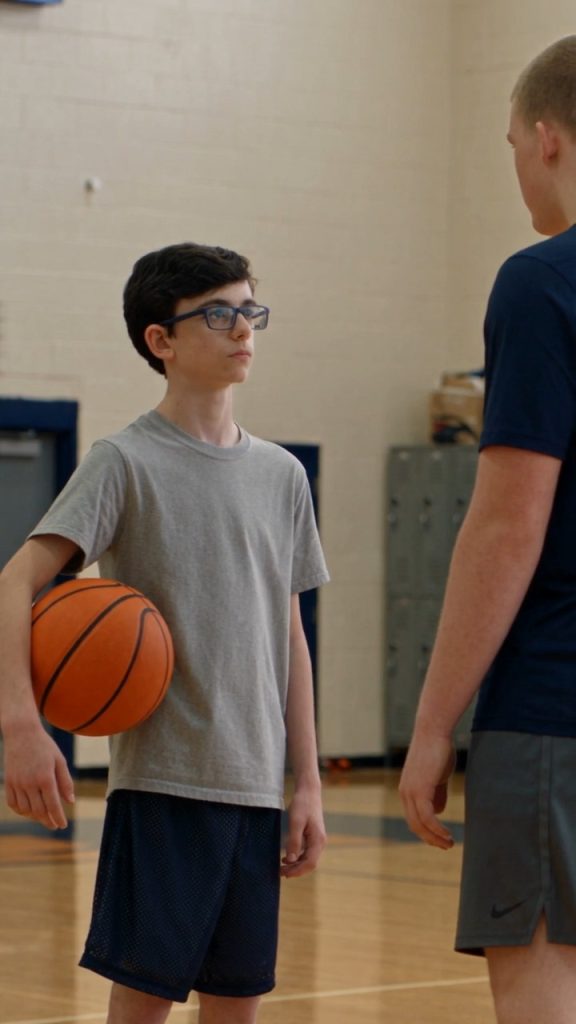
After class Coach Parker asked if the new partner rotation helped. Eli said it did, except that he worried about being placed with Mason later by accident. The coach made a note and assured him he would check the roster. He didn’t promise that Mason would never occupy the same room. Eli was relieved to hear a workable boundary instead of an impossible one.
Mr. Daniel Price, the assistant principal, met with Eli that afternoon. His office held a clean desk, a small plant near the window, and a stack of schedules marked with sticky tabs. The ordinary furnishings made the meeting feel both more serious and less frightening than Eli had imagined.
Mr. Price explained that he would speak to students separately, give Mason a chance to respond, and compare accounts only on points each person could reasonably know. “We are not deciding whether you deserved to win a game,” he said. “We are examining repeated treatment at school, including whether students were pressured or publicly humiliated.”
Eli showed him the corrected note. Mr. Price read both versions. “Thank you for indicating the change,” he said. “If there are other details you genuinely don’t know, it’s all right to say so.”
Eli had a question ready. “Can you keep us from being paired in PE while this happens?”
“We can give a clear direction about pair assignments and contact. We’ll speak with Coach Parker and both students. You should be able to attend class while the matter is reviewed.”
“And if he says I asked for the game?”
“We’ll consider that account too. The fact that you played doesn’t necessarily answer whether you felt pressured to play. That’s why context and corroboration matter.”
Eli sat straighter. He wasn’t asking to be believed by magic. He was asking someone to look at the difference between accepting a challenge and freely choosing one. It was the distinction he’d been unable to put into words beside the water fountain after the game.
As the meeting ended, Eli asked Mr. Price whether he was required to be part of every conversation with Mason. The assistant principal said no. Staff would need details from Eli when he was the only person who could supply them, but they would not arrange a confrontation for the sake of drama. The school could examine reports separately and set classroom expectations without asking the students to settle the dispute in person.
Eli hadn’t realized how much he’d been dreading another face-to-face test. The basketball court had offered clear terms and a score. A meeting where Mason spoke over him or laughed at his discomfort might produce nothing except the old sensation of being watched. He had already made his complaint. He didn’t need to reenact it for a new audience.
Mr. Price gave him the names of staff who could address any contact during the review. Eli copied them into the back of the notebook instead of relying on memory. He liked that the list included the coach, who would actually be present when stations changed, and Ms. Brooks, who could follow up afterward. It was more helpful than being told simply to be confident. He could be nervous and still know whom to ask.
Walking out, he thought about how often adults called students resilient when they meant students had endured something without complaint. The people in the office hadn’t praised him for tolerating another week. They’d made specific changes that reduced what he had to tolerate. That difference stayed with him as he reached the stairwell.
When Eli left the office, he met Tessa near the stairwell. She had her mustard cardigan draped over one arm and was standing still while students passed around her. He knew her mostly from PE and an occasional science lab, where she was careful about her work and quick to laugh when her friends laughed. She had looked troubled on the sideline Thursday. He wasn’t sure whether mentioning it would make her retreat.
“Hi,” she said first.
“Hi.”
She glanced down the hall. “Did Price ask you about the game?”
“Yeah.”
“People are saying you complained because you embarrassed Mason.”
Eli felt the familiar pressure to defend every detail. “I complained because he keeps trying to embarrass people. I shouldn’t have to play him to get him to stop.”
Tessa’s grip tightened on the cardigan. “I know.”
It was the certainty that startled him. Before he could ask what she meant, the hallway filled with students heading to afternoon classes. She stepped away, saying she was late.
Eli watched her go. He did not follow. He suspected she knew something, but suspicion wasn’t evidence, and she hadn’t said enough to show him what it was.
That evening his mother asked whether the school was taking the report seriously. He told her about Mr. Price’s questions and the temporary pairing arrangement. She seemed relieved by the specificity. He wanted to tell her that Mason’s friends had been avoiding him, but he couldn’t make the complaint sound large enough. They hadn’t struck him or spoken openly to him. They had merely shifted chairs, exchanged glances, made his name the center of conversations that stopped when he approached.
Marisol listened when he finally mentioned it. “Being ignored on purpose can make a place feel smaller,” she said. “You can tell the counselor if it starts affecting class.”
“What if I become the kid who reports every weird look?”
“Then you and the counselor can work out what needs action and what can be recorded without deciding its meaning immediately.”
Eli sighed. His mother had recently become very good at refusing to provide a simple dramatic answer. He suspected she had learned it from the same difficult week he had.





