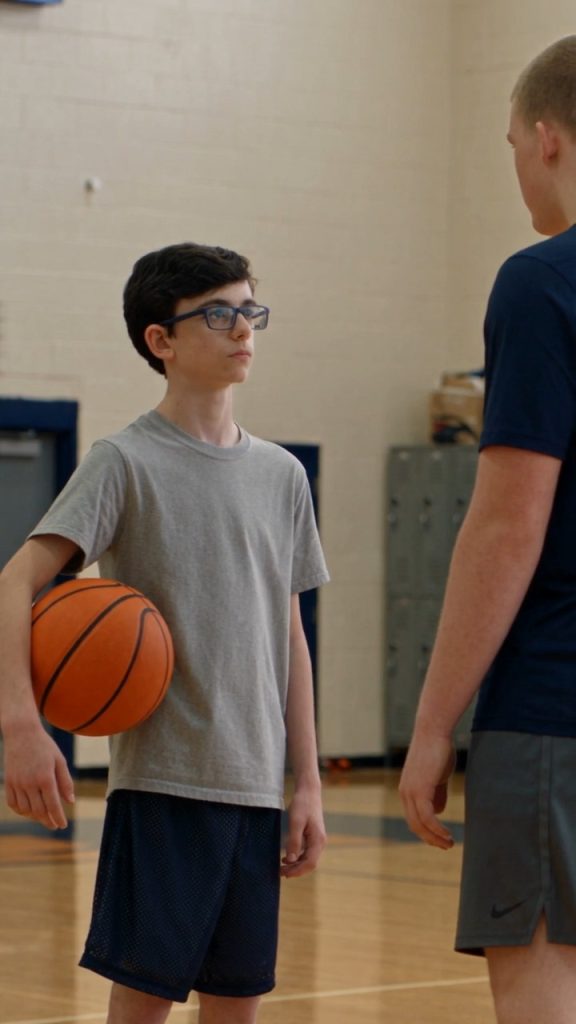
Eli didn’t know either. He could not promise that Noah’s report would produce a particular outcome or protect him from every whisper. He could acknowledge that the choice mattered regardless of who eventually believed it.
“I’m glad you told them,” he said.
Noah nodded, and for a while they watched traffic without speaking.
Near the end of the school day, Eli went to student services to ask Ms. Brooks whether she needed his revised timeline again. She said she had the corrected copy and thanked him. As he stepped back into the hallway, he noticed Tessa at the far end, moving toward the counselor’s door. She held a small notebook in one hand. A date was written near the top of an open page, though he was too far away to read her notes and did not try.
Tessa slowed before the threshold. For a heartbeat Eli thought she might turn around. Then she knocked, heard Ms. Brooks invite her in, and opened the door with her dated notes still in her hand.
On Monday, October 26, the hall outside student services was full of students going somewhere else. They carried lab reports and gym bags, talked about lunch, complained about a quiz. Eli had spent so long thinking about the review that he almost expected the building to feel different on the day of the decision. Instead, the vending machine was broken again and someone had dropped a trail of pencil shavings beside the stairwell.
He checked his schedule, although he knew it by heart. Third-period PE still appeared on the page. Nothing about the calendar acknowledged the effort it had taken to keep going to that class.
At eight thirty, Ms. Brooks had asked him to stop by during his free study period. She explained that final conversations were taking place that day, and that Mr. Price would contact him after reviewing them. She couldn’t give him an outcome in advance. She did not say what Tessa had written on Thursday. Eli was glad of that, despite his curiosity. If he wanted people to trust the review, he couldn’t demand that confidentiality disappear whenever he felt anxious.
Tessa passed him in the hall before second period. She was carrying a binder against her chest, and her expression was serious. She gave him a small nod. It was not a signal that everything would be fine; he couldn’t know what it meant. He returned the nod and continued toward class.
At lunch Zoe asked whether he’d heard anything. He shook his head. She offered him half of the orange she’d been peeling, and they sat at their corner table. Noah came over with a science worksheet. The three of them spent most of the break debating an answer about chemical reactions. Eli liked that none of them suggested the entire day should be devoted to the case. The review mattered. So did the question on the worksheet, and the taste of a fresh orange, and an afternoon that would continue no matter what Mr. Price decided.
At one fifteen, the office sent for him.
Marisol had arranged to be available by phone; she could not leave work for another meeting without warning. Eli stepped into Mr. Price’s office and found Ms. Brooks there beside an empty chair. They asked if he wanted his mother on speaker for the discussion. He said yes. When she answered, her voice came from the center of the desk, a small, welcome reminder that he didn’t have to be the only person carrying his experience.
Mr. Price began slowly. The school had considered several separate accounts of incidents in PE, including an earlier equipment assignment, the repeated drill involving another student, and the public basketball challenge. Not every detail was observed by the same person. The reports differed in their scope and in small particulars. The school had not treated those differences as an excuse to ignore what multiple students independently described.
Eli held his knees beneath the desk. He listened carefully because the words seemed too important to survive a quick summary.
The critical detail, Mr. Price explained, came from a student who had been standing near Mason before the challenge. Tessa had told Ms. Brooks informally the previous week that she’d heard Mason plan to make Eli the center of a joke. On Thursday she’d brought her own dated recollection, then on Monday she’d given a fuller, formal firsthand account after being invited to clarify it. She recalled Mason saying to the nearby group, “Watch him miss.” She had heard the words directly, before Eli was close enough to hear them. She had also seen the ball sent toward his foot and watched students gather.
Eli stared at the pencil cup on the desk. The words were short. They didn’t sound threatening out of context. But he could suddenly picture Tessa looking away while Mason called to him, her discomfort taking on a meaning he hadn’t been entitled to assume before. He had not heard the pregame line himself. He was hearing about it now through the staff who had gathered the accounts. That difference mattered, even in the relief of recognizing his own experience.
Mr. Price continued. Zoe had independently described the bounce, the challenge and the reaction of the spectators. She had confirmed the game score without making it the reason for her concern. Noah’s report concerned a different day: Mason telling him to repeat a drill after he’d finished and using possible embarrassment to force compliance. Noah did not pretend to have heard Tessa’s words or witnessed every exchange involving Eli. Coach Parker’s statement covered the final part of the game, the audience and Eli’s request to be left alone. The coach had expressly said he had not seen the hostile opening.
“And I corrected my account,” Eli said quietly.
“Yes,” Mr. Price replied. “You corrected the sequence of the first two baskets. We considered the clarification. It doesn’t change the concern being examined.”





