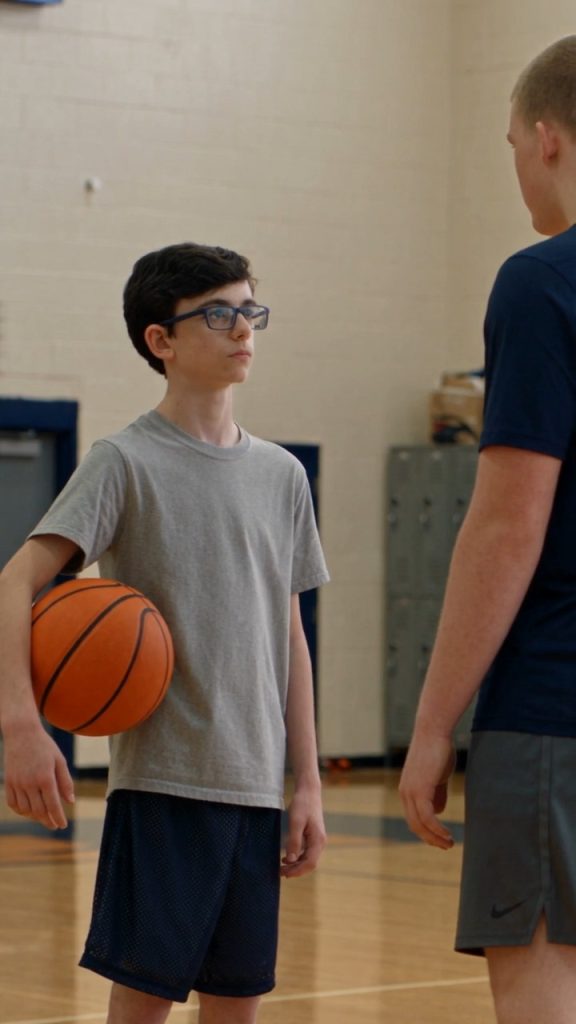
By the last bell on Tuesday, Eli was tired of watching people sort themselves into teams they hadn’t officially joined. A boy who’d borrowed an eraser from him the previous week now greeted him with an elaborate politeness, as if an ordinary “hello” might be entered into a school record. Another classmate said the entire business would be over if Eli could “take a joke.” Eli answered that he’d taken plenty of them and had finally explained why he didn’t want to. The classmate shook his head and left. Eli felt neither victorious nor ashamed. Mostly he felt as though he’d spent his whole day defending the distinction between a joke and a demand.
In the library after school, he found a quiet table to work on the biology homework he’d barely touched. The assignment asked him to compare observations from two experiments. He wrote the first answer, read it again and realized he’d assumed something the results didn’t show. He struck the sentence and started over. Usually he liked this part of school: the moment when noticing a mistake wasn’t humiliation, only a way to get closer to understanding. He wished the adults and students around the gym could regard a corrected memory that way, too.
Zoe came in to return a book and spotted him by the windows. She took the chair opposite him for a few minutes. He told her he’d given Ms. Brooks an update about Mason’s attempts to control the way everyone told the story. He was careful not to suggest that Zoe should strengthen her statement in return.
“It’s weird,” Zoe said. “People keep asking whether you’re angry he lost or happy you won. I keep telling them that’s not what you reported.”
“Do they believe you?”
“Some do. Some just want the shortest explanation.”
Eli capped his pen. “I’m afraid I’m starting to make every conversation about this.”
“Then we can talk about something else.” She pointed to the biology sheet. “Like why the graph looks like a staircase when the data’s continuous.”
He tried to explain and ended up laughing when he realized he had drawn the axes incorrectly. They corrected the graph together. He was grateful she could help him with something unrelated to courage, and that he could return the favor. Friendship might grow out of one difficult moment, he thought, but it couldn’t be fed only by difficulty.
As they left the library, they saw Tessa standing by the lockers with a girl from Mason’s usual circle. The girl’s voice was not loud, but the emptying hallway carried the words clearly: “If you make it official, people are going to say you’re trying to get him kicked out of class.”
Tessa looked toward the end of the corridor. “I didn’t say that was what I wanted.”
“Then don’t turn it into a thing.”
Eli stopped by the drinking fountain, unsure whether to step away or make himself known. Zoe noticed the exchange too. She touched his elbow and shook her head almost imperceptibly, reminding him that they didn’t know the whole conversation. The girl saw them and walked off, expression stiff. Tessa remained by the lockers, pressing her lips together.
“Are you okay?” Zoe asked, keeping her voice low.
Tessa considered the question. “I think so.”
“You don’t have to answer us,” Eli said. “If you’re worried about what you tell the school, you can ask Ms. Brooks how the process works.”
Tessa looked from one to the other. “I know where her office is.” The answer came out more defensive than Eli expected. A moment later she added, “Sorry. I know you’re trying to help.”
“You can decide for yourself,” Eli said.
“Everybody keeps telling me that,” Tessa replied, “and then telling me what I should decide.”
She picked up her school bag and left before they could answer. Zoe watched her go. “We can’t make her brave on schedule,” she said.
Eli looked down the hallway, where the afternoon sun made long pale rectangles on the polished floor. He understood why Tessa was caught between friendships and what she might have witnessed. He also wanted to be angry with her for hesitating. Both feelings existed at once, and neither gave him the right to command her. It was possible she knew only something small. It was possible she knew something that would change how adults viewed the challenge. He couldn’t know which, and he wouldn’t pretend to.
Outside, the air smelled of wet leaves. Noah came out of the building behind them and hesitated near the steps. Eli asked if he’d finished the science quiz he’d mentioned. Noah said yes, and that it had gone badly enough he was considering changing his favorite subject. Zoe told him everyone said that after the chemistry unit. They walked toward the bus loop talking about schoolwork. Eli kept looking back toward the hallway windows, not because he expected Tessa to appear with a dramatic announcement, but because he was starting to understand how hard it could be to turn a private memory into words that other people would use.
He had spent the last week asking classmates to recognize that Mason had made a choice about how to treat them. Now another kind of choice was being made in quiet corridors. Tessa knew whether she had heard something. Eli did not. Speaking would cost her something, and silence would cost something too. Whatever she decided, it had to be hers.
On Wednesday, October 21, Eli found out that a person could be relieved by a rule and still dread the reason it existed.





